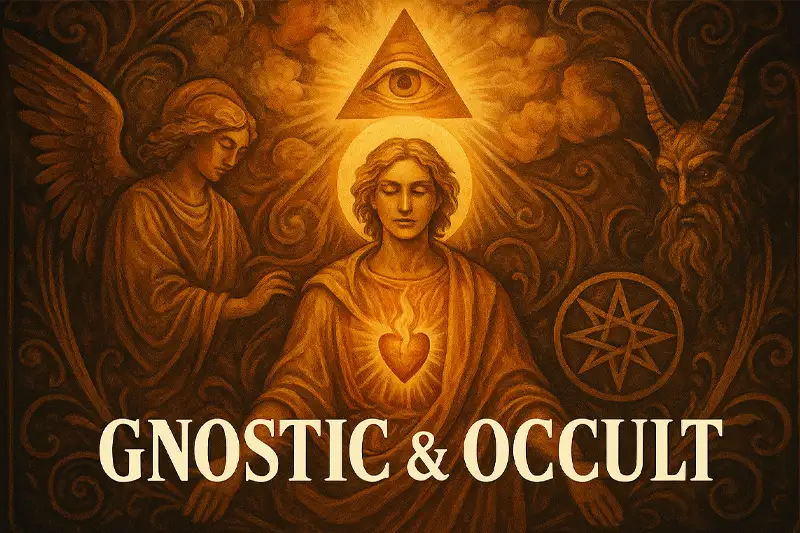
Much of what you see as ‘reality’ is most likely just the tip of an invisible layer that connects everything together — from mind to matter, from feeling to consciousness. Hermetic philosophy suggests that everything begins in thought.
According to ancient esoteric knowledge, your perception and free will are influenced by forces you cannot directly measure, but which are definitely felt. Aether, or the connecting ‘intermediate substance,’ plays a key role in this. The same applies to mysterious concepts like the daemon and the archons.
The 5 Key Takeaways
- What if everything you call reality comes from consciousness, not from matter?..
- The ‘aether’ is not ancient superstition, but a forgotten building block of our existence..
- Archons are not mythical beings, but mental structures that limit your consciousness..
- Your daemon is not a dangerous entity, but an inner guide that has been present your whole life..
- Hermeticism offers no dogma, but a signpost toward inner autonomy..
Why Consciousness is the Real Starting Point
What we call ‘reality’ probably doesn’t begin outside us, but within us. Consciousness increasingly appears to be the key to how we shape experience.
Whether you look at quantum theory or ancient mysticism, the common thread is clear: without an observer, there is no reality. What you believe and expect influences what you experience.
Consciousness as the Foundation of Reality
According to hermetic traditions, the world is not built from matter, but from mind. Everything you perceive first arises as a thought in an all-encompassing consciousness: the Divine Mind.
What you experience as the ‘outside world’ is therefore not objective reality, but a projection connected to your attention and beliefs.
The Forgotten Role of Aether
Aether was seen by many ancient civilizations as the subtle connecting layer between mind and matter. It was not a myth, but a working principle that explained how thoughts could take form in the physical world. Aether makes wordless communication, energetic healing, and synchronicity possible.
Although modern science has rejected the concept, more and more researchers recognize parallels in quantum fields and zero-point energy.
Hermeticism as Spiritual Physics
Benefits of Hermetic Thinking
- Provides space for an inner compass outside religion or dogma
- Offers a clear framework for understanding consciousness and energy
- Helps recognize inner and external structures of influence
- Strengthens the sense of connection and direction
Drawbacks of Hermetic Thinking
- Can be perceived as too abstract or airy
- Requires strong inner discipline and self-reflection
- Is difficult to test within regular scientific models
- Can lead to confusion if symbolism is interpreted literally
Archons: Mental Forces Behind Repetition
In gnostic teaching, archons are not physical entities, but patterns that keep you trapped in repetition, doubt, and dependency. They live in your habits, your beliefs, and your fear of coloring outside the lines.
These structures feed on predictability. Every time you repeat an automatic reaction without awareness, you give them power.

What If You Took Yourself Seriously Again?
Many people intuitively feel that they are more than a collection of thoughts, impulses, and roles. Inner guidance is not a luxury, but a forgotten compass waiting to be used again.
When you stop reducing yourself to an adaptable individual and start listening to what truly resonates, something remarkable happens: you become the owner of your story again.
Your Daemon: Inner Guide, Not Demon
The term daemon sounds negative to many, but in hermeticism it actually refers to your inner guide — that part of you that gives you direction beyond reason or fear.
It’s not a voice that screams, but a whisper that emerges through symbolism, synchronicity, or a sudden feeling of ‘this is right.’
The Inner Work Begins in Silence
You don’t need to understand hermeticism as science to experience it. Silence is not emptiness, but the space in which your own wisdom becomes audible.
Those who walk this inner path often notice that synchronicity increases, that choices become clearer, and that life seems not like chance but a process of meaningful connections.
Science and Mysticism Are Growing Toward Each Other
Increasingly, scientific discoveries, such as the observer effect in quantum physics, align remarkably well with hermetic principles. Intention appears to actually influence outcome.
The ancient mystics didn’t need measuring equipment. Their laboratory was consciousness itself — and it turns out to be a very valuable source of insight.
The Danger of Forgotten Knowledge
Hermetic wisdom was suppressed for centuries — not because it was outdated, but because it gives humans power. Self-determination is, after all, difficult to control.
Those who remember that consciousness shapes form are less likely to be guided by fear or hierarchy. And that makes ancient knowledge surprisingly relevant — and potentially threatening to existing systems — in modern times.
Glossary
- Hermeticism: Ancient philosophical system that states everything begins in the mind, with the motto “As above, so below.”
- Aether: Invisible connecting layer between mind and matter, according to ancient cosmologies.
- Archons: Mental forces that limit your consciousness through repetition and conditioning.
- Daemon: Your personal, inner guide that gives you direction on a soul level.
Conclusion
According to hermeticism, everything is essentially mind, not matter. Aether, archons, and daemons are not fantasy, but symbols for inner processes and universal principles.
Those who take this approach seriously can shape their lives more purposefully. Not from fear or control, but from attunement to something deeper that was always present — but is often drowned out by external noise.
Gerelateerde artikelen


![The Illusion of Self: What If Your ‘I’ Doesn’t Exist? [Free E-Book].](https://liberteque.com/wp-content/uploads/2025/09/GoodFeeling.nl-xxx-7-300x200.webp "What is Hermeticism? Discover the Hidden Forces of Consciousness, Aether, and Inner Guidance 5")

Frequently Asked Questions
What does ‘aether’ mean in hermeticism?
Aether is seen as a subtle, invisible substance that connects everything together. It is the bridge between thought and form.
Are archons real beings?
In the hermetic and gnostic tradition, archons are primarily mental forces or beliefs that limit your consciousness.
What is a daemon according to hermeticism?
A daemon is your inner guide or soul voice. It helps you follow your true path, beyond conditioning.
Is hermeticism a religion?
No, hermeticism is not a religion. It is a philosophical system that invites direct experience and inner inquiry.
How can you apply hermetic principles in daily life?
By directing your attention to your thoughts, emotions, and intentions, and becoming still so your intuition becomes more perceptible.
What is the meaning of hermeticism?
Hermeticism is an ancient philosophical system that states that everything in the cosmos comes from mind or consciousness. It emphasizes self-knowledge, inner development, and the principle that the universe forms one whole.
What is hermetic thinking?
Hermetic thinking means seeing the world as a reflection of spiritual laws. According to this view, everything you experience is influenced by your consciousness, intention, and perception.
What is hermetic philosophy?
Hermetic philosophy combines elements of spirituality, cosmology, psychology, and natural science. It is based on texts attributed to Hermes Trismegistus and states that the universe is guided by universal, spiritual laws.
What are the 7 hermetic principles?
The seven principles are: mentalism, correspondence (“As above, so below”), vibration, polarity, rhythm, cause and effect, and gender. Each principle describes a universal mechanism of operation within creation.
What is the meaning of the word hermetic?
Outside the philosophical context, ‘hermetic’ usually means completely sealed or impenetrable. It originally refers to the mythical Hermes Trismegistus and the secret nature of his teachings.
What does hermetically sealed mean?
Hermetically sealed means something is made airtight and completely closed, so nothing can get in or out. The expression originates from alchemical techniques attributed to Hermes Trismegistus.
Why is Hermes called Hermes?
The name Hermes refers to the Greek god Hermes, who served as a messenger between worlds. In hermeticism, it refers to Hermes Trismegistus, a symbolic figure embodying Greek and Egyptian wisdom.
What are hermetic poems?
Hermetic poems are often difficult to understand and use symbolism or abstract language. They sometimes refer to mystical, esoteric, or spiritual themes, though that is not always the case literally.
Continue reading
- What Alan Watts Meant by Differentiated Consciousness and Do You Have This Rare Personality?
- We Might Be Living in a Simulation — and Descartes Already Figured That Out
- 10 Scientific Clues That Our Reality Might Be a Simulation
- The 7 Levels of Reality Explained: From Hermetic Principles to Consciousness and Meaning