In recent years, the idea that our reality might not be real, but rather an advanced simulation, has been taken increasingly seriously. Not only by science fiction enthusiasts, but also by scientists and philosophers exploring the boundaries of physics and consciousness.
In this article, we examine ten striking clues that support this possibility — from microscopic laws of nature to cosmic mysteries. Each point offers a different perspective on the question: do we live in an autonomous universe, or in a carefully designed environment that’s just real enough to make us believe it is?
Number 10: The Pixel Limit
There exists a smallest possible unit of space. It’s called the Planck length, approximately 1.6 x 10 to the power of -35 meters. Smaller than that, and the laws of physics cease to exist. Not only is that unimaginably small, it’s suspicious. In a truly analog universe, there shouldn’t be a minimum size.
Space should be able to divide itself forever, with infinite resolution. Instead, it hits a floor, like a screen you can’t zoom into further. Not because of your eyes, but because there’s simply nothing more to load. This is exactly how digital simulations work. The resolution isn’t infinite, but just high enough to fool you.
So what does that change? It breaks the assumption that reality is smooth, continuous, and infinitely explorable. And it opens the door to something far more interesting. If there’s a smallest unit of space, there’s a chance you live in something that was built, not born. And builders always leave patterns behind. That means if you study the seams, you might not find deeper meaning, but you might find the manual.

Number 9: The Observer Effect
At the quantum level, particles only behave when someone is looking. Literally: electrons act like a wave and exist in multiple states at once, until you measure them. Then they choose one path and lock in. This is called the observer effect, and it’s not a theory; it’s been successfully repeated over and over.
That shouldn’t be possible. Observation shouldn’t change the physical outcome, but in quantum mechanics, it does. It’s one of the most astonishing discoveries in modern science.
How do you explain that? Some physicists say this happens because the universe doesn’t fully render itself unless attention forces it to, exactly like a video game only generates what the player sees.
This brings us to ideas that are often laughed at: “you create your own reality,” “your focus shapes your world.” Maybe they got the mechanics wrong, but the principle right. If attention collapses probability, then what you look at can actually determine what becomes reality. Not spiritually, but mechanically. That’s not magic, that’s the user interface.

Number 8: Mathematical Compression
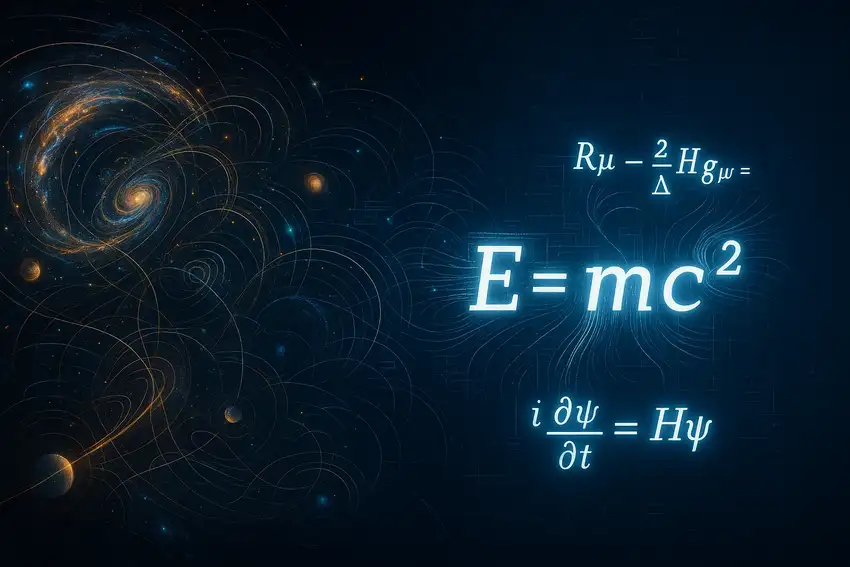
There’s something strange about how neat the universe is. The most complex phenomena, like motion, mass, gravity, and even time, can all be expressed with ridiculously small equations. E=MC², the Schrödinger equation, Einstein’s field equations; not pages of code, no chaos, but pure, compressed elegance. In nature, that’s rare, because randomness produces mess and entropy. This, on the other hand, seems designed.
Programmers do this constantly. Instead of manually programming every outcome, they write one line that generates them all. The code isn’t a list, but a formula that can scale infinitely without changing the core logic. If reality itself runs on elegant mathematics, that doesn’t prove a simulation, but it does change the strategy.
In such systems, brute force never works. You don’t fight the system; you try to understand it through ‘reverse engineering.’ Start by looking for patterns and stop assuming everything is chaos, because once you speak the language of the system, it starts to respond. Not emotionally, but efficiently.
Number 7: Cosmic Censorship
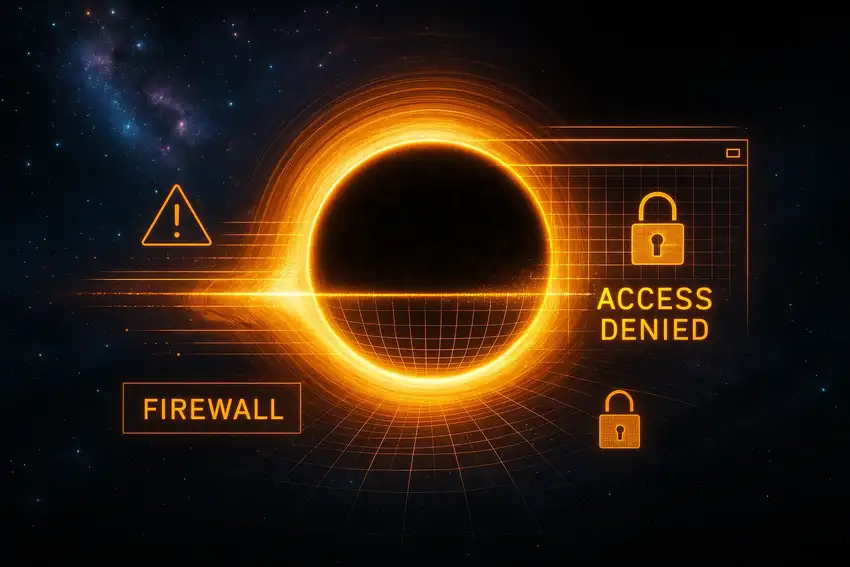
Black holes don’t just warp space, they erase it. At their center lies a singularity: a point where gravity becomes infinite, time collapses, and math completely breaks down. But here’s the strange part. You can’t see it.
Not because it’s far away, but because physics won’t allow it. There’s a boundary, the event horizon, and once something crosses that boundary, it’s gone forever. No data, no light, no information ever escapes. It’s not just hidden; it’s forbidden territory.
Physicists call this cosmic censorship: the idea that the universe deliberately hides its own flaws. If that sounds like a patch for a system error, that’s because it might be. Simulations don’t crash; they isolate the problem in a ‘sandbox.’ They quarantine the exceptional cases so the user never sees the seams.
So if black holes are invisible, unreachable, and unmeasurable, then they’re not just extreme objects. They’re firewalls. This raises the question: if the universe blocks access to its source code, maybe that’s not because you’re not smart enough, but because you’re simply logged in as a guest.
Number 6: Probabilistic Reality
In classical physics, reality is a matter of cause and effect: predictable, orderly, and logical. But quantum mechanics flatly disagrees. At the smallest level, particles don’t behave deterministically.
They exist in probabilities. Not “this will happen,” but “this could happen with a certain likelihood.” And until something interacts with them, they remain in a kind of floating ‘maybe’ state.
This isn’t uncertainty from ignorance; it’s built into the system. That should be terrifying, unless it’s not an accident. Because when designing video games, probability isn’t chaos, it’s a feature. Randomness creates dynamic outcomes and unexpected behavior.
Maybe you’re not in a broken reality, but in a shielded world designed to respond to how you move, not just what you know. A world where possibilities only collapse when you act. This doesn’t mean everything happens for a reason, but that nothing happens until there is a reason, and most people never create one.

Number 5: Processing Efficiency
Have you ever noticed that the moon always shows the same side to Earth? Or that stars in space don’t twinkle? Or how the universe seems increasingly random the farther away we look?
Verified Sources
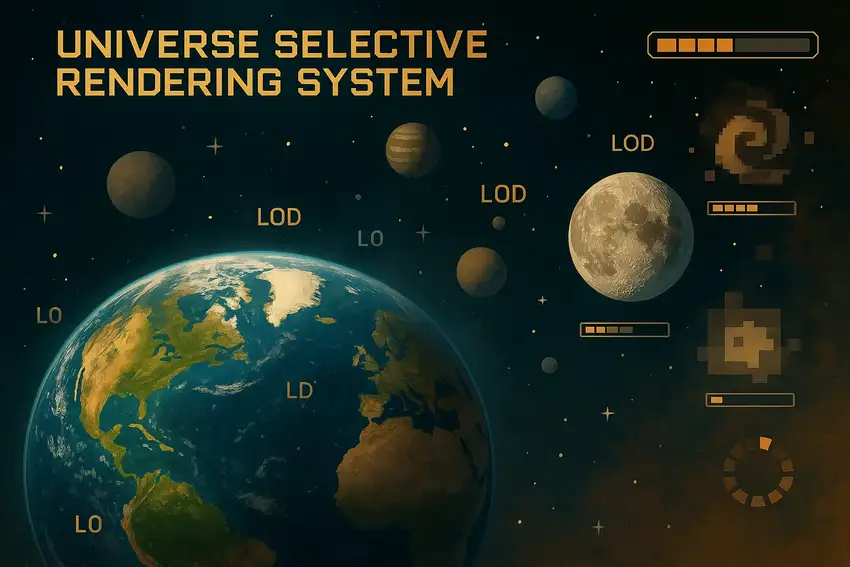
Now ask yourself: why haven’t we found life anywhere else? Why does deep space look like a painting? Maybe it’s not empty out there, it’s just on standby. Here’s the twist: if the simulation renders based on activity, then your actions matter more than your beliefs.
Your movement and curiosity might not change reality, but they might determine how much of it you get access to. If you never ask anything, the system gives no answer. And if you stay passive, the game stays paused.
Number 4: Memory Glitches
Memory isn’t a recording, it’s a reconstruction. Every time you remember something, your brain rebuilds it and subtly rewrites it. This scientifically confirmed phenomenon is called reconsolidation. Every memory introduces distortions, fills in gaps, and sometimes invents entire scenes.
It gets stranger: large groups of people sometimes remember the same thing incorrectly. This is called the Mandela Effect, like the false memory that the Monopoly man had a monocle. Regular psychology calls this a false memory.
Simulation theory advocates point to something different. When multiple users remember different versions of a shared event, you’re dealing with either human error or a patch update that didn’t sync properly. Either way, it breaks the assumption that your memories are real.
You stop treating your memory as evidence and start seeing it as rendered content: fluid, rewritable, and less reliable than you thought. This doesn’t make your past fake, it just means the system lets you believe whatever story keeps you logged in.

Number 3: Loops in Consciousness
You think you’re conscious because you have thoughts, but science has never been able to explain how those thoughts arise from neurons. The brain processes input like electricity and chemistry, but the ‘you’ that perceives everything, that feeling of a ‘self,’ no one can find. This is called the ‘hard problem of consciousness’: the idea that subjective experience can’t be explained by physical processes alone.
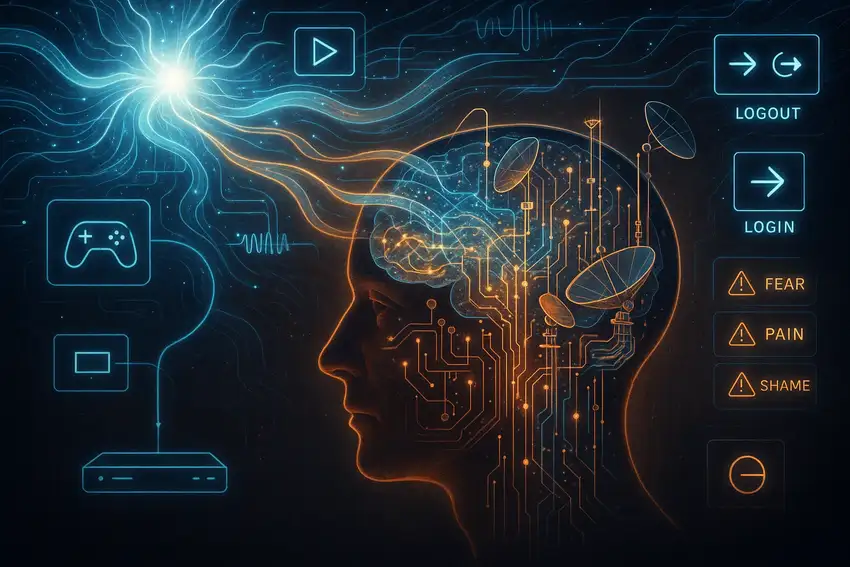
Simulation theory offers a bold thought. What if consciousness isn’t in the system, but the interface that communicates with it? Your sense of self, your consciousness, your attention; not byproducts of the brain, but an external signal that uses the brain as a receiver. Think of it this way: the character in a game thinks it’s alive, but the player is somewhere else.
If your consciousness isn’t in your body, you’re not trapped here; you’re logged in. This means fear, pain, and shame are just signals on a dashboard. Unpleasant, certainly, but they’re only what the interface uses to keep you engaged in the game.
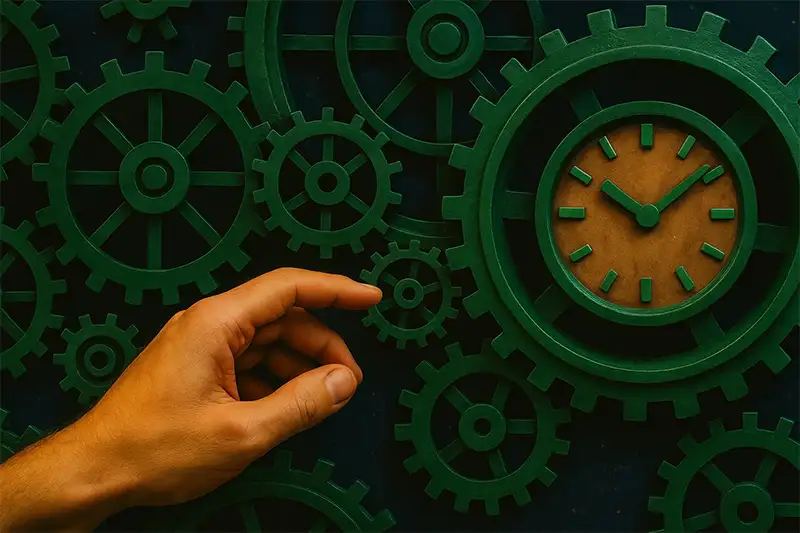
Number 2: Artificial Time
Time feels like a given. A second is a second, a minute is a minute. But that’s only because you’re standing still. Einstein proved that time stretches and contracts, depending on gravity and speed. Two people moving at different speeds will actually experience time differently. Not just perceive it differently, but live it differently. That’s not a metaphor, that’s pure physics.
So if time isn’t universal and not absolute, what is it then? One answer: a variable clock in the runtime. In simulated environments, time doesn’t move on its own; it runs based on cycles, input, and rendering requirements. Sometimes, to save computing power, it slows down or speeds up behind the scenes.
If time in the real world isn’t consistent, maybe it’s not a law of nature, but a function, a setting, a local rule. And what does that mean for you? Stop assuming you’re late or that there isn’t enough time. Because if time adapts to context, urgency might be an illusion designed to make you click through.

Number 1: The Anthropic Trap
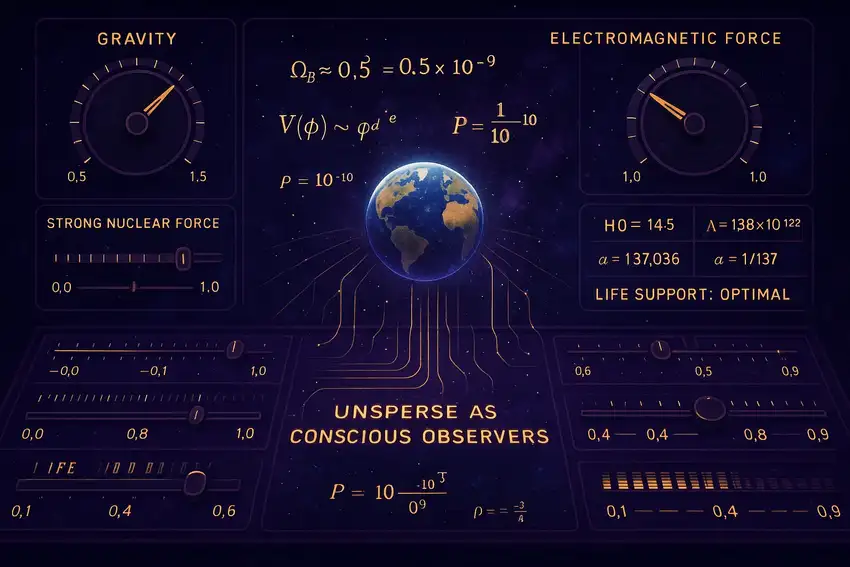
Here’s the final glitch in the system. The universe seems perfectly tuned to support life. Not just any life, but your life. The physical constants, like gravity and the strong nuclear force, are so precisely balanced that even the smallest changes would make reality uninhabitable.
Physicists call this the problem of fine-tuning. It’s like finding a computer that has the perfect specifications down to the decimal and then assuming it built itself by accident.
The usual explanation is that there are infinite universes and we just happen to live in the lucky one. That’s not logic; that’s a way to cope with it. Simulation theory takes a different path. Maybe the reason this universe supports life is that it was programmed to. And that changes everything.
You’re not insignificant, random, or a speck in a cosmic accident. You’re part of the function. Your consciousness, decisions, and input aren’t side effects of the system; they’re the purpose of it. If that’s even partially true, maybe the glitch was never in the simulation, but in how we’ve been taught to ignore it.
Conclusion
The clues in this overview don’t form conclusive proof that our reality is a simulation, but they do show how often nature behaves as if there’s a design behind it. Whether it’s the limits of space and time, the role of observation, or the striking efficiency of the universe’s ‘code’ — the same pattern keeps emerging: it seems too cleverly built for pure chance to explain.
Ultimately, it’s less about whether we actually live in a simulation, and more about what you do with that idea. Because if reality responds to your choices and attention, it makes sense to act as if you have influence. Whether that comes from code, from laws of nature, or from something we don’t yet understand, the effect is much the same.
Related Articles


![The Illusion of Self: What If Your ‘I’ Doesn’t Exist? [Free E-Book].](https://liberteque.com/wp-content/uploads/2025/09/GoodFeeling.nl-xxx-7-300x200.webp "10 Scientific Clues That Our Reality Might Be a Simulation 15")
Frequently Asked Questions
Is simulation theory pure science fiction or a serious idea?
What makes the Planck length so special?
The Planck length is the smallest possible unit of space as we know it. Smaller than that, nature seems to contain no information. That raises the comparison to a pixel limit in digital environments.
How can observation change the outcome of an experiment?
In quantum experiments, a particle ‘decides’ its state only when measured. That’s like a system that only renders when needed — just like a game that only generates what you see.
Why does the universe use such simple formulas?
Many laws of nature fit into elegant, compact equations. That mathematical efficiency suggests smart code: short, powerful, and infinitely scalable.
What does cosmic censorship say about black holes?
Black holes hide their core behind a boundary where no information can pass through. It feels like a system protecting its most vulnerable processes from the user.
What is meant by a probabilistic reality?
At the smallest level, nature works with probabilities rather than fixed outcomes. That can seem like a game world that dynamically adapts to the player.
Why does time seem flexible?
According to Einstein, time flows differently depending on speed and gravity. In a simulated environment, that would correspond to a clock that moves with the circumstances.
How does consciousness fit into this theory?
The idea: consciousness isn’t a byproduct of the brain, but the interface through which you connect with the system. Your ‘self’ might exist outside the simulation.
What does the fine-tuning of physical constants suggest?
The laws of nature are precisely calibrated for life. Coincidence? Or specifications deliberately chosen for a playground where we can exist.