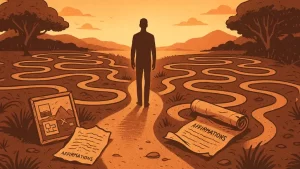
It was 2012 when a Reddit user named Temptatsoon shared a story that would grip thousands of people by the throat. It didn’t begin with a bang, but with a flash of realization. A young man awakens in a life that is unmistakably his own. The woman beside him, her familiar voice. The smell of coffee and the laughter of his daughter from the next room. He is perfectly happy.
For ten years, he builds this existence: a family, a career, a treasure trove of memories. Until one evening, a crack appears in reality. A lamp in the living room behaves strangely; the light bends around it in an impossible way. For three days, he stares at it, obsessed. And then his world crumbles. The lamp isn’t real. My wife, my children… nothing is real.
The room dissolves into a sea of red light, screams, and pure pain. When he finally opens his eyes again, he lies broken on the sidewalk, surrounded by strangers. The last thing he remembers is the fist of an American football player striking his face. He was unconscious for seven minutes. Seven minutes here, which were ten years of another life. The question that has haunted him since is simple and yet impossible: which of the two worlds was real?
When the Boundary Between Dream and Reality Blurs
But what if that question is posed incorrectly? What if the answer is: both. What if every night you don’t drift into fantasy, but simply wake up somewhere else? This life you’re living now is then merely one day in an endless series, lived by countless versions of yourself in innumerable worlds. Think about it. Have you ever woken up, gone through your entire morning routine—showering, making coffee, checking your phone—only to truly wake up with a start? That phenomenon is called a “false awakening.” If you’ve experienced it, you know that unsettling feeling. Everything seemed completely normal. Everything felt real. Until suddenly it wasn’t.
A Dream Disguised as Reality
The strange thing about false awakenings is their normalcy. You don’t fly, you don’t talk to deceased relatives; typical dream logic is completely absent. You simply live your life. The coffee tastes as it always does. Your thoughts are clear. Yet there are subtle clues, small cracks in the facade. A clock that refuses to show the correct time. A light switch that does nothing. Text in a book that changes every time you look away. What scientists in sleep laboratories truly find breathtaking, however, is the data from brain scans. When they wake someone during such a false awakening, they discover something that should be impossible. The brain is not awake, but it’s not dreaming either. It’s doing both simultaneously.
The Quantum Leap of Consciousness
The measurements are undeniable: theta waves, the hallmark of a dreaming brain, pulse through bursts of alpha rhythms, the pattern of an alert mind. Your brain is literally awake within the dream, conscious within the unconscious. And here is where it gets truly interesting. This hybrid state rarely stands alone. Those who experience false awakenings statistically have a greater chance of also experiencing lucid dreams, sleep paralysis, and out-of-body experiences. It’s as if there’s a spectrum of consciousness in which sleep and waking are not opposites, but overlapping regions. A place where you can be here and somewhere else simultaneously.
The Many-Worlds Theory
Perhaps these kinds of experiences aren’t errors in our perception at all. Perhaps they’re glimpses, moments when the barrier between timelines becomes thin enough for our consciousness to slip through. If your brain can be awake in a dream, then reality itself is likely not an on-or-off switch either. In 1957, physicist Hugh Everett launched his “many-worlds interpretation” of quantum mechanics. His theory? Every event at the subatomic level causes reality to branch into parallel universes. Every decision, every random twist of fate, creates a new timeline in which a different outcome unfolds.
Quantum Immortality: Why You Always Survive
This morning you chose coffee, but there’s a universe where you had tea. There’s a universe where you never woke up. There’s one where you’re president. Infinite versions of you, flowing through infinite possibilities. Most see this as a philosophical thought experiment, but physicist Max Tegmark went a step further with his concept of “quantum immortality.” The principle is as simple as it is shocking: your consciousness can only persist in the timelines in which you survive.
That time you squeaked through by the skin of your teeth, that car you barely missed… the theory suggests that in countless other universes, you didn’t survive. But your consciousness cannot experience those realities. It simply hops forward in the branches where you keep living. From your perspective, you are therefore functionally immortal. But the question that remains is crucial: what happens to your consciousness at those branching moments? What if dreams are the way consciousness navigates between those timelines?
Can Consciousness Travel? The Spooky Data
In the 1960s and 1970s, long before the internet, researchers Stanley Krippner and Montague Ullman stumbled upon results they couldn’t explain. At Maimonides Medical Center in Brooklyn, they tested dream telepathy: could a “sender” at a remote location transmit an image to a sleeping “receiver”? The protocol was strict. While the receiver slept in a monitored room, the sender concentrated on a randomly selected artwork. Once the receiver reached REM sleep, they were awakened to describe their dream. Independent judges then compared those descriptions to the artworks. Pure chance would yield a match one in six times. They consistently found better results.
Thoughts Through the Dream Wall
During a famous trial, the target was Salvador Dalí’s “The Sacrament of the Last Supper.” The dreamer described: “A seminar… with emphasis on ‘Sea of Galilee.’ A patient lay on a bed. A therapist led some kind of group religion. Water, a horizontal figure, a gathering of people.” The correspondence was too precise to ignore. Not literal, but symbolic, the way dream language works. Critics found flaws in the experiments, and later attempts at replication yielded mixed results. But perhaps that inconsistency wasn’t scientific failure. Perhaps it’s precisely a property of the phenomenon itself: consciousness is not a stable signal you can measure, but a field that responds to connection and attention.
Dreams That Last a Lifetime
Jump to September 2024. A Silicon Valley startup, REMspace, announces a breakthrough. Using specially developed equipment that monitors brain activity and muscle movements, they succeed in allowing two people in separate lucid dreams to exchange a message with each other. This raises an uncomfortable question: if consciousness can receive signals from outside the brain, has it ever been completely inside the brain? What if dreams aren’t inventions, but migrations? Temporary relocations to other coordinates in reality. This brings us to a strange pattern that increasingly appears online: thousands of people describe entire lifetime dreams.
The Generation That Grieves Dream Families
It goes far beyond the story of the lamp. Hundreds of accounts from people who closed their eyes for one night and lived years in another world. They remember the scent of a coffee brand that doesn’t exist here, the layout of a city they’ve never visited. One man described how he grew old, died surrounded by grandchildren, only to wake up as his 25-year-old self. The emotional impact was so devastating that he sought therapy. Because how do you grieve children who were never born? How do you mourn a spouse who never existed?
The Quantum Architecture of Reality
What distinguishes these experiences from normal dreams is the internal logic. A linear timeline, consistent memories, cause and effect. Yet there was occasionally that one, small hiccup. A clock with an impossible time. A word on a page that kept changing. Those “glitches” didn’t feel like dream errors, but like memories. As if something was trying to tell them: “You don’t belong here.” This is the core: consciousness doesn’t create these worlds, it visits them. Once it remembers where it came from, reality itself begins to tear. That’s what happened with the lamp. It was the moment when the visiting consciousness noticed the impossibility and the entire structure collapsed.
Does Consciousness Reside in Our Cells?
Neuroscientist Stuart Hameroff and physicist Roger Penrose offer a possible explanation with their theory of “orchestrated objective reduction.” They suggest that consciousness doesn’t arise from firing neurons, but from quantum processes deep within the microtubules of our brain cells. If they’re right, consciousness itself operates according to the rules of quantum mechanics: it can literally exist in multiple places at once, in multiple timelines. Sleep is then the moment when the anchors that tie your consciousness to this reality loosen slightly. You then briefly experience what it’s like to be the “you” who made a different choice.
The Gray Zone: Between Waking and Other Worlds
Researcher Robert Lanza goes even further with his “Biocentrism” theory. He argues that consciousness creates reality, rather than the other way around. Space and time are not external facts, but constructions of our mind. At death, Lanza suggests, your consciousness doesn’t end. It simply shifts to a universe where that version of you continues to exist. If consciousness can travel at death, why not during that in-between state we call sleep? This brings us to the most disturbing experience of all: sleep paralysis.
Sleep Paralysis: Dreaming That You’re Awake
You wake up, but you can’t move. Your eyes are open, your body is trapped. And often, disturbingly often, you feel a presence in the room. The scientific explanation is that your consciousness wakes up before the physical paralysis of REM sleep has worn off. The shadowy figures are hallucinations. But the brain scans tell a different story. During sleep paralysis, your brain predominantly shows theta waves, the pattern of dreaming. Scientifically speaking, you’re not awake. You’re dreaming that you’re awake and paralyzed. And if in that dream there’s a strange presence, is it a hallucination within a dream, or a perception of something that’s real in the timeline you’re currently in?
The Great Reunion: Dreams as Return
Every culture on Earth has stories about entities that visit sleepers. The incubus, the nightmare, the shadow people. Are these archetypes, or do we gain access during these hybrid sleep states to a layer of reality that normally remains hidden? Perhaps they’re not visitors, but echoes of ourselves. This idea is reinforced by phenomena such as phantom limbs—amputees who feel arms, or even wings, they never had. Or children who, as researcher Jim Tucker has documented, have detailed memories of past lives that prove to be historically accurate.
The Story of the Lamp: A Synchronization, Not a Dream
What if consciousness isn’t created by the brain, but merely filtered through it? Then dreams are the moments when that filter weakens and you briefly remember other lives. The man with the lamp didn’t dream a life. He remembered one. A life that his consciousness was simultaneously living in another timeline. When that other “him” suffered trauma—the blow to his head—the two consciousness streams synchronized briefly. The seven minutes of unconsciousness on the sidewalk coincided with ten years lived elsewhere. He retained memories of both. That’s not a dream. That’s experiencing a consciousness that exists in multiple places at once.
Why Déjà Vu and Strange Sorrow Feel REAL
This changes everything. Dreams aren’t escapes, but returns. Every night, when your body goes still and your brain begins to hum with theta waves, you don’t disappear. You shift to a different configuration of yourself. Another branch that continued living where this one stopped. And perhaps that’s why some dreams feel like memories. Why meeting a stranger can feel like a reunion. Why you can grieve a loss you never suffered. Because somewhere else, you genuinely did.
Related Articles


![The Illusion of Self: What If Your ‘I’ Doesn’t Exist? [Free E-Book].](https://liberteque.com/wp-content/uploads/2025/09/GoodFeeling.nl-xxx-7-300x200.webp "The Man with the Lamp: The Reddit Story That Forever Changed Our Understanding of Dreams, Consciousness, and Parallel Worlds 4")

Frequently Asked Questions
What exactly is a “false awakening”?
A false awakening is a dream in which you believe you’ve woken up. You go through your normal routine, such as getting up and making coffee, in a dream that feels hyperrealistic. The eye-opener is that your brain is simultaneously showing the signals of both waking and dreaming, which completely blurs the boundary between those two states.
Is the “many-worlds theory” scientifically accepted?
The Many-Worlds Interpretation (MWI) is a serious and respected theory within quantum physics, proposed by Hugh Everett. While it’s not the only interpretation and is by definition difficult to prove, it’s considered a plausible explanation for how the universe works by many leading physicists, such as Sean Carroll and Max Tegmark.
Are the dream telepathy experiments reliable?
The Maimonides experiments from the 1960s and 1970s are controversial. The results were statistically significant, suggesting there was more going on than pure chance. Critics, however, point to possible methodological weaknesses. Later attempts to replicate the results yielded mixed outcomes. So it’s not hard proof, but it remains a fascinating and unexplained anomaly in consciousness science.
What should I do if I experience a “lifetime in a dream”?
The emotional impact of such an experience can be enormous, comparable to the loss of a real life. The most important thing is to acknowledge and take your feelings seriously. It can help to talk about it with friends, family, or a therapist. The realization that you’re not alone—thousands of others share similar stories online—can also be a source of comfort and validation.