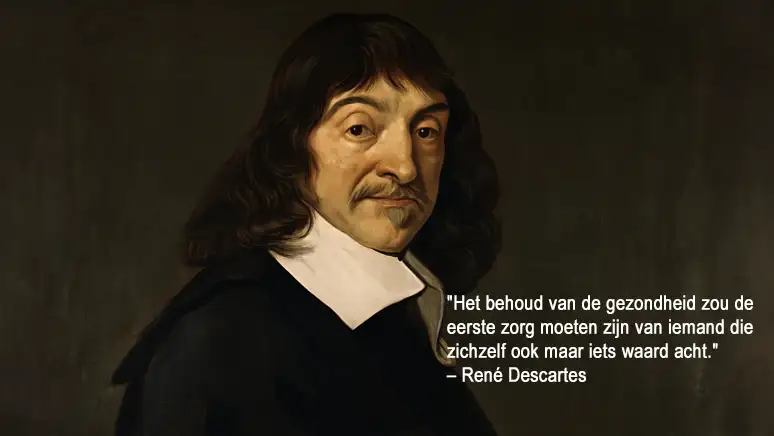
What if everything we experience — from buildings to conversations, from memories to beliefs — are merely projections within a system that lies beyond our reach? It sounds like science fiction, but the question is centuries old. René Descartes wondered back in the 17th century whether our reality is actually real, or merely an illusion fed by a deceptive source.
With his radical doubt, he laid a foundation that remains surprisingly relevant. Today’s simulation hypothesis may sound modern, but the underlying idea — that what we experience is not necessarily what is real — aligns closely with Descartes’ skepticism. His famous “I think, therefore I am” still serves as a philosophical anchor in an increasingly virtual world.
The 5 Key Takeaways
- Descartes introduced the idea of a malevolent demon that could fundamentally deceive us about what is real — a precursor to the modern simulation concept.
- The simulation hypothesis reflects Descartes’ doubts about sensory perception: how do we know that what we see and feel is real?
- Nick Bostrom proposes three possibilities, one of which implies we almost certainly live in a simulation — unless we assume that conscious civilizations rarely develop such simulations.
- Progress in virtual technology raises the question of where the boundary lies between simulation and reality — and whether that boundary is even meaningful anymore.
- The ability to ask these questions — about the nature of experience and existence itself — might be the only thing that escapes the simulation.
We don’t perceive reality as it is — but as we’ve evolved to see it. ~ Donald Hoffman
Descartes’ Radical Doubt About Reality
In the early 17th century, René Descartes posed a question far ahead of his time: how do we actually know that what we perceive truly exists? He observed that our senses are unreliable. A stick in water appears bent, dreams feel real while we sleep, and optical illusions reveal how easily our brain can be deceived. What remains that we can actually be certain about?
Perhaps it’s precisely that remnant of doubt that opens the door to genuine reflection.
The Malevolent Demon as a Precursor to AI
To strengthen his point, Descartes devised a thought experiment: suppose there exists a malevolent demon that consistently deceives us. Not just about what we see, but even about what we think. This metaphorical demon seemed abstract at the time — a philosophical tool — but takes on a surprisingly timely form in our era.
In the age of algorithms, deepfakes, and artificial intelligence, the idea of an imposed false reality is less far-fetched than ever.
Where Descartes assumed a demon, we now speak of an artificial reality created by a higher form of intelligence. The parallel is striking — and perhaps no coincidence.
From Philosophical Doubt to Scientific Theory
Pros of Descartes’ Approach
- Encourages critical thinking as the foundation for self-examination
- Creates space for fundamental questions about existence
- Laid the groundwork for modern epistemology and consciousness as a fundamental given
- Revalues the role of introspection and reasoning
Cons of Descartes’ Approach
- Can lead to paralyzing doubt and existential uncertainty
- Complicates practical functioning in everyday life
- Strains social connection through detached perspective
- Opens a door to endless questions without solid ground
The Modern Simulation Hypothesis
British philosopher Nick Bostrom formulated a thesis at the turn of the century that has since become notorious: either we perish before we can build advanced simulations, or we choose never to create them, or we almost certainly live in a simulation.
Three options — and none of them is reassuring.
Elon Musk later added that the probability we live in base reality is negligibly small. What once began as speculative philosophy has become popular culture theory. But look closely, and you’ll see Descartes’ echo in every pixel of this idea. The fundamental skepticism about our perception hasn’t disappeared — it’s simply been translated into technological terms.
We don’t perceive reality as it is — but as we’ve evolved to see it. ~ Donald Hoffman
Technology Makes the Boundary Thinner
The line between the physical and the virtual blurs with every technological leap. Virtual reality becomes more convincing, artificial intelligence increasingly refined. Meanwhile, scientists experiment with neural interfaces that directly link thoughts to simulated input. What was once purely imaginative is now becoming tangible possibility.
Philosophers like David Chalmers shift the discussion: the question is no longer whether we can simulate consciousness, but how. The classical opposition between real and artificial seems to lose its self-evidence — exactly as Descartes suspected about our perception. Perhaps ‘real’ is less absolute than we think.
Glossary
- Simulation hypothesis: The theory that our reality might be a computer simulation
- Cogito ergo sum: Descartes’ famous statement “I think, therefore I am”
- Radical doubt: Questioning all knowledge to arrive at absolute certainty
- Malevolent demon: Descartes’ thought experiment about an entity that completely deceives us
Consciousness as Final Certainty
When Descartes doubted everything, one unquestionable anchor remained: his own consciousness. Even if he were completely deceived, he could not doubt the fact that he was doubting. In the experience of doubt, existence itself revealed itself.
In our time, we might phrase it differently: “I simulate, therefore I exist.” Whatever we are — biological organism, digital entity, or something in between — the fact that we wonder what we are remains an irrefutable signal of subjectivity. Conscious perception seems, for now, our only certainty.
Whether we were born in a physical world or generated within a simulation, the inclination to question, doubt, and seek connects us to something deeper. Not the answer, but the desire for truth seems to form our human core.
Descartes’ intellectual legacy consists not of conclusions, but of a method — an invitation to look again, to think again. In a time when artificial worlds surround us daily, his centuries-old doubts touch the core once more.
Virtual reality is genuine reality — as genuine as any reality we have access to. ~ David Chalmers
Conclusion
Gerelateerde artikelen


![The Illusion of Self: What If Your ‘I’ Doesn’t Exist? [Free E-Book].](https://liberteque.com/wp-content/uploads/2025/09/GoodFeeling.nl-xxx-7-300x200.webp "We Might Be Living in a Simulation — and Descartes Already Figured That Out 4")

Frequently Asked Questions
What did Descartes mean by “I think, therefore I am”?
He meant that our own consciousness is the only thing that cannot be doubted. Even if everything is an illusion, the experience of doubt itself proves existence.
Is the simulation hypothesis scientifically valid?
How can we know if we’re living in a simulation?
Perhaps we can’t. If our senses are part of the simulation, the distinction between ‘real’ and ‘artificial’ may cease to exist entirely.
Why is Descartes’ philosophy still relevant today?
His method of systematic doubt remains the foundation for critical thinking. In a world of AI and virtual realities, that’s more relevant than ever.
What’s the difference between Descartes’ demon and a computer simulation?
Both represent external manipulation of our reality. The demon is a metaphysical concept; the simulation is a technological interpretation of the same idea.
Continue reading
- 10 Scientific Clues That Our Reality Might Be a Simulation
- Is Consciousness the Source of Reality? What Quantum Physics Teaches Us – Federico Faggin
- What is Hermeticism? Discover the Hidden Forces of Consciousness, Aether, and Inner Guidance
- What Alan Watts Meant by Differentiated Consciousness and Do You Have This Rare Personality?