Telepathy has long been viewed throughout the centuries as a mysterious phenomenon, surrounded by myths and speculation. With The Telepathy Tapes, this subject receives a contemporary and research-based approach.
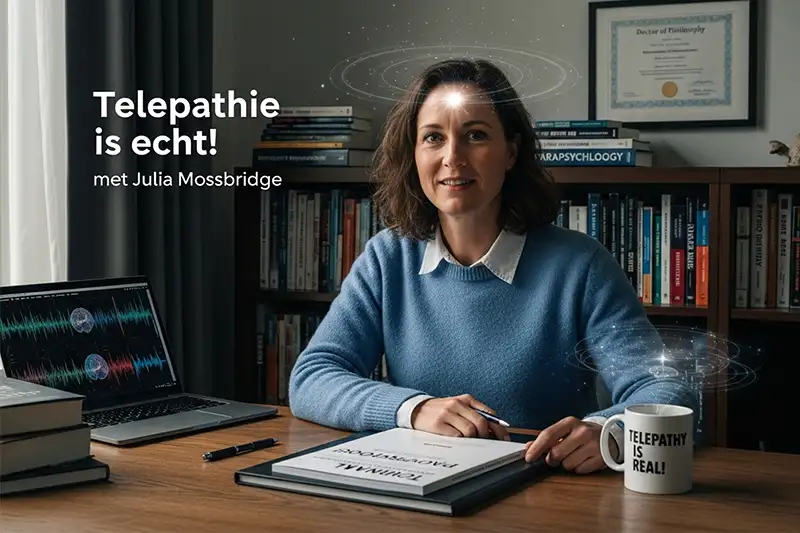
Filmmaker Ky Dickens and neuroscientist Julia Mossbridge collaborate on a project that connects personal testimonies to controlled experiments and reflections on potential societal impact.
While Dickens captures the human stories, Mossbridge brings scientific structure. She works with carefully designed experiments and emphasizes the value of an open, testing-oriented approach. This creates a combination of experience and evidence that gives the telepathy debate a new perspective.
The core is simple: the absence of conclusive proof does not mean the phenomenon is ruled out. This project opens space to explore what telepathy could mean for relationships, education, and social structures, should it be further confirmed.
Key Points
- Overview of The Telepathy Tapes: A podcast and documentary project by filmmaker Ky Dickens, focused on telepathic abilities in non-speaking autistic children through methods such as Spelling to Communicate (S2C) and Rapid Prompting Method (RPM). Controlled experiments yield clues that stimulate further research.
- Julia Mossbridge’s Role: Internationally recognized neuroscientist specializing in consciousness and precognition. As Human Potential Research Lead, she develops randomized and double-blind experiments, including remote viewing and emotional response analyses. She distinguishes proximity-based and distance-based forms of telepathy and works on publications contributing to scientific discourse.
- Implications of Accessible Telepathy: Greater empathy and transparency, plus new applications in communication, education, and diplomacy. This also raises ethical questions about consent and balanced use.
- Privacy and Confidentiality: Even in a telepathic future, personal space remains possible. Mental protection mechanisms and technical tools such as neural blockers can help safeguard boundaries.
- Education and Psionic Children: Schools can integrate telepathic training into the curriculum, emphasizing ethics and control. This can help young learners with special talents develop their abilities responsibly.
- Other Possible Applications: Consider military strategy, religious interpretations, new detection methods, and integration with technology such as AI and brain-computer interfaces.
Research into The Telepathy Tapes
The podcast The Telepathy Tapes, which launched in late 2024, documents both personal stories and controlled experiments around telepathy in non-speaking autistic individuals. The first season gathered testimonies from families worldwide. Season 2, launching in September 2025, broadens the focus to non-autistic cases, as described in this NewsNation article.
A documentary is planned for 2026 to showcase the experiments. Julia Mossbridge joined the project in early 2025 and provided it with a scientific foundation, increasing the credibility of the setup.
In interviews, including on NewsNation’s Reality Check, Mossbridge emphasizes that initial results are promising. She points out that a lack of conclusive proof does not equate to the absence of a phenomenon. The project thus opens a broader conversation about human potential, both in science and society.
Julia Mossbridge’s Contributions
Mossbridge, with a doctorate in psychoacoustics and affiliated with institutions such as the Institute for Love and Time, uses her neuroscientific expertise to systematically test telepathy. She works with EEG measurements, AI-driven analyses, and strict protocols, including physically separating test subjects and applying random stimuli.
Initial results point to statistical significance, for example when participants accurately describe images at a distance they could not see. Mossbridge places this in a broader theoretical framework in which telepathy may have connections to quantum entanglement. She distinguishes between two forms: one based on emotional attunement and one involving information transfer across distance.
Core Implications
If telepathy proves genuinely learnable, it can deepen relationships through direct empathic connection and lay new foundations for human interaction. Political and social structures would become more transparent, with greater room for honest decision-making. Markets would also benefit from openness and fairness.
At the same time, such a development requires clear ethical guidance, especially regarding privacy and careful support for young people. Education can play a central role by linking telepathy skills to responsibility and moral awareness. Additional background can be found in the Future of Privacy Forum report on connected minds.
Also Read: Telepathy in Autistic Children – Insights from The Telepathy Tapes and Julia Mossbridge’s Role
Extended Exploration of The Telepathy Tapes and the Implications of Telepathy
I. Introduction to The Telepathy Tapes
The Telepathy Tapes is a contemporary exploration of extrasensory perception (ESP), with particular focus on non-speaking autistic children who, according to the creators, show signs of telepathic communication. The project, set up by filmmaker Ky Dickens, combines personal testimonies, family interviews, and initial research trials. The documentary planned for 2026 builds on this foundation.
The starting point is that telepathy not only remains conceivable but may also be concretely observable in certain groups. Neuroscientist Julia Mossbridge plays a key role as Human Potential Research Lead. She connects the stories to systematic experiments, giving the project both human and scientific weight.
The exploration addresses the origin of the initiative, Mossbridge’s specific contributions, and broader implications if telepathy is no longer an exception but a skill that can be made accessible through training and research.
The exploration goes further than asking whether telepathy is provable and touches on broader themes. Think of the need for ethical consent in mental interactions, the use of telepathy for intelligence in military contexts, and religious reinterpretations of mystical experiences. There are also psychological issues, such as the burden constant connectedness can cause, and cultural shifts in art and language.
The spectrum ranges from hopeful visions of global empathy to concerns about a society where complete transparency becomes the norm. The central idea remains that the absence of conclusive proof does not mean there is nothing to investigate—on the contrary, further research is necessary and promising.
A structured table of contents shows how broad the analysis reaches. The speculations are inspired by existing philosophical, scientific, and social discussions about phenomena resembling telepathy, for example via BCIs like Neuralink’s. The contribution of The Telepathy Tapes is positioned as a stimulating step toward a new understanding of human potential.
II. Background of The Telepathy Tapes
The project emerged from Ky Dickens’ interest in the work of psychiatrist Diane Hennacy Powell on autistic savants, influenced in part by neurologist Oliver Sacks’ observations. The podcast launched in fall 2024 and quickly gained many listeners in the US and UK, with ratings averaging 4.9 out of 5 stars on Spotify.
Episodes contain stories from non-speaking individuals who claim to read thoughts, describe access to a shared mental space they call the “hill,” and demonstrate knowledge of languages or historical facts without prior exposure. Season 1 focused primarily on autism-related cases, while Season 2 (planned for September 2025) targets non-autistic participants.
Notable episodes describe experiments where children correctly name numbers or images without visual input, often using letter boards. Supporters view these outcomes—such as accurately naming the “northern lights” from a distance—as evidence for telepathy, with results exceeding chance. Some researchers draw connections to quantum entanglement as a theoretical framework. The combination of personal testimonies, innovative methods, and involvement of scientists like Julia Mossbridge makes this project seen as a serious and carefully executed attempt to re-examine an age-old question with new tools.
III. Julia Mossbridge’s Role
Mossbridge, with academic training in neuroscience and affiliated with institutions including the Mossbridge Institute and Florida Atlantic University’s Center for the Future Mind, brings specific expertise in consciousness, intuition, and precognition. Since January 2025, she has led the research program alongside co-researcher Jeff Tarrant. Her work consists of designing randomized and strictly controlled trials, such as EEG measurements of emotional responses to stimuli presented at a distance, and analyzing data using AI to ensure statistical reliability.
Her findings suggest that telepathy manifests in two main categories: a variant centered on emotional attunement and one focused on information transfer across distance. In interviews, she indicates that signals in non-speaking autistic participants are particularly compelling and places this in a broader context of a “non-local consciousness field,” an idea also found in Vedic traditions. Her studies will soon appear in peer-reviewed journals, including analyses of EEG data and theoretical frameworks in publications such as Mindfield.
Who is Julia Mossbridge?
Julia Mossbridge is primarily known for her research into consciousness, time, and human potential. Some key points for which she has gained international recognition:
-
Predictive Capacities (Precognition): She published studies suggesting that people can show physiological signals before a future event occurs.
-
“Time Travel” of Information: She investigates how information may move through time, also called “informational time travel.”
-
Institute of Noetic Sciences (IONS): She worked there as a researcher on the relationship between consciousness and scientific insights outside the mainstream.
-
Human Potential Research Lead: In various projects (such as The Telepathy Tapes), she focuses on exploring non-traditional forms of human communication.
-
Books: She authored, among others, Transcendent Mind (2017, with Imants Barušs), in which she advocates for a scientific approach to phenomena such as telepathy and consciousness beyond the brain.
IV. Scientific Basis
The evidence includes triple-blind experiments with thirteen cameras, random generators, and complete sensory shielding, yet high accuracy was measured (e.g., non-speaking participants commenting on invisible video footage). Mossbridge’s team confirms the existence of the so-called “hill” as a global telepathic network, with examples from various cultures. These findings not only provide clues for telepathy but also a new framework for how human connectedness can be investigated.
V. Implications of Accessible Telepathy
Interpersonal
- Positive: Direct empathy, deeper relationships, conflict resolution through shared understanding.
- Negative: Overstimulation from constant thoughts, blurred personal boundaries, risk of manipulation.
- Other: New forms of intimacy (“mind-melding”), family dynamics change through unspoken truths.
Social
- Positive: Stronger community bonds, less loneliness, collective problem-solving.
- Negative: Social hierarchies based on telepathic strength, stigma for non-telepaths.
- Other: New etiquette around “thought eavesdropping,” art forms like telepathic storytelling emerge.
Societal
- Positive: Advances in healthcare (telepathic therapy), education through direct knowledge transfer.
- Negative: Mental overload, fragmentation if access is unequally distributed.
- Other: Higher productivity but also more burnout, language skills may decline.
International
- Positive: Diplomacy without deception, global cooperation on climate issues.
- Negative: Conflicts from thought-spying, cultural tensions amplified.
- Other: Language barriers disappear, shared consciousness promotes environmental awareness.
Political
- Positive: Transparent governance, fair elections, policy based on collective “mind consensus.”
- Negative: Authoritarian control through thought monitoring, rise of “thought police.”
- Other: Leadership chosen for telepathic skills, treaties on mental sovereignty.
Financial/Economic
- Positive: More transparent markets, less fraud, greater innovation through shared ideas.
- Negative: Economic instability from corporate secret leaks, inequality if telepathy is monetized.
- Other: New forms of commerce (direct negotiations), labor market shifts toward telepathic roles.
Privacy
- Positive: Ability to selectively share, growth of ethical awareness around consent.
- Negative: Hiding secrets becomes difficult without mental “shields,” risk of total surveillance.
- Other: Privacy laws extended to thoughts, development of neural firewalls.
Education
- Positive: Direct mind-to-mind learning, early training in control and ethics.
- Negative: Overload in young learners, separation between psionic and non-psionic children, fraud risk.
- Other: Schools develop into “psionic academies,” curriculum with empathic ethics, challenges for neurodivergent learners.
Ethics
- Positive: Stronger moral awareness, interactions based on consent.
- Negative: Dilemmas around involuntary thought-reading, risk of exploiting the vulnerable.
- Other: Regulation through licenses for telepaths, philosophical debates on free will.
Legal
- Positive: Advanced detection, justice through “mental witnesses.”
- Negative: Criminalization of “thought crime,” increase in privacy cases.
- Other: Human rights expanded with mental integrity, treaties against telepathic warfare.
Military/Security
- Positive: Better intelligence, non-lethal “mind operations.”
- Negative: Arms race in telepathic technology, ethical risks in interrogation.
- Other: Espionage gains new dimensions, defense through anti-telepathic technology.
Culture/Religion
- Positive: Sense of spiritual unity, new interpretations of religious experiences.
- Negative: Religious schisms, loss of sacred privacy.
- Other: Emergence of “mental art,” rituals with shared visions.
Psychological/Health
- Positive: Breakthroughs in therapy, reduction of loneliness.
- Negative: New disorders from overload, dependence on constant connectedness.
- Other: Evolutionary adaptation with stronger mental barriers, integration with BCIs for mental health.
Technological
- Positive: Brain-computer interfaces enhance telepathy (e.g., Neuralink).
- Negative: Hacking risk, dependence on technology for privacy.
- Other: Hybrid forms of AI and telepathy, inequality through technological enhancement.
Environment/Global
- Positive: Shared awareness promotes sustainability and cooperation.
- Negative: Tensions from exposed hidden agendas, pressure on population growth.
- Other: Collective action on global crises, but also wider gap if access is unequally distributed.
VI. Speculative Scenarios
In some future visions, telepathy could lead to a society based on shared consciousness, where deception is barely possible and cooperation in science and politics accelerates. Conversely, a world without clear boundaries also becomes vulnerable: too much openness or the rise of power structures controlling thoughts are real risks. A more balanced scenario seems to lie in regulated access, where education and ethics ensure boundaries while simultaneously strengthening the benefits of these abilities.
VII. Conclusion
The Telepathy Tapes underscores the need to always link hopeful insights to thorough research. If telepathy truly becomes accessible, developing ethical frameworks is essential. Julia Mossbridge’s work shows that careful experiments can provide a solid foundation. Follow-up studies, including independent replications, are crucial to further explore this complex and promising field.
Verified Sources
- NewsNation: Telepathy Tapes Season 2 Exclusive
- Mossbridge Institute: Who We Are
- YouTube: Reality Check Interview
- The Autism Cafe: Separating Science from Pseudoscience
- McGill OSS: Telepathy Tapes Prove We All Want to Believe
- VICE: The Problem With the ‘Magical Children’
- Wikipedia: The Telepathy Tapes
- Quora: Societal Impacts of Telepathy
- LinkedIn: Human Telepathy by 2025
- Medium: Mind-Blowing Possibilities
- FPF: Privacy and the Connected Mind
Related Articles


![The Illusion of Self: What If Your ‘I’ Doesn’t Exist? [Free E-Book].](https://liberteque.com/wp-content/uploads/2025/09/GoodFeeling.nl-xxx-7-300x200.webp "Scientific Research into Telepathy: The Telepathy Tapes Explained and Julia Mossbridge's Role 5")
Frequently Asked Questions
What is The Telepathy Tapes?
The Telepathy Tapes is a podcast and upcoming documentary in which filmmaker Ky Dickens and neuroscientist Julia Mossbridge investigate telepathic experiences. The project combines personal stories with controlled trials and focuses on both non-speaking autistic individuals and broader cases.
Who is Julia Mossbridge?
Julia Mossbridge is an internationally recognized neuroscientist specializing in consciousness, intuition, and precognition. Within The Telepathy Tapes, she develops and leads controlled research with EEG measurements, AI analysis, and double-blind protocols to test telepathic signals.
Is there already scientific evidence for telepathy?
Initial research led by Mossbridge shows statistical deviations, such as accurately describing images that were not visible. While this is promising, replication by independent teams remains necessary to solidly support the results.
What are the potential benefits of telepathy?
Telepathy could foster greater empathy and openness, more honest communication, and innovative educational approaches. In diplomacy and science, it could also lead to new forms of collaboration and solutions to global challenges.
What challenges does telepathy present?
Important considerations include protecting privacy, developing clear ethical guidelines, and ensuring equal access. Education and public dialogue are essential to managing this responsibly.