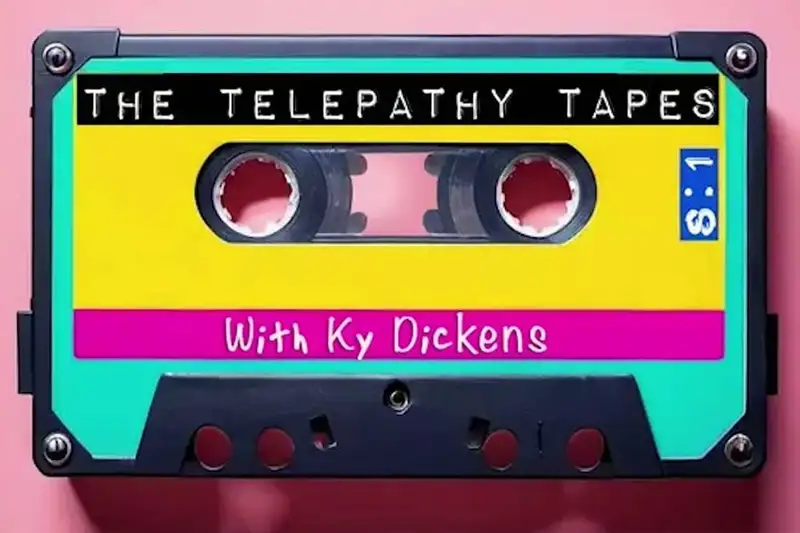
A podcast that opens doors to a new understanding of telepathic experiments in autistic children. The Telepathy Tapes by filmmaker Ky Dickens brings together parents, researchers, and the curious around a topic that can fundamentally expand our view of human communication.
Neuroscientist Julia Mossbridge, internationally recognized for her research into predictive capacities, plays a leading role as Human Potential Research Lead. Her presence ensures a rigorous and careful approach to the experiments. Mossbridge combines academic rigor with an open attitude toward possibilities that explore the boundaries of human consciousness. Lack of evidence here is not evidence of lack, but rather an invitation for further research.
The 5 Key Takeaways
- Julia Mossbridge, internationally recognized neuroscientist, ensures meticulous scientific execution of telepathy research
- Autistic children show signs of telepathic abilities that are being investigated through innovative experiments
- The project offers new perspectives on human communication and consciousness
- Telepathy could in the future transform our education, legal system, and social structures
- The research emphasizes hope, curiosity, and the value of exploring untapped human capacities
The Scientific Foundation
Julia Mossbridge brings impressive credentials to The Telepathy Tapes project. Her background as a cognitive neuroscientist at Northwestern University and the Institute of Noetic Sciences provides scientific credibility to this research. Through her involvement, it is ensured that experiments are conducted carefully and with academic discipline.
Her earlier publications on precognition and ‘informational time travel’ already laid a foundation for investigating phenomena that broaden the horizon of conventional science. Daryl Bem’s groundbreaking study on precognition illustrated that people may be capable of foreseeing future events, showing that exploratory research on these topics can be fruitful ground.
Also Read: Scientific Research on Telepathy: The Telepathy Tapes Explained and Julia Mossbridge’s Role
The Telepathy Experiments
The experiments central to The Telepathy Tapes follow a protocol in which autistic children appear to transmit information without using traditional communication methods. The recordings were conducted from various angles to make the transmission as transparent as possible. This approach demonstrates the intention to apply scientific methodology as carefully as possible and create space for new insights.
Related Articles


![The Illusion of Self: What If Your ‘I’ Doesn’t Exist? [Free E-Book].](https://liberteque.com/wp-content/uploads/2025/09/GoodFeeling.nl-xxx-7-300x200.webp "Telepathy in Autistic Children – Insights from The Telepathy Tapes and Julia Mossbridge's Role 5")
Frequently Asked Questions
Who is Julia Mossbridge?

Julia Mossbridge is primarily known for her research into consciousness, time, and human potential. Some key points for which she has gained international recognition:
-
Predictive Capacities (Precognition): She published studies suggesting that people can show physiological signals before a future event occurs.
-
“Time Travel” of Information: She investigates how information may be able to move through time, also called “informational time travel.”
-
Institute of Noetic Sciences (IONS): There she worked as a researcher on the relationship between consciousness and scientific insights outside the mainstream.
-
Human Potential Research Lead: In various projects (such as The Telepathy Tapes), she focuses on exploring non-traditional forms of human communication.
-
Books: She wrote, among others, Transcendent Mind (2017, with Imants Barušs) in which she advocates for a scientific approach to phenomena such as telepathy and consciousness beyond the brain.
Societal Implications of Telepathic Capacities
When telepathy develops further, it opens the way to a societal revolution with unprecedented possibilities. In education, this could lead to new forms of learning in which children directly share thoughts and insights. Teachers would develop skills to guide this transparent exchange, making collaboration and empathy central to the classroom.
Our understanding of privacy would also deepen. New norms and rules can emerge that protect mental autonomy and respectfully address the most intimate layers of human consciousness. It would be an opportunity to redefine personal boundaries in a way that strengthens connection and trust.
Economic Development
A society in which telepathy plays a role would generate innovative industries around mental communication and privacy. Companies can invest in psychic security systems and supporting technologies that enable safe thought exchange. At the same time, existing sectors have the opportunity to reinvent themselves and integrate telepathic applications into their services.
The job market will expand with new professions such as telepathic consultants, mental trainers, and privacy specialists. These developments can open doors to greater inclusivity and collaboration. Where differences once existed, telepathy can contribute to greater understanding between people with diverse talents and capacities.
Glossary
- Facilitated Communication: Communication method in which a facilitator provides support to the user
- RPM (Rapid Prompting Method): Technique in which letter boards are used as an aid in communication
- Precognition: The ability to foresee or sense future events
- Parapsychology: Study of phenomena that challenge the boundaries of conventional science, such as telepathy
International Political Implications
Telepathy could also transform international diplomacy. Negotiations take on a new character when openness and direct thought exchange become part of the process. Countries could focus on cooperation and developing telepathic capacities that contribute to mutual understanding and global stability.
Democratic processes would become more transparent, with greater emphasis on honesty and shared responsibility. Political leaders will find new ways to strengthen trust, while cultures worldwide can develop their own approaches to embracing telepathy within their values and traditions. This can lead to an enrichment of diversity in how societies deal with this new form of communication.
Technological Convergence and AI
Brain-computer interfaces could develop into instruments that amplify and translate telepathic signals. Artificial intelligence can play a key role in understanding telepathic communication and creating technologies that protect mental privacy. The boundary between natural and technologically supported telepathy can thus become increasingly fluid.
Psychological and Cultural Adaptations
Mental health care can also develop within a telepathic context. Therapists will have the opportunity to design new methods that align with a reality in which thoughts can be directly shared. This can not only present challenges but also provide powerful new forms of support and connection.
Cultural and religious traditions worldwide will determine their place in this new era. For some, telepathy may mean spiritual deepening; for others, an invitation to reconsider centuries-old values. What is certain: our understanding of individuality and identity takes on new meaning in a world where collective consciousness becomes tangible.
Pros and Cons
Benefits of Telepathy
- Direct communication without language barriers, promoting international cooperation
- Greater empathy and mutual understanding as feelings and thoughts can be openly shared
- Faster and more honest decision-making in politics, education, and healthcare
- Reduction of misunderstandings, lies, and manipulation in social relationships
- New forms of art, culture, and spirituality centered on collective experience
- Opportunities to resolve international conflicts more peacefully through transparent communication
- Strengthening of solidarity and connection within and between societies
Considerations with Telepathy
- The need to develop new rules for mental privacy and personal boundaries
- Risk of overload or stress from constant access to others’ thoughts
- Inequality between people with strong and weak telepathic abilities
- International tensions if countries use telepathic capacities for espionage or defense
- Dangers of abuse in propaganda, power, or manipulation on a large scale
- Cultural and religious differences in how telepathy is interpreted and applied
- The challenge of maintaining personal identity and autonomy in collective consciousness
Conclusion
The Telepathy Tapes with Julia Mossbridge shows how exploratory research can open doors to the future of human communication. With her international reputation and scientific expertise, Mossbridge ensures careful execution that creates space to seriously explore the possibilities of telepathy.
When telepathy proves to be real, we stand on the threshold of a societal transformation that will profoundly enrich our education, economy, politics, and relationships. This research already invites us to think about what it means to be human in a time when thoughts can directly touch each other.
Verified Sources
- Bem (2011) – Feeling the Future: Retroactive Influences on Cognition
- Bem et al. (2016) – Meta-analysis of 90 Psi Experiments
- Braude (2019) – Special Section on Reber & Alcock
- Cardeña (2018) – Overview of Experimental Evidence for Parapsychology
- NewsNation – Telepathy Tapes Season 2 Interview
- Mossbridge Institute – Who We Are
- YouTube – Reality Check Interview on Telepathy
- The Autism Cafe – Critique of Telepathy Tapes Podcast
- McGill OSS – Critical Look at Belief in Telepathy
- VICE – Problem with ‘Magic Children’ and Pseudoscience
Verified Sources
Is The Telepathy Tapes scientifically reliable?
The podcast presents innovative research that is carefully guided by experienced scientists. Julia Mossbridge and her team are committed to rigorous execution and transparency in methods. While the field is still developing, the experiments show promising leads that are being further investigated.
What is Julia Mossbridge’s role in telepathy research?
Mossbridge serves as Human Potential Research Lead for The Telepathy Tapes. She brings her broad expertise in neuroscience and consciousness research and ensures that experiments are conducted in a meticulous manner. Her presence gives the project international credibility and direction.
Do autistic children really have telepathic abilities?
The experiments point to intriguing possibilities that some children may be able to transmit information in an alternative way. This is being investigated under controlled conditions, with the aim of gaining a better understanding of their unique communicative abilities. The research emphasizes openness and respect for neurodiversity.
What would telepathy mean for our privacy?
Telepathy can fundamentally expand our understanding of privacy. New technologies, laws, and social norms can emerge to protect mental autonomy. At the same time, this offers the opportunity to develop new forms of trust and transparency in our society.
Can everyone learn telepathy?
Proponents suggest that telepathy may be a natural human capacity that can be further developed. Research must confirm this, but the idea that more people can gain access to this form of communication opens inspiring perspectives for the future.