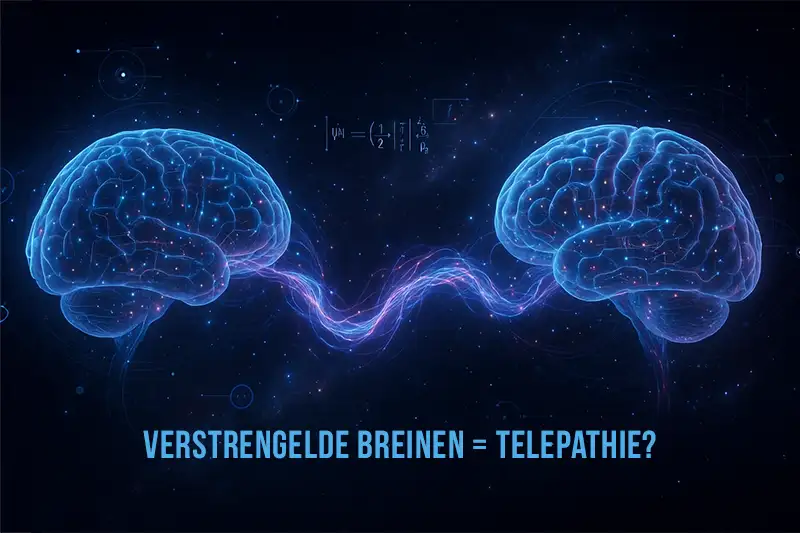
In the world of quantum physics and neuroscience, insights occasionally emerge that shake the foundations of our perspective on reality. A 1994 study, published in Physics Essays (PDF), suggests that the human brain may operate with a quantum component — an idea that sounded radical at the time, and still pushes the boundaries of the explainable today.
Einstein-Podolsky-Rosen (EPR): The Beginning of a Paradox
Related Articles



![The Illusion of Self: What If Your ‘I’ Doesn’t Exist? [Free E-Book].](https://liberteque.com/wp-content/uploads/2025/09/GoodFeeling.nl-xxx-7-300x200.webp "The Einstein-Podolsky-Rosen (EPR) Paradox - Can Brains Become Entangled with Each Other? 🧠⚡🧠 5")
Frequently Asked Questions
Einstein found this idea incompatible with relativity theory. According to him, information simply cannot travel faster than light. Yet experiments by Alain Aspect in 1982 showed that these non-local interactions do indeed occur. Since then, we speak of EPR correlation: a fundamental feature of quantum entanglement.
The implication is staggering. If two particles are entangled, then a measurement on one particle immediately determines the state of the other — regardless of the distance between them. Scientists wondered: is this phenomenon limited to particles? Or can larger systems, such as the human brain, also behave quantum mechanically?
The Hypothesis: Does Our Brain Function as a Quantum System?
Neurons, Synapses, and Microtubules
There has long been suspicion that the brain is more than a biological switching system of chemical signals. British physicist Roger Penrose and anesthesiologist Stuart Hameroff proposed a controversial hypothesis: that microtubules in neurons could functionally act as quantum computers.
Other researchers — such as Eugene Walker and Nobel laureate John Eccles — pointed to quantum tunneling as a possible factor in synaptic transmission. Along similar lines, Amit Goswami, co-author of the discussed research, describes the brain as a hybrid system in which classical and quantum processes converge. Within that model, consciousness would be the mechanism that ‘collapses’ the quantum state.
Jacobo Grinberg-Zylberbaum and his team wanted to test this idea. They searched for EPR-like correlations between human brains, measured with EEG. According to the so-called synergic theory, the neuronal field — the totality of electrical activity in the brain — forms a quantum-ordered system. If this is correct, entanglement between brains should be demonstrable.
Early Signs of Connected Brain Activity
Even before this experiment, there were indications that brains can synchronize under certain conditions. Meditation appears to increase coherence between brain hemispheres. There is also evidence that empathic contact without words — for example, between family members or couples — leads to striking similarities in EEG patterns. Grinberg-Zylberbaum had previously measured that brain activity seemed transferable between two people who had spent time together. That earlier research formed the stepping stone to a more rigorously designed experiment with better shielding and greater distance.
Experiment Design: How Do You Test Brain Entanglement?
For the experiment, seven pairs were assembled, consisting of men and women between 20 and 44 years old. Each test was conducted in a controlled setting with two separate Faraday cages: rooms that block both sound and electromagnetic signals. The distance between the rooms was 14.5 meters. This ruled out classical forms of communication — audible, tactile, or via radiation.
Step-by-Step Approach
The researchers began with a control condition. Two strangers sat in separate rooms without prior contact. One person (A) was shown a series of 100 light flashes, while EEG was recorded from both. No effect on person B’s brain was expected, and this was confirmed in the data.
Then came the actual experiment. Each pair spent 20 minutes together in meditative silence to achieve a state of ‘direct communication’ — a feeling of inner attunement. Subsequently, person B moved to the second room. Person A received flashes again, while brain activity in both was measured synchronously. To reduce noise, low frequencies were filtered from the data.
The researchers used additional control moments, in which either no flashes were given, or A was not even in the room. Statistical comparison was performed using correlation coefficients and t-tests, looking at whether the so-called transferred potentials in B matched the evoked potentials in A.
Continue reading
- Telepathy in Autistic Children – Insights from The Telepathy Tapes and Julia Mossbridge’s Role
- Intensive 7-Day Meditation Retreat Rapidly Rewires Brain and Blood Composition
- Scientific Research into Telepathy: The Telepathy Tapes Explained and Julia Mossbridge’s Role
- Manifesting from Coherence: From Survival Mode to Loving Presence – Dr. Joe Dispenza