You’d expect intelligence and self-confidence to go hand in hand. Yet it turns out that smart people often struggle with insecurity. This phenomenon can be explained by the constant self-evaluation and high expectations that intelligent people have of themselves. Moreover, it’s interesting to explore the concepts of wisdom versus intelligence; while intelligence is often measured by cognitive skills, wisdom encompasses a deeper understanding of the world and personal experiences, leading to greater self-confidence. This complex interaction between the two can contribute to the insecurity many experience, despite their intellectual capacity.
This paradox has everything to do with how the intelligent brain perceives the world. Where less intelligent people quickly form a judgment, smart people see the full complexity of a situation. That bird’s-eye view comes at a price, however.
The 5 Key Takeaways
- The link between intelligence and the ability to constantly question yourself
- How the Dunning-Kruger effect explains why unintelligent people seem more self-assured
- Why smart people systematically underestimate themselves
- The role of self-reflection in the emergence of doubt
- The difference between knowing and understanding as a source of insecurity
The Paradoxical Effect of Intelligence
Intelligence doesn’t automatically provide self-confidence. In fact, the opposite proves true. Smart people question things, including themselves.
While less intelligent people cling to simple beliefs like “it’s always been this way” or “my boss says so,” intelligent people see nuance and complexity. That versatility makes decisions more complicated.
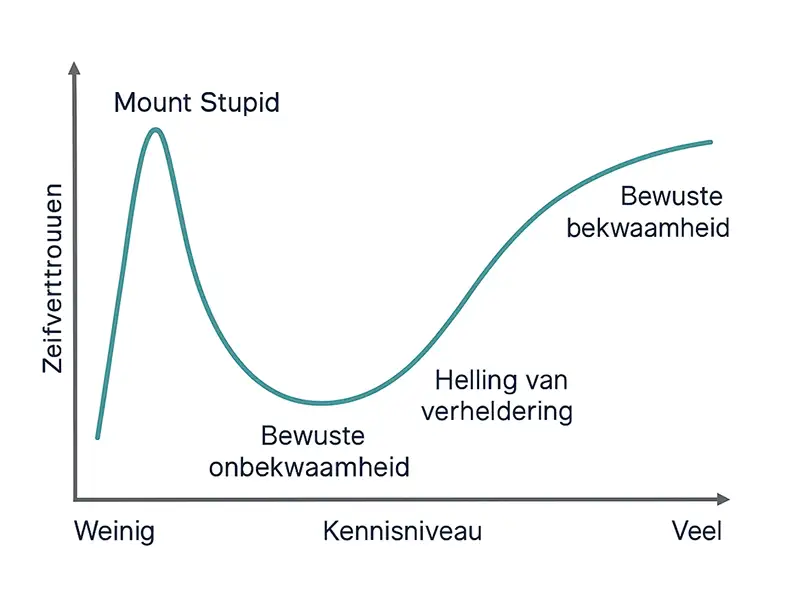
Mount Stupid Versus the Slope of Enlightenment
The Dunning-Kruger effect shows why unintelligent people often come across as more convinced. They remain stuck on what experts call “Mount Stupid”: an exaggerated self-confidence based on limited knowledge.
Smart people, by contrast, find themselves on the “slope of enlightenment.” They know enough to realize how much they still don’t know. That realization creates doubt, even though they possess more knowledge than the average person.
Pros and Cons of Intelligence With Doubt
Pros
- Thorough thinking prevents thoughtless decisions
- Self-critical ability leads to continuous growth
- Openness to new insights promotes creativity
- Awareness of own limitations prevents arrogance
Cons
- Overthinking slows down decision-making
- Constant doubt undermines self-confidence
- Perfectionism can be paralyzing
- Impostor syndrome creates unnecessary stress
The Slowing Effect of Multiple Scenarios
Smart people process information differently. Where you ask a simple question, they rapidly consider 10 to 20 possible correct answers. That internal weighing takes time.
It explains why intelligent people sometimes come across as slow in conversations. They account for scientific studies, their conversation partner’s understanding, and all variables at play. That carefulness is often mistaken for insecurity, however.
Impostor Syndrome and Denying Your Own Intelligence
Many people with a high IQ don’t even know they have a high IQ. Worse, some deny it to themselves. This mechanism protects against fear of failure.
If the environment has low expectations, you can at least not disappoint. This reasoning may seem strange, but it offers psychological safety. Impostor syndrome reinforces this pattern: the more you know, the more you doubt your own competence.
Glossary
- Dunning-Kruger effect: Psychological phenomenon where people with limited knowledge overestimate their own competence
- Impostor syndrome: The feeling of being a fraud despite objective successes and competencies
- Self-reflection: The ability to look critically at your own thoughts and actions
- Bird’s-eye view: An overview of the big picture and connections in complex situations
Knowing Versus Understanding as a Source of Doubt
Smart people distinguish between superficial knowledge and deep understanding. They don’t share information they haven’t thoroughly grasped. That makes them reserved.
Less intelligent people rely on what they know and are therefore more confident. They don’t assume others have thought through their knowledge. For intelligent people, the opposite is true: they assume others also analyze everything thoroughly.
| Characteristic | Smart People | Average Intelligence |
| Response Speed | Slow (considers multiple options) | Fast (first instinct) |
| Self-Confidence | Low to average | Average to high |
| Awareness of Limitations | High | Low |
| Doubt | Constantly present | Limited |
The Social Cost of Being Different
Being exceptional has consequences. Whether you’re smarter, more beautiful, or taller than the masses, you stand out. Those who stand out easily fall outside the group. Without proper guidance as a child, you don’t survive that without scars.
In elementary school, excelling is sometimes even punished instead of encouraged. That experience lingers. Intelligent children learn that their intellectual development causes discomfort in others, contributing to later insecurity.
What Helps With That Doubt?
Doubt isn’t something you need to train away. It comes with a brain that sees many connections and thinks ahead. Still, you can learn to handle it better so it doesn’t paralyze you.
- Acknowledge your thinking pace. Those who reason quickly tend to keep ruminating. Sometimes it helps to step back and not try to wrap things up immediately. That creates space.
- Use your analysis as a tool, not an obstacle. Set limits on how many scenarios you consider. Thinking through one or two options thoroughly is often more effective than half-thinking through ten.
- Seek like-minded people. Talk to people who recognize your way of thinking. That prevents the feeling that you’re the one who “thinks too much.”
- Redefine success. Not every decision needs to be perfect. Sometimes “good enough” is the only way to move forward.
- Trust your pattern recognition. If you often turn out to be right in your analyses, you can build on that too. Self-confidence usually grows only afterward—after repetition and proof.
These small shifts ensure that self-reflection doesn’t become a burden but a form of sharpness you can use. Insecurity remains, but takes on a different function: that of a direction indicator rather than a brake.
Conclusion
Insecurity in smart people is not a shortcoming but a logical consequence of their thinking process. They see more, consider more, and understand the complexity of every issue.
That nuance makes decisions more complicated and creates doubt. At the same time, it prevents thoughtless choices and promotes continuous growth. The art may well be to recognize that doubt and intelligence are inextricably linked, without letting insecurity become paralyzing.
Related Articles



Frequently Asked Questions
Why are smart people often more insecure?
Smart people see the complexity of situations and incorporate more perspectives into their considerations. That brings nuance, but also doubt. While someone with less knowledge forms a judgment more quickly, the intelligent thinker weighs longer. That slows decisions and can undermine the feeling of certainty. That continuous self-reflection means they more often question their own judgment.
What is the Dunning-Kruger effect and how does it explain self-assurance?
The Dunning-Kruger effect describes how people with little knowledge overestimate their own abilities, while people with much knowledge are more critical of themselves. Those who know little often lack the ability to recognize that ignorance, and therefore come across as more self-assured. Those who know more see better what remains unknown, which can temper their self-confidence.
What is impostor syndrome and how does it affect smart people?
Impostor syndrome is the feeling that your success isn’t deserved, even though all the facts point to the contrary. Especially smart, perfectionist people struggle with this. They attribute their achievements to luck or coincidence and live with the fear of being exposed. That often creates stress and a constant feeling of falling short.