
In the late 17th century, French philosopher René Descartes sat alone in a dimly lit room, doubting everything he thought he knew. He realized that his senses, beliefs, and even his memories could all be illusions.
He asked himself:
- What if everything I ever knew was a lie?
- What if my senses deceive you?
- What if the world outside your mind doesn’t even exist?
This led him to his famous conclusion: “I think, therefore I am.”
For him, this meant that even if everything else was an illusion, at least something was aware of those thoughts.
But here’s the question: what if even the ‘I’ that thinks isn’t real? Descartes assumed that because thoughts existed, there must be a thinker behind them. However, centuries later, modern neuroscience and Eastern philosophy would challenge this idea. If you pay close attention, you’ll see that thoughts arise on their own, emotions come and go, and memories shift and fade.
But who creates them? Most people never question this; they go through life assuming they are a single, stable self, a personality that exists in your mind, makes decisions, and controls your thoughts. But if you sit in silence and simply observe your own mind, something strange happens.
The thoughts keep coming, but they don’t need you to create them. They appear from nowhere, play out in your mind, and disappear again. And yet there is something in you that sees all this unfold. That consciousness is real, but the voice in your head, the shifting emotions, the personality that feels so solid—that’s just a story being told: the illusion of the self.
The 5 Key Takeaways
- The idea of a fixed ‘self’ is an illusion, because you are constantly changing and your personality adapts to different situations.
- Thoughts and emotions often happen to you; you’re not always in control, which shows that your conscious mind isn’t the only driving force.
- The mind claims ownership of thoughts and actions as if it’s the author, when in reality it’s often just a narrator constructing a story after the fact.
- Your identity is flexible and context-dependent, making the ‘real you’ dependent on circumstances and the roles you play.
- By realizing that the self is an illusion, you can free yourself from limiting beliefs and patterns, allowing you to be more open and flexible in life.

In 1848, a railroad worker named Phineas Gage experienced a bizarre accident: a metal rod shot through his skull. He survived, but the person who woke up was completely different. His personality changed overnight; he became impulsive, reckless, and aggressive, unrecognizable to those who had known him.
So who was the real Phineas Gage? The responsible, balanced man before the accident, or the erratic, unpredictable one after? If the self were something fixed, something permanent within us, it couldn’t change so easily.
And yet we change all the time. Buddha understood this more than 2,500 years ago. He taught that the self is an illusion, not because it doesn’t exist, but because it constantly shifts, like a flowing river rather than a solid object.
Even modern science confirms this. Neuroscientists have searched the brain for a central self, a place where our true identity resides, but they’ve found nothing. Instead, the brain functions as a network of memories, reactions, and thoughts, all constantly changing.
Also Read: The Mystery of Consciousness: Are We More Than Our Brains? [Mini e-Book Online]
Glossary
- Illusion: An incorrect idea or false perception of reality.
- Neuroscience: The study of the nervous system, including the brain.
- Personality: The sum of characteristic behaviors, thoughts, and feelings of an individual.
- Free Will: The ability to make independent choices without coercion.
- Shapeshifting: Adapting your behavior and personality to different situations.
And yet we cling to identity. You say: “I’m an anxious person,” “I’m a failure,” “I’m not smart enough.” But if you really look, you’ll see that these are just thoughts. They arise, stay for a while, and then pass. Who are you?
The Investigation of the Self
Philosopher David Hume once tried to find his true self by looking deep into his own mind. He meditated, he searched, and he came to a shocking conclusion: “I never catch myself at any time without a perception. I can never perceive anything but the perception.”
In other words, he searched for the self and found nothing, only thoughts that appeared and disappeared. So if thoughts come and go, emotions rise and fall, and personality shifts: what’s left? What does this mean for the idea of free will?
The question of whether you actually have control over your decisions and actions has been debated for centuries. The answer to that question might surprise you. The idea that you have free will is also seen as an illusion.
If you truly had control over your mind, wouldn’t you be able to determine your next thought before it happens? Wouldn’t you be able to choose to feel happy, sad, or calm at will? But you can’t.
Thoughts happen to you, emotions happen to you. This is what makes the illusion of the self so convincing: the moment a thought arises, the mind claims ownership of it. “I think this,” “I feel this,” “I decided to do this.”
But this is all just the mind taking credit for something it didn’t actually do. It’s like a narrator telling a story after it’s already been written, pretending to be the author. This phenomenon has been extensively studied through science.

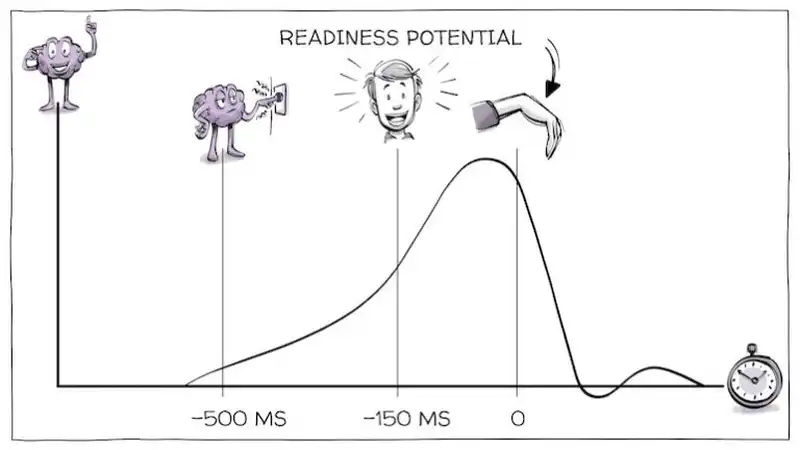
Neuroscientists like Benjamin Libet have tested this in a famous experiment. Research has shown that when a person decides to move their hand, their brain has already made the decision before they’re even conscious of it.
Electrical signals fire, neurons send messages, muscles begin to move, and only after all this happens does the person think: “I choose to move my hand.” Think about what this means: your brain acts before your conscious mind even realizes it. So where is the self that supposedly has control?
The Prison of Identity
You’re not the same person in every situation. Think about how you behave when you’re alone versus when you’re with friends; how you act around family versus strangers; how your thoughts shift when you’re happy versus when you’re angry.
Which version is the real you? Most people don’t notice, but they’re constantly shapeshifting. The personality you think is your self is actually just a collection of roles you play in different situations.
A man who is gentle and soft-spoken at home can become dominant and assertive at work. Yet he never notices the contradiction; his mind smooths over the gaps to maintain the illusion of a single, unified self.
This is what makes the illusion of the self so powerful: it’s like a movie. Every scene flows so seamlessly that you never stop to question it. But if you slow it down, you see that there’s no single identity, just different versions of you responding to different moments.
So you’re actually like a chameleon, adapting to your environment. This often happens unconsciously and is a mechanism built into the human mind. The human mind is very complex and can fool itself.
Your whole life, your mind has played you a trick, a trick so convincing that it shapes everything you believe about yourself. It has convinced you that you’re in control, that there’s a real self inside you making choices and steering your life.
But once you see through this illusion, everything changes. You stop getting lost in thoughts, because you realize they’re just passing events. You stop identifying with emotions, because you see them as temporary, not part of your identity.
You stop defending a false sense of self and start experiencing life without filters. Most people spend their entire lives trapped in a character they didn’t even choose.
But here’s the truth: you were never meant to be just one thing. The moment you let go of the need to define yourself, you become limitless. You stop being controlled by the illusion, and for the first time, you’re free.
Verified Sources
Gerelateerde artikelen


Frequently Asked Questions
What is the illusion of the self?
The illusion of the self is the idea that you have a fixed, unchanging identity. In reality, your self-image is flexible and context-dependent. It’s important to become aware of the different influences that shape your identity, such as social interactions, personal experiences, and cultural context. By understanding this dynamic, you can explore the meaning of the ego and view your identity as a continuously evolving process rather than a static given. This creates space for growth and self-discovery.
How does the illusion of the self arise?
The illusion arises because your mind tends to construct a coherent story about yourself. This story is based on your memories, experiences, and the roles you play.
Why is it important to recognize the illusion of the self?
Recognizing the illusion can free you from limiting beliefs and patterns. You become more flexible and more open to new experiences.
Can I control my thoughts and emotions?
You don’t always have complete control over your thoughts and emotions. They come and go, often without you consciously choosing them.
What does it mean to be ‘free’ from the illusion of the self?
It means you no longer identify with a fixed self-image. You accept that you are constantly changing and that you are more than the roles you play.