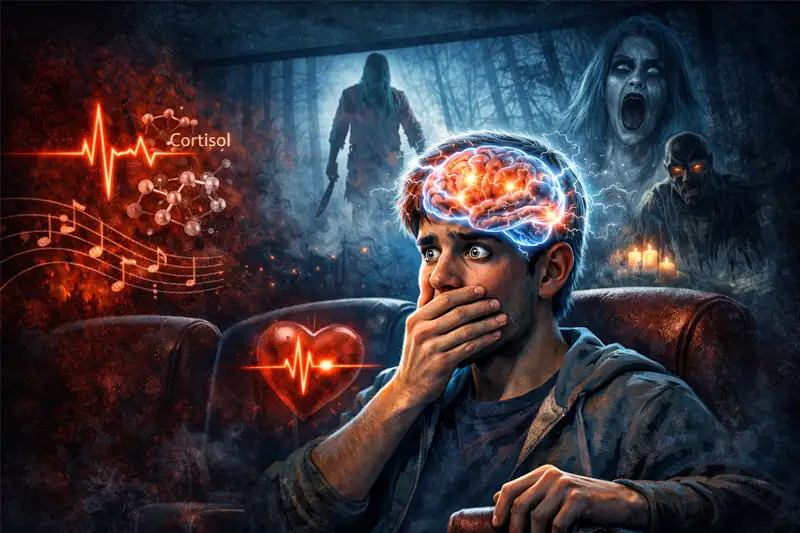
Watching a horror film is more than passive entertainment. What happens in your brain during scary movies touches deeper layers of perception, emotion, and even meaning-making.
Fear is not a neutral experience. It activates your body, colors your thoughts, and can carry over into your sleep with potentially disturbing dreams or nightmares. Yet people choose to watch them — precisely because of that intensity. Some seek thrills, others want to explore their boundaries. The question is: when does that work “positively,” and when does it disrupt your balance?
The 5 Key Takeaways
- Horror directly activates your physiological alarm system — which can carry over for days
- Some viewers experience pleasure from tension, while others feel overwhelmed
- Music and sound influence your unconscious mind often more strongly than images
- Spiritually sensitive people may experience supernatural themes as burdensome
- There are concrete strategies to calm your system after a frightening film
Psychology behind fear and pleasure in horror
When you watch a frightening scene, your brain interprets that threat as real — even though you rationally know it’s fiction. Your unconscious mind reacts to what you perceive, regardless of context. As a result, your heart rate rises, your focus narrows, and your body produces stress hormones. This reaction is evolutionarily useful: it ensures you can act quickly in the face of danger.
At the same time, that fight-or-flight response can also bring pleasure. Some people deliberately seek tension because they want to feel they’re experiencing something intensely — without actual risk. This mechanism is also called morbid curiosity: the urge to explore something frightening from a safe distance. For them, horror functions as a kind of resilience training.
What happens physiologically during startle reactions
During a jump scare or gruesome scene, your body springs into action immediately. Your heart rate rises, your breathing quickens, and your muscles tense up. Research shows that music and sound amplify this stress response — often more than the image itself. Dissonant tones and unexpected silences stimulate your nervous system in ways you don’t consciously register immediately.
After the film ends, that activation often lingers. Some viewers notice they lie awake at night, flooded with thoughts or restlessness. This is because your system needs time to regulate again. The influence of horror films on your stress hormone and heart rate can persist for hours or sometimes even days, depending on your sensitivity and how activated you already were before watching.
When horror helps — and when it doesn’t
For some people, horror actually works therapeutically. It can be a safe way to explore fear, to learn that you can tolerate tension without getting stuck in it. Exposure — deliberate exposure to fear stimuli in controlled form — can help increase your tolerance. You learn that discomfort isn’t necessarily dangerous.
However, this definitely doesn’t apply to everyone. The psychological effect of scary films on anxiety-sensitive people can actually be counterproductive when you’re already struggling with regulation. People with trauma, sleep problems, or heightened sensitivity may find that horror overloads their system. Then it’s no longer training, but a trigger. The boundary lies with you — and you’re allowed to respect it.
Pros and cons of watching horror films
Pros
- Can help with resilience training and learning to tolerate tension
- Offers some viewers dopamine reward through intensity and release
- Provides opportunity to explore fear in a safe context
- Can help integrate symbolic themes around death and existence
Cons
- Can raise stress response long-term, especially in sensitive viewers
- May disrupt sleep hygiene and rest after intense imagery
- Can cause anxiety disorders or nightmares in children
- Risk of energetic burden for people with trauma or overstimulation
Spiritual interpretations and personal boundaries
Some viewers experience horror not only psychologically but also energetically. Visual and auditory stimuli can trigger bodily reactions that deeply affect your emotional state. The spiritual meaning of supernatural themes in horror films is especially relevant for films featuring demons, possessed people, or occult elements. For people sensitive to subtle energies, that sometimes feels like more than fiction.
It’s not unfounded to acknowledge that certain images or symbols can affect you in ways that go beyond rational explanation. Maybe you notice feeling uncomfortable after a film without being able to pinpoint exactly why. That may be a signal that setting boundaries is more important than willpower. Not everything needs to be endured.
Practical viewing guidelines for sensitive viewers
If you notice horror overwhelms you, there are ways to keep your system calmer. Start with mindful viewing: deliberately choose films that aren’t too intense, watch during the day rather than at night, and take regular breaks. Music and sound often determine the intensity of your experience — consider lowering the volume during tense moments.
After a film, it’s wise to help your body down-regulate. Light movement, conscious breathing, or something neutral like tidying up can help signal your nervous system that the threat has passed. These tips for sleeping better right after watching horror films are really strategies for bringing your system back into balance. Avoid screens immediately afterward, choose calming environmental stimuli, and allow yourself time to recover without moving directly to the next stimulus.
Explanatory glossary
- Fight-or-flight: Physiological response where your body prepares to fight or flee in the face of threat
- Morbid curiosity: Fascination with frightening or dark subjects stemming from psychological curiosity
- Exposure: Therapeutic technique where you deliberately confront fear stimuli to build tolerance
- Dopamine reward: Pleasurable feeling that arises after enduring tension, caused by the neurotransmitter dopamine
Why people experience pleasure from fear and tension
It seems paradoxical: why would you voluntarily watch something that scares you? Part of the answer lies in how your brain processes rewards. When you experience tension and then notice you’re safe, your brain releases a dose of dopamine — a kind of relief and satisfaction combined. This cycle of fear and release can become addictive.
Additionally, curiosity plays a role. Horror shows you what normally remains hidden: violence, death, the unexplainable. That touches on existential questions you might otherwise avoid. For some, that’s confronting in a way that helps you meet deeper layers of yourself. For others, it feels overwhelming. The reason why people experience pleasure from fear and tension varies quite a bit by person and relates to how you process stress and how much control you feel while watching.
| Viewer type | Reaction to horror | Underlying mechanism |
| Sensation seeker | Enjoys intensity and adrenaline | High dopamine reward after tension |
| Sensitive processor | Feels overwhelmed and restless | Prolonged stress response, difficulty downregulating |
| Curious explorer | Uses horror for self-reflection | Exposure as a means to understand fear |
Impact on children and vulnerable groups
Children don’t yet have a fully developed ability to separate fiction from reality. The risks for children exposed to scary films are considerable: nightmares, heightened fear, and sometimes prolonged stress can result. Their brain registers fear the same way as in adults, except they lack the cognitive buffer that says: this is fake. Because of this, a scary scene can linger for weeks or months.
Adult survivors of trauma or people with anxiety disorders are also at risk. Horror can activate memories or worsen existing symptoms. That doesn’t mean you should never watch, but awareness of your own vulnerability helps you make responsible choices. Sometimes it’s wiser to choose milder tension or different forms of entertainment that don’t burden your system as much.
Conclusion
Horror affects you on multiple levels simultaneously: physically, emotionally, and sometimes even spiritually. The influence of horror films on your stress hormone and heart rate is measurable and can persist for days, depending on your sensitivity and context.
Whether horror strengthens or disrupts you depends on your system and your capacity to regulate. Some find it healing to explore fear in safe form, others notice it disrupts their balance. Both experiences are valid, but it’s about learning to recognize what you need and what you’re better off avoiding — and respecting that boundary, regardless of what others do or expect from you.
Verified Sources
- Healthline – Can Horror Movies Negatively Impact Your Mental Health? – Overview of impact in anxiety-sensitive individuals and possible triggers.
- Harvard Business Review – The Psychology Behind Why We Love (or Hate) Horror – Explanation of stimulation, arousal, and controlled fear.
- The Scientist – Why Do We Enjoy Horror Movies? – Emotion rehearsal and “safe practice” with fear.
- NPO Radio 1 – Waarom we naar horrorfilms kijken – Expert commentary on fear as a powerful emotion.
- VPRO Gids – Horrorfilms en omgaan met angst – Research on resilience among horror fans.
- Psychreg: How Horror Films Affect Our Consciousness – Discusses how horror films activate emotions and inner reactions, influencing consciousness.
- NLP Coaching: Do Movies Affect the Unconscious Mind? – Explanation of how films and media influence unconscious beliefs and emotions.
- Medium: The Role of Music in Horror Movies – On how music in horror films affects the unconscious through repetition and dissonance.
- Wikipedia: Frisson – Description of the phenomenon where music and film trigger bodily and emotional reactions.
- Psychology and Education Journal: Horror Cinema and the Audience – Academic analysis of horror films’ psychological impact on viewers.
- ResearchGate: More horror due to specific music placement? – Study on the psychophysiological effects of music in horror films.
Related Articles


Frequently Asked Questions
Are horror films bad for your health?
Generally, scary films produce a temporary stress reaction (faster heart rate, increased cortisol and adrenaline). For most healthy adults this is harmless, but those with heart or anxiety concerns may experience worsened symptoms and should watch selectively or with breaks.
Why do people enjoy horror films?
The genre offers a safe way to experience strong emotions. The tension is followed by relief and a reward feeling; additionally, curiosity about “dark” themes plays a role.
What happens in your body and brain during a horror film?
Your threat system activates: your fight-or-flight response engages, stress hormones rise, and brain regions for attention and emotion fire more actively. This explains sweaty palms, tense muscles, and the rush afterward.
Can horror films worsen anxiety, stress, or sleep problems?
Yes, especially in people with high anxiety sensitivity or existing complaints. Intense imagery and sound can fuel rumination or nightmares. Choose milder titles, watch earlier in the evening, and end with a calming routine.
Are horror films spiritually harmful or can they also be meaningful?
That depends on your beliefs and boundaries. Some experience themes as burdensome and avoid them; others see symbolism around good-evil or mortality and use it reflectively. Listen to your own values and limitations.