In hospitals, it’s often assumed that all beds are equal, but scientific research shows the opposite. Patients lying close to a window recover significantly faster than those farther from daylight.
This finding has everything to do with how natural light affects our bodies during the healing process. Research shows that sunlight not only improves mood but also actually accelerates physical recovery and reduces pain perception.
The 5 Key Takeaways
- Patients by the window leave the hospital an average of one day earlier than others.
- Daylight reduces painkiller use by as much as 22 percent.
- Natural light restores the disrupted biological clock during hospital stays.
- Sunlight stimulates serotonin production, which counteracts depressive feelings.
- A view of nature reduces stress and improves sleep quality.
Roger Ulrich’s Groundbreaking Discovery
In 1984, researcher Roger Ulrich made a remarkable discovery that caught the medical world’s attention. He compared two groups of patients who had undergone the same gallbladder surgery but were in different rooms.
Scientific Evidence Accumulates
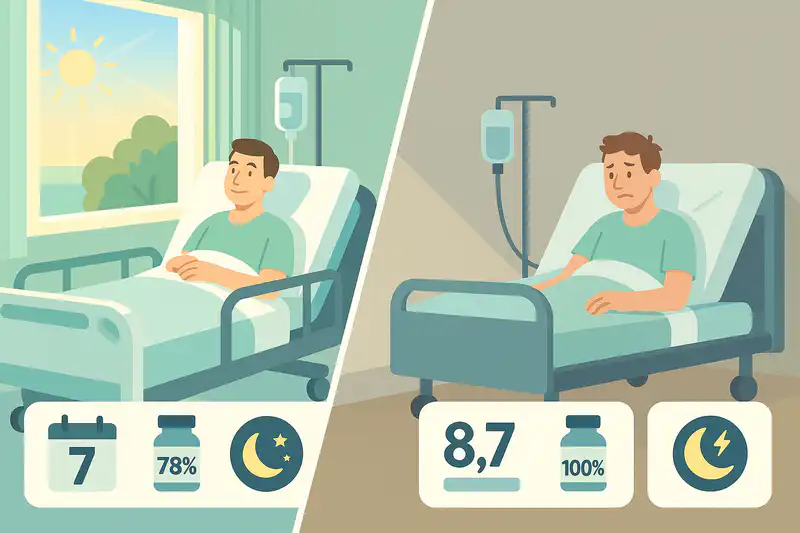
The effect of daylight on recovery is no coincidence but a scientifically proven phenomenon. Ulrich’s research showed that patients with a view of trees stayed in the hospital an average of 7.96 days, compared to 8.7 days for those looking out at a wall.
Later studies confirmed these findings repeatedly. Walch’s research on back surgeries showed that sunlight can drastically reduce medication use.
Restoring the Biological Clock
Benefits of Daylight in Hospitals
- Shorter hospital stays – an average of one day less
- Fewer painkillers needed – up to 22% reduction
- Better sleep quality through natural light-dark cycle
- Increased serotonin production for better mood
Drawbacks of Rooms Without Daylight
- Disrupted circadian rhythm
- Increased risk of delirium in elderly patients
- More stress and anxiety
- Slower cell regeneration
How Daylight Affects the Body
Natural light does much more than brighten a room. It has a direct impact on our circadian rhythm – the internal biological clock that regulates numerous body processes.
When this rhythm is disrupted by artificial light or darkness, it affects sleep quality, hormone balance, and even the speed at which cells recover. Patients in rooms without daylight therefore often experience more complications.
Sunshine Against Depression
Especially during prolonged hospital stays, the mental component plays a crucial role. Research by Beauchemin and Hays showed that patients with severe depression in sunny rooms could go home an average of 2.6 days earlier.
Sunlight stimulates the production of serotonin, a neurotransmitter that contributes to feelings of well-being. This explains why patients by the window often have better moods than those in dark rooms.
Glossary
- Circadian rhythm: The natural biological clock of the body
- Serotonin: Neurotransmitter that contributes to feelings of happiness
- Delirium: Acute confusion, often in elderly hospital patients
- Cell regeneration: The natural process by which cells repair themselves
Practical Implications for Hospitals
These scientific insights have led to concrete recommendations for hospital design. Küller’s research shows that natural light not only helps patients but also makes hospital staff more alert.
Modern hospitals therefore increasingly take daylight access and window orientation into account. Some facilities even prioritize window beds for vulnerable patients.
More Than Just a Nice View
The effect of daylight goes beyond psychological comfort. Ulrich’s groundbreaking study showed that patients with a view of nature also had fewer negative remarks in their medical records.
This suggests that the combination of natural light and a natural environment has a powerful influence on the healing process. It’s as if nature itself is a medicine that’s freely available.
Verified Sources
- Ulrich (1984) – Study shows that a view of nature accelerates recovery after surgery. Patients stayed shorter in the hospital and used less pain relief.
- HealthDesign PDF – Full version of Ulrich’s article on the effect of daylight on hospital stay and recovery.
- PubMed: Ulrich – Summary of the original research published in Science on the importance of views for patients.
- Walch et al. (2005) – Research on daylight after back surgery. Patients in bright rooms used fewer painkillers and experienced less stress.
- ResearchGate: Walch – Full study on the impact of sunlight on postoperative pain management.
- Beauchemin & Hays (1996) – Sunlight accelerates recovery in depressed patients. Stays in sunny rooms led to earlier discharge dates.
- ScienceDirect – Full text of the study on the effect of light in severe depression in hospitals.
- Küller et al. (2006) – Study shows relationship between light, color, and mood in care environments. Light affects time orientation.
- Taylor & Francis – Cross-cultural research on indoor lighting. Natural light improves well-being and cognitive functions.
Conclusion
The location of a hospital bed is therefore much more than a logistical matter. Natural daylight proves to be a powerful ally in recovery – free, simple, and biologically effective.
These insights are changing the way we look at hospital architecture. The distance to the window turns out to truly be the distance to faster recovery, a discovery that will continue to influence future hospitals.
Related Articles





Frequently Asked Questions
Why do patients near windows recover faster?
Natural daylight restores the circadian rhythm and stimulates the production of serotonin. This leads to better sleep, less stress, and an accelerated healing process.
How much painkiller do patients by the window save?
Research shows that patients in bright rooms use up to 22% less pain medication. The difference is greatest in back surgeries.
Does this effect apply to all types of patients?
Studies have been conducted on various patient groups, from gallbladder surgery to depressed patients. The effect is universal but strongest in prolonged stays.
Can artificial light and light therapy have the same effect?
Dynamic lighting systems can help, but natural daylight proves most effective. The combination of light and a view of nature enhances the healing process.
How can hospitals apply this?
Hospitals can prioritize window beds for vulnerable patients and create more daylight access in their design. Some facilities allow patients to spend time by windows or on balconies during the day.