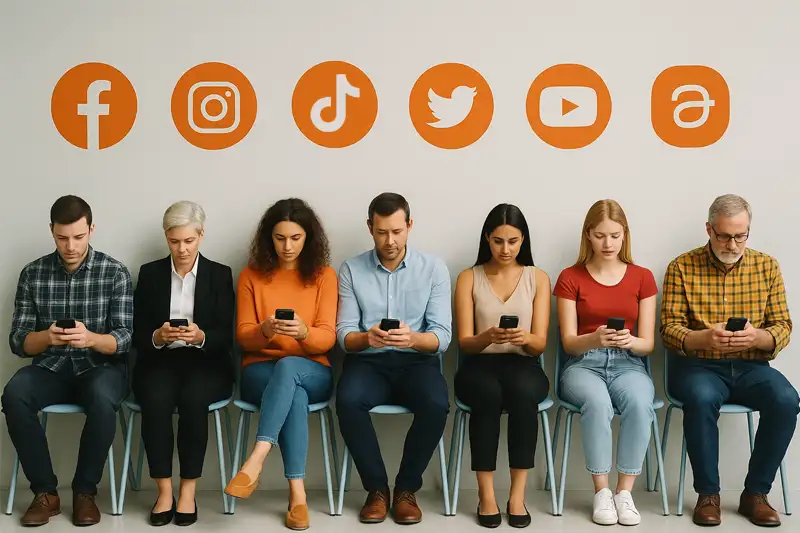
In a world that screams for attention, there lies a special power in people who choose to remain silent. Their restraint on social media is not a sign of absence, but rather of a deeply rooted inner certainty.
It’s fascinating to discover what the psychology behind this silence truly reveals about self-awareness, boundary-setting, and what an authentic life really means. Research shows that approximately 30 to 40% of online users observe without contributing themselves. Let’s not view that choice as passive, but as a deliberate strategy.
The 5 Key Takeaways
- Silence is a choice, not insecurity. The difference between the two is greater than most people think.
- Real confidence grows from within. It’s not dependent on likes on a screen, but on internal validation.
- Psychologists increasingly see privacy as emotional maturity. It’s a sign of self-respect.
- Rest and achievement are partners, not opposites. True progress requires deep focus, away from the noise.
- Keeping your life offline is an investment. You’re protecting something infinitely more valuable than fleeting attention.
Why silence is a foundation for strength
People who don’t post possess something many desire: self-validation without external applause. They have anchored their confidence in who they are, not in the reactions they receive. Psychologists call this intrinsic motivation and view it as an unmistakable sign of maturity.
This is absolutely not about arrogance or a lack of social interest. The core is that their self-worth simply isn’t tied to the whims of an algorithm. They have consciously abandoned the pursuit of the next dopamine hit that makes social media so addictive.
Privacy as a guardian of your inner peace
Privacy is often confused with secrecy, but that’s a misunderstanding. People who keep their lives private are actually protecting their mental and emotional peace. They instinctively understand that constant visibility comes with a price.
There’s a gap between what you can share and what you want to share. They bridge that gap with a conscious choice. They understand that what you keep offline is what nourishes and protects you, not what you’re hiding.
The trade-off: what you gain and what you let go
Let’s be honest: every choice has two sides. To give you a clear picture, I’ve outlined the Pros and Cons of a life with less social media below.
Pros
- Deep mental peace: You escape the constant pressure, the comparison cycle, and the hunt for validation.
- Authentic self-image: You build your self-worth from within, completely independent of external opinions.
- Unparalleled focus: Your time and energy go toward real growth, deep work, and meaningful projects, not online performance.
- Complete privacy control: You decide who has access to your life, thoughts, and energy.
Cons
- Less professional visibility: In some careers or as an entrepreneur, being online ‘invisible’ can cost you opportunities.
- Social misunderstandings: People around you may misinterpret your silence as disinterest or aloofness.
- Feeling out of the loop: You miss quick updates, trends, and low-barrier social interactions happening online.
- Harder to build an audience: Without social media, it’s more challenging to find an audience for your creative work or ideas.
Where the real work happens
Many wrongly view online absence as passivity. Yet for private people, the most important work happens offline. There they build their business, create art, or deepen their knowledge. Without the distraction of constant commentary.
While one group is busy documenting the work, the other is actually doing the work. Silence is the breeding ground for focus, and focus is where mastery flourishes.
Introversion is not fear, it’s observational power
Research on personality traits shows that confident people simply need less external approval. They feel no urge to showcase every step of their life. This is not a shortcoming; it’s actually a form of independence.
They are often analytical by nature; they prefer to observe rather than speak. For them, social media is a kind of study material, a window into human nature, not a stage to perform on. This trait, known as cognitive openness, is directly linked to independent and critical thinking.
Halting the comparison epidemic
Passive scrolling can be a mental minefield. By not posting themselves, people build a natural defense against one of the most toxic aspects of our time: constant comparison with the carefully staged lives of others.
They see through the illusion. They know that behind every perfect vacation photo and every ‘couple goals’ post lies a far more complex reality. This is called emotional realism: the ability to distinguish between a performance and authentic reality.
Glossary
- Lurker (observational behavior): Someone who consciously gathers information and impressions online but chooses not to actively participate in conversation.
- Intrinsic motivation: The drive that comes from within; your self-worth is based on your own standards, not on external applause.
- Social media fatigue: A feeling of exhaustion from the pressure to be constantly online and perfect, chasing validation.
- Clear self-concept: A strong and stable sense of your own identity, values, and goals, independent of others’ opinions.
- Emotional realism: The ability to see the online world for what it is – a selective representation – and separate it from the much richer offline reality.
What science says about online inactivity
Recent research breaks with the old idea of mere screen time. For mental health, particularly among young people, it’s much more about how you use social media. This is a crucial distinction.
Passive consumption with clear boundaries can be fine. Constant posting in search of validation, on the other hand, is mentally draining. The ability to guard that boundary works as a powerful shield against social anxiety and exhaustion.
The misconception about follower counts
Those who aren’t active on social media may not have a large online following. But don’t be mistaken: real impact often happens outside the sight of the masses. Silence and influence are not opposites.
Herein lies enormous liberation. You’re not at the mercy of an algorithm’s whims. You’re not trapped in the unspoken expectation that you must constantly be ‘on.’ Your life is yours; it doesn’t belong on a screen.
To make this concrete, I’ve outlined the key characteristics and their effect on your well-being below.
| Character trait | Description | Effect on well-being |
|---|---|---|
| Selectivity in sharing | They only share what’s truly meaningful to them, not what happens to be trending. | Less stress, more mental space and focus. |
| Privacy awareness | They actively shield their personal life as a form of self-care. | A greater sense of control and autonomy. |
| Observational mindset | They learn by watching and analyzing, not by participating in the noise. | Deeper understanding and less superficial distraction. |
| Internal validation | Their sense of self-worth is anchored in themselves, not in external opinions. | Tremendous resilience against criticism and negativity. |
How to recognize that privacy is your strength
Perhaps you’ve never made a conscious choice to stop posting, but you simply notice that you feel better when you don’t. That feeling is data. It points to a deeper understanding that visibility and worth are two completely different things.
The signals are often subtle. You feel more like yourself when no one is watching. You prefer one deep conversation to a hundred shallow likes. You feel no need to constantly explain your achievements to others. That’s not weakness; that’s your anchor.
The true meaning of absence
You don’t have to be loud to be heard. You don’t have to grow publicly to actually grow. And you certainly don’t need to be seen to be meaningful.
Silence is also an action. Absence is also a form of presence. Sometimes the most powerful thing you can do is step off the stage to work backstage on becoming who you want to be. Not for an audience. Only for yourself.
Conclusion
Not posting is not a symptom of deficiency; it’s a deliberate action that speaks to character and a deep understanding of your own boundaries. Keeping your life to yourself is not a retreat. It’s one of the most powerful investments you can make.
In a world obsessed with exposure, the people who cultivate their inner world are the ones who are truly unshakable. They’ve found what the rest are still searching for: sustainable peace, authentic growth, and the ability to be content with yourself without someone needing to click ‘like.’ That’s not just psychologically healthy – it’s a superpower.
Verified Sources
- Good Feeling: Self-validation without external applause – On the importance of inner certainty.
- Frontiers in Psychology: Privacy and mental peace – Research on psychological benefits of privacy.
- GeEditing: What staying silent online reveals about you – Psychological behavioral traits of silent users.
- Artful Parent: Traits of people who don’t post – Characteristics of introverted online users.
- VegOut Mag: The psychology of lurkers – Insight into cognitive and emotional tendencies.
- VegOut Mag: 8 traits of observational users – Behavioral analysis of passive social media users.
- ScienceDaily: Impact of social media use on mental health – New research on usage patterns and well-being.
- PMC: Conscious consumption as mental protection – Study on psychological resilience with passive use.
- Medium: Why some people never post anything – Reflection on introversion and authenticity.
- Women Daily Magazine: The power of absence – Analysis of silence as a sign of strength.
Related Articles

Frequently Asked Questions
Is it antisocial to not post anything on social media?
Absolutely not. It’s a different form of socializing. People who post less often invest their social energy in deeper, offline connections. They prefer quality of interaction over quantity of visibility. So it’s not a rejection of contact, but a deliberate choice for a different kind of contact.
Does not posting mean you’re insecure?
Surprisingly, research often suggests the opposite. It actually takes considerable confidence to resist social pressure and not make your self-worth dependent on online approval. In this case, silence is more a sign of inner certainty than of fear.
Can ‘lurking’ (just watching) also be harmful?
Certainly, the pitfall is passive consumption without awareness. If you endlessly scroll and constantly compare yourself to the perfect pictures of others, that can undermine your self-image. The key is intention: are you observing out of curiosity with healthy distance, or are you becoming entangled in the illusion? Conscious boundaries are essential here.
How do I know if posting less is good for me?
Listen to your feelings. Do you feel relieved when you close the app? Do you experience more peace and focus if you don’t post for a few days? Do you feel more authentic in your offline life? Those feelings are your compass. If silence feels like a breath of fresh air, it’s probably the right path for you.
Continue reading
- Breaking Through Limiting Beliefs: A Practical Guide with Effective Steps 🚀
- The Pygmalion Effect in the Classroom: How to Turn High Expectations into Better Performance
- Can Horror Films And Gangsta Rap Psychologically And Spiritually Harm Your Conscious And Unconscious Mind?
- 97.5% Of Women In STEM Experience Impostor Syndrome Despite Success