
If you’re over sixty and drinking bone broth every morning because you read somewhere that it protects your muscles, it might be time to stop. Recent research shows that certain foods are far more effective against age-related muscle loss.
These seven everyday supermarket foods, used correctly, can significantly slow sarcopenia. They work not through expensive supplements or exotic ingredients, but through smart food choices that actually nourish your muscles. Some of these choices sound surprisingly simple—until you discover exactly why they work so well.
The 5 Key Takeaways
- One food proves more effective than protein powder costing ten times the price, but you must eat it at the right time
- The combination of fats and amino acids in certain foods works better than isolated protein sources
- Fermentation makes proteins significantly easier to absorb for aging digestive systems
- Anti-inflammatory fatty acids double the muscle-building effect of protein intake
- Timing and portion distribution prove just as important as the food type itself
What Is Sarcopenia and Why It Increases After 60
Starting at sixty, your body loses an average of one to two percent of muscle mass per year. This process, called sarcopenia, occurs partly because your digestive system produces less stomach acid, making nutrient absorption less efficient. Sarcopenia is a gradual process where strength, balance, and overall function decline.
At the same time, your muscle cells become less responsive to growth signals. Even if you consume enough protein, your muscles no longer use it as efficiently. That’s why simply eating more protein often doesn’t work—you need nutrition that teaches your muscles to respond again.
Why Protein Distribution Per Meal Is Critical
Research emphasizes that older adults need at least 1.2 grams (0.04 oz) of protein per kilogram (2.2 lbs) of body weight daily. More importantly, distribution matters: your muscles only respond to protein intake when you consume approximately three grams (0.1 oz) of leucine per meal—the amino acid that acts as a switch for muscle growth.
One large protein meal in the evening barely helps. Better is three meals daily, each with sufficient leucine, so your muscles stay continuously stimulated. This timing likely makes the difference between maintaining muscle or gradually losing it.
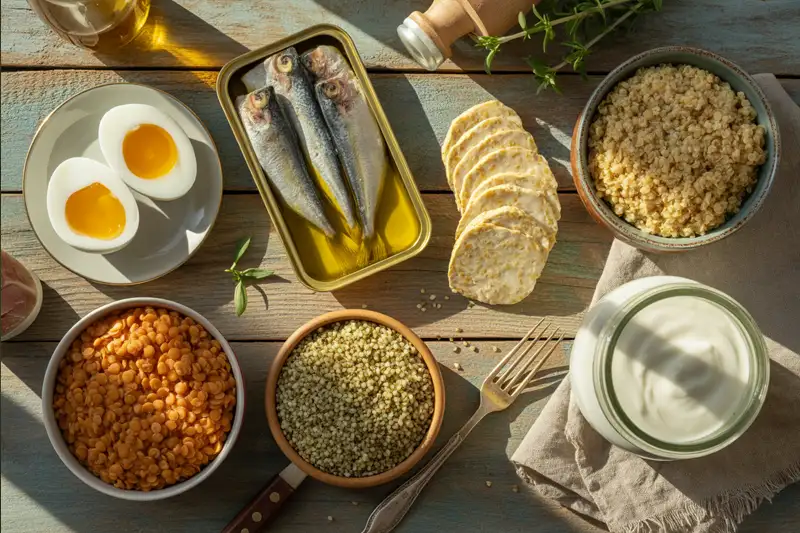
The 7 Foods for Muscle Maintenance at 60+
1. Eggs: The Biological Standard for Muscle Building
Verified Sources
The yolk especially contains choline, essential for communication between your nervous system and muscle cells. Without enough choline, nerve signals become disrupted and you lose strength, even if you train. Two eggs at breakfast ensure your muscle cells respond better to protein intake from later meals throughout the day—a kind of metabolic reset.
2. Hemp Seeds: The Most Complete Plant-Based Protein Source
Hemp seeds contain edestin, a protein nearly identical to human blood plasma. Your body recognizes it immediately and converts it to muscle tissue with minimal loss. Additionally, the omega ratio sits at the perfect anti-inflammatory optimum: three parts omega-3 to one part omega-6, a balance completely absent in most Western diets.
Three tablespoons (45 ml) of hemp seeds daily, uncooked over yogurt or salad, delivers all twenty amino acids plus arginine. This substance improves blood flow to muscles, allowing nutrients to arrive faster and waste to be removed more quickly. The combination makes hemp seeds probably the most powerful plant-based muscle protector.
3. Quinoa: The Only Grain With Complete Amino Acids
Quinoa is the only plant-based grain with all nine essential amino acids in the correct ratio. It also contains ecdysteroids, natural compounds that stimulate protein synthesis in muscle cells. Studies in older adults even showed muscle mass growth without extra exercise—simply by adding quinoa.
Rinse quinoa thoroughly before cooking to remove saponins, compounds that interfere with protein absorption. Preferably cook it in broth instead of water for extra amino acids, and add one tablespoon (15 ml) of apple cider vinegar to the cooking liquid. This increases mineral absorption by approximately thirty percent.
4. Greek Yogurt: Fast and Slow Proteins Combined
Greek yogurt contains both whey protein and casein, a combination that feeds your muscles immediately and for hours afterward. Whey triggers rapid muscle growth, while casein forms a gel in your stomach that slowly releases amino acids. This dual action keeps your muscles in building mode longer than chicken or fish.
The probiotics in yogurt produce substances that directly influence muscle cells. Choose varieties with live cultures and no added sugars. A serving before bed prevents muscle breakdown during the night, as casein continues delivering amino acids for hours.
5. Lentils: Slow-Release Fuel With Anti-Inflammatory Action
Red lentils release their protein gradually over several hours, keeping your muscles in a stable building phase. The resistant starch reaches your colon undigested, where gut bacteria convert it to butyrate. This reduces inflammation in muscle tissue and improves muscle cell sensitivity to insulin—crucial for nutrient uptake.
Soak lentils for twelve hours before cooking to reduce anti-nutrients. Add kombu seaweed during cooking for extra minerals. Red lentils are easiest to digest for aging digestive systems and contain eighteen grams (0.6 oz) of protein per serving plus sixteen grams (0.5 oz) of fiber that dampens blood sugar spikes.
6. Tempeh: Fermented Protein for Better Digestion
Fermentation makes the protein in tempeh extremely bioavailable, essential when stomach acid production drops by as much as forty percent after sixty. The beneficial bacteria in tempeh also improve your gut flora, allowing you to extract amino acids from food up to forty-two percent more efficiently. This effect persists for days after consumption.
Steam tempeh for ten minutes before frying to further increase digestibility. Then fry it in coconut oil until golden brown and season with turmeric and black pepper. This combination increases protein absorption by approximately twenty percent. Per 100 grams (3.5 oz) of tempeh, you get twenty grams (0.7 oz) of complete protein plus isoflavones that support hormonal balance.
7. Sardines: Vitamin D and Omega-3 for Muscle Sensitivity
One can of sardines contains 350 international units of vitamin D3, crucial because this vitamin determines how efficiently your muscles convert protein. Without adequate vitamin D, you could eat all the protein in the world without your muscles using it well. Studies show older adults with optimal vitamin D levels build muscle protein sixty-five percent more effectively.
The omega-3 fatty acids EPA and DHA penetrate muscle cell membranes, making them more responsive to growth signals. Additionally, sardines provide coenzyme Q10 for better energy production in mitochondria. Eat them including the soft bones for calcium and phosphorus, twice weekly from cans, preferably wild-caught from the Pacific Ocean.
Pros and Cons of High-Protein Eating After 60
Pros
- Direct improvement in muscle tissue and strength within weeks
- Better balance and mobility through muscle mass preservation
- Reduced inflammation through omega-3 and fermentation
- Cheaper and more accessible than most supplements
Cons
- Requires discipline and planning for proper timing and portions
- Some tastes like sardines or tempeh require adjustment
- High protein intake can be problematic with kidney issues
- Exercise remains necessary for optimal results
Practical Daily Schedules: Portions, Timing, and Combinations
Start your day with two whole eggs, preferably soft-boiled or poached. Combine them with bell pepper or tomato for vitamin C that increases iron absorption from the yolk. At ten a.m., have Greek yogurt with three tablespoons (45 ml) of hemp seeds and frozen berries—that gives you your second leucine peak and antioxidants against training damage.
Lunch with a bowl of quinoa as the base, supplemented with tempeh and vegetables. In the evening, make lentil soup or eat sardines on whole grain toast with avocado. Those avocado fats help vitamin D absorption. Before bed, another serving of yogurt to prevent nighttime muscle breakdown—casein continues feeding your muscles for hours.
| Time | Food | Leucine (grams) |
|---|---|---|
| 7:00 a.m. | 2 eggs + bell pepper | 2.8 |
| 10:00 a.m. | Greek yogurt + hemp seeds | 3.2 |
| 1:00 p.m. | Quinoa + tempeh | 3.5 |
| 6:00 p.m. | Lentil soup + sardines | 3.1 |
| 9:00 p.m. | Greek yogurt | 2.5 |
Common Mistakes: Bone Broth, Supplements, and Misinformation
Isolated protein powders without fats or fiber are absorbed quickly but provide no lasting nutrition. Many supplements also contain synthetic forms your body recognizes less well. Whole foods deliver protein plus co-factors like probiotics, fatty acids, and vitamins that strengthen each other—something powder simply cannot match.
Glossary
- Sarcopenia: Gradual loss of muscle mass and strength after sixty, averaging one to two percent annually.
- Leucine: Essential amino acid that acts as a switch for muscle growth; you need approximately three grams (0.1 oz) per meal.
- Edestin: Plant protein from hemp seeds nearly identical to human blood plasma and extremely bioavailable.
- Casein: Slow-digesting milk protein that continues releasing amino acids to your muscles for hours.
Why Timing Matters as Much as Food Choice
Your muscles respond especially well to protein within thirty minutes after exercise and in the morning after the overnight fasting period. Research describes how timing and movement together make the difference in muscle preservation. Protein intake outside these windows works less effectively, because your muscle cells are then less responsive to growth signals.
Conclusion
These seven foods offer a complete system to combat sarcopenia and rebuild muscle after sixty. Eggs deliver perfect amino acid balance, hemp seeds provide complete plant proteins, quinoa offers natural growth compounds, yogurt supplies sustained nutrition, lentils provide stable fuel, tempeh offers fermented bioavailability, and sardines deliver vitamin D with anti-inflammatory action.
Start with one new food per week until all seven appear regularly in your menu. Focus especially on eggs and hemp seeds as your daily foundation, and rotate the others throughout the week. Muscle loss is not inevitable with aging—it occurs because nutrition falls short, and that’s exactly what you can change.
- https://www.voedingscentrum.nl/nl/thema/eten-na-je-70ste/hier-let-je-op-na-je-70ste.aspx – Guidelines for nutrition in older adults, practical protein and portion advice.
- https://www.henw.org/artikelen/beweging-en-voeding-op-recept-bij-sarcopenie – Research on protein requirements (≥1.2 g/kg/day) combined with training for sarcopenia.
- https://www.uzleuven.be/nl/sarcopenie – Hospital resource with definition, risk factors, and context for sarcopenia.
- https://defysiotherapeut.com/aandoeningen-en-klachten/sarcopenie/ – Overview of symptoms, progression, and considerations for sarcopenia.
- https://www.fit.nl/spiermassa/leeftijd-herstel-spiermassa – Explanation of muscle building and recovery at later ages with practical tips.