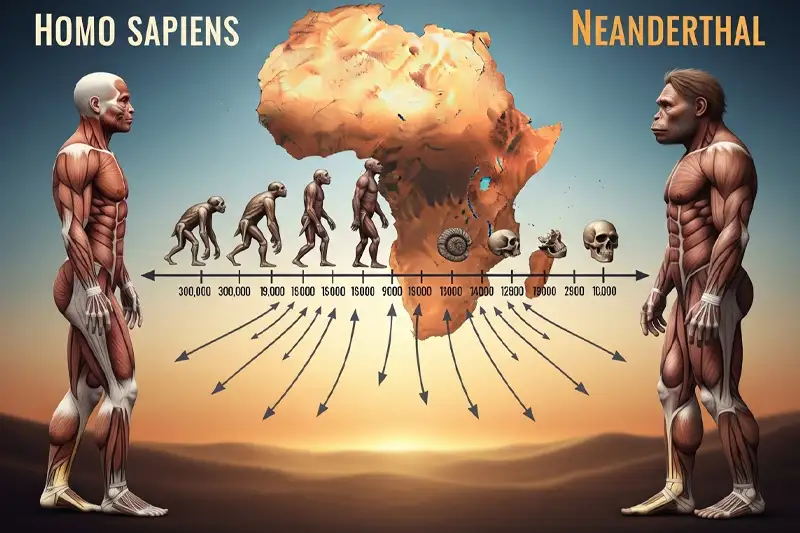
The question of when anatomically modern humans first appeared continues to spark heated debate. Scientists agree that Homo sapiens emerged roughly 200,000 years ago, but the story is more nuanced than commonly assumed.
New DNA studies and fossil discoveries paint a picture that diverges from classical evolutionary theory. The oldest remains, such as those from Jebel Irhoud and Omo Kibish, suggest that our species did not gradually develop from earlier hominins. In fact, we appeared quite suddenly, fully formed, with characteristics that have barely changed since.
The 5 Key Takeaways
- DNA research shows that modern humans are genetically nearly identical to fossils from 28,000 years ago
- Neanderthals were not direct ancestors, despite decades of teaching the opposite
- The oldest Homo sapiens finds date to approximately 300,000 years ago, not 200,000
- Evolutionary ‘missing links’ remain unfound after 150 years of searching
- Scientists now speak of an ‘evolutionary bush’ rather than a straight family tree
Anatomically Modern Humans: Definition and Context
What makes someone an anatomically modern human? It involves a combination of skull shape, facial structure, and body build that matches our current anatomy. Cro-Magnon, a term once common, is now replaced by the acronym AMH: Anatomically Modern Human.
That name change is telling. It implies that fossils tens of thousands of years old are virtually identical to our skeletal structure today. Even brain size appears comparable, though some early specimens may have had slightly larger volume due to different skull construction.
Oldest Finds: Jebel Irhoud and Omo Kibish
The Jebel Irhoud site in Morocco has yielded fossils approximately 300,000 years old. Researchers at the Max Planck Institute consider these remains very early representatives of Homo sapiens. In Ethiopia, Omo Kibish yielded skull fragments equally ancient; a 2022 Nature study dates Omo I to at least 233,000 years ago.
These discoveries push the origin of modern humans ever further back in time. Simultaneously, they show that our species likely developed in Africa, long before colonizing other continents.
Pros and Cons of: DNA Testing on Ancient Fossils
Pros
- Provides direct genetic information about species relationships
- Can debunk or confirm myths about human ancestry
- Enables scientists to reconstruct migration patterns more accurately
- Helps understand adaptations to climate and environment
Cons
- DNA degrades rapidly, making older fossils often unusable
- Contamination with modern DNA can skew results
- Interpretation requires large datasets; single samples provide limited insight
- Technology is expensive and not available everywhere for smaller research teams
Characteristics of Homo sapiens: Skull, Chin, and Dentition
A striking feature of Homo sapiens is the rounded skull with a high forehead. Additionally, we have a prominent chin, something absent in earlier human species. The Smithsonian Institution also emphasizes our relatively small jaws and teeth compared to more robust hominins.
These characteristics appear in the very oldest fossils and remain consistent through time. This suggests stable anatomy with minimal changes, even over hundreds of thousands of years.
Homo sapiens vs. Neanderthal: The Differences
For years, we were taught that the Neanderthal was a direct ancestor. However, DNA analysis from 2000, published in Nature, showed that modern humans did not descend from Neanderthals. We did live on Earth simultaneously, but genetic overlap is limited to just a few percent.
Chromosome maps show barely any similarities between Neanderthal and modern human DNA. That small overlap is comparable to what we see in other mammals, such as cattle or fruit flies, and thus does not indicate direct descent.
Glossary
- Anatomically Modern Human (AMH): Homo sapiens with skull shape and body build identical to present-day humans
- Jebel Irhoud: Archaeological site in Morocco with fossils approximately 300,000 years old
- Omo Kibish: Site in Ethiopia with very ancient Homo sapiens remains
- Neanderthal: Extinct human species that lived alongside modern humans until approximately 40,000 years ago
Migration Out of Africa: Early Ventures and Lasting Dispersal
The ‘Out of Africa’ theory posits that Homo sapiens migrated from Africa to other continents. The Natural History Museum describes how that migration occurred in waves, possibly as early as 200,000 years ago. Some groups returned; others settled permanently in Asia and Europe.
Genetic traces suggest that modern non-African populations share a common origin in a relatively small group that left Africa. That bottleneck explains why genetic diversity outside Africa is lower than within the continent.
| Site | Age (years ago) | Key Feature |
| Jebel Irhoud | ~300,000 | Earliest Homo sapiens characteristics |
| Omo Kibish | ~233,000 | Modern skull shape |
| Qafzeh (Israel) | ~90,000 | Early migration out of Africa |
| Cro-Magnon (France) | ~28,000 | Fully modern anatomy |
Evolutionary Bush Rather Than Family Tree
Traditional depictions showed a straight line from primitive hominins to modern humans. Scientists today prefer to speak of an ‘evolutionary bush.’ The Rijksmuseum van Oudheden explains that different human species lived simultaneously and sometimes interbred, but direct descent is often absent.
Those dotted lines in evolutionary diagrams? They represent speculative connections, not proven relationships. After 150 years of intensive research, the fossil ‘intermediate forms’ that Darwin predicted remain missing.

Conclusion
The notion that anatomically modern humans gradually evolved from earlier hominins is weakening under the weight of new evidence. DNA research and fossil data point to a rapid emergence, fully formed and stable.
Related Articles


Frequently Asked Questions
Verified Sources
- https://www.nature.com/articles/s41586-021-04275-8 – Nature study (2022) dating Omo I to at least 233 ± 22 thousand years ago.
- https://www.eva.mpg.de/press/news/2017/2017-06-07-the-first-of-our-kind/ – Max Planck press release on Jebel Irhoud (~300 ka) as very early H. sapiens.
- https://www.nhm.ac.uk/discover/modern-humans-homo-sapiens-when-where-how-did-we-evolve.html – NHM overview with H. sapiens characteristics and dispersal.
- https://humanorigins.si.edu/evidence/human-fossils/species/homo-sapiens – Smithsonian profile of H. sapiens with anatomical features.
- https://www.rmo.nl/museumkennis/archeologie-van-nederland/nederland-in-de-prehistorie/onze-voorouders/ – RMO context: emergence of H. sapiens and relationship to other human species.
What are anatomically modern humans?
The term refers to Homo sapiens with a combination of features we also see in present-day humans, such as a more rounded skull, smaller face, and distinct chin; it distinguishes us from archaic humans who lived at the same time.
When did Homo sapiens originate?
The fossil record places Homo sapiens’ origin in Africa during the (late) Middle Pleistocene; finds like Jebel Irhoud (~300,000 years ago) and Omo I (at least ~233,000 years ago) show an early and possibly widespread origin.
What is the difference between Homo sapiens and the Neanderthal?
Sapiens typically has a higher, more globular skull, a smaller, flatter face, and a true chin; Neanderthals were more robustly built with elongated skulls and no pronounced chin, though overlapping variation existed.
Where have the oldest Homo sapiens fossils been found?
Important early finds come from Jebel Irhoud (Morocco, ~300 ka) and Ethiopia: Omo Kibish (Omo I, ≥~233 ka) and Herto (~160 ka), which together strengthen the early Africa-wide picture.
When did modern humans leave Africa?
There were early ventures ≥180 ka, but lasting worldwide dispersal occurred in waves around 60,000–50,000 years ago, with further expansion into Europe (~45–40 ka) and later the rest of the world.