Decades ago, Carl Jung described an undercurrent in the human psyche that can deeply affect highly sensitive people. People with strong empathic tendencies seem to unintentionally attract certain personality types that feel nourished by their energy.
This exchange rarely happens consciously, but can lead to a creeping process of emotional exhaustion. Jung saw this not as coincidence, but as an archetypal pattern that repeats itself over and over — unless you learn to recognize and break it. The question then becomes: how do you stay true to your sensitivity without losing yourself?
The 5 Key Takeaways
- Empaths unconsciously attract narcissistic personalities through a dangerous psychological law.
- Your body always sends signals when someone is draining your energy, but these are often ignored.
- The belief that you can ‘save’ others by sacrificing yourself is actually a form of spiritual martyrdom.
- Jung discovered that high sensitivity often develops as a survival mechanism in childhood.
- There is a powerful way to protect your gift without becoming cold or insensitive.
The Dangerous Attraction Between Light and Shadow
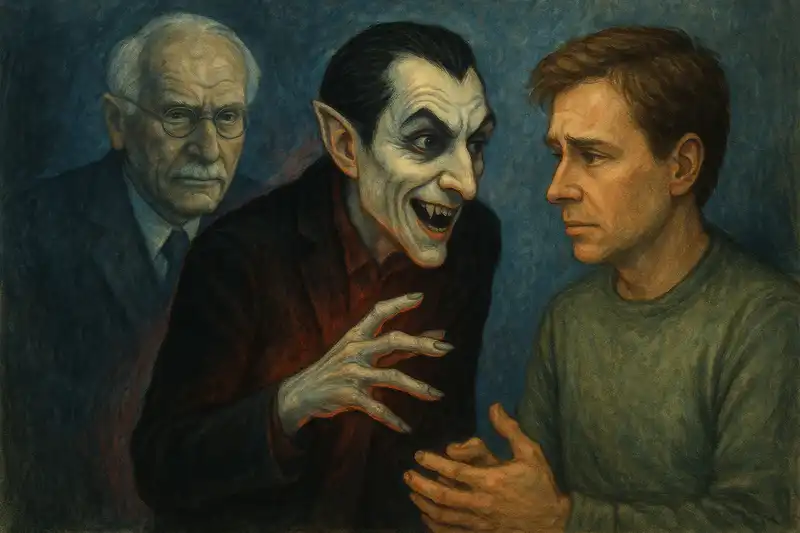
Jung described a striking psychological law: opposites in the human psyche often exert an irresistible attraction on each other. In that context, empaths can become a kind of magnet for people who have lost their own inner connection.
It’s not that the other person consciously drains you — but your openness and sensitivity touch exactly what that person is missing. Authenticity, emotional depth, and vulnerability are unconsciously sought and absorbed. This creates an exhausting dynamic between attraction and dependency.
Also read: Guide for the Healer: Prevent Getting Sick
Why Highly Sensitive People Are So Vulnerable
For many empaths, their sensitivity was not a conscious choice, but a necessary adaptation to an unsafe environment. As children, they learned to sense moods with lightning speed — not out of curiosity, but out of necessity to emotionally survive.
Their body became, in a sense, a finely tuned instrument that was constantly attuned to the signals of others. This hyperalertness became their second nature, an inner alarm system that never really turns off.
What was once a protective mechanism becomes later an invisible burden. In adult life, these people remain unconsciously focused on calming others’ emotions, often at the expense of their own well-being.
They repeat the old dynamic in which love equals sacrifice, and where harmony is bought with self-denial. This makes them vulnerable to relationships where giving structurally becomes more important than receiving.
The Unconscious Dance Between Empath and Narcissist
Benefits of Empathic Sensitivity
- Deep intuitive insight into others
- Natural healing qualities
- Strong connection with emotions and energy
- Ability for deep, authentic relationships
Drawbacks of Unprotected Empathy
- Chronic exhaustion from energy loss
- Attracting narcissistic personalities
- Loss of personal identity and boundaries
- Tendency toward self-sacrifice and martyrdom
The Danger of the Savior Complex
Many empaths deeply believe they can heal others by channeling their own life energy for the other person’s well-being. Jung recognized in this the archetypal figure of the wounded healer: someone who tries to heal what actually mirrors their own pain.
The urge to help rarely comes from strength — but from lack. Often it’s about unprocessed childhood grief that has become a silent driver to be meaningful, at any cost.
The other person, often someone with narcissistic traits, initially feels relieved by this care, but will over time unconsciously resist what the empath mirrors: a painful lack of inner fulfillment. And so a pattern emerges where giving doesn’t strengthen a bond, but slowly drains it.
The only way out is the realization that you are not responsible for someone else’s inner emptiness — and that your life force is not a bottomless source. Only by recognizing that does space open up for real change.
Signs Your Energy Is Being Drained
Jung emphasized that the body never lies — and with energy loss, that’s no different. If you consistently feel exhausted after contact with certain people, that’s often an inner warning that something is wrong. The body speaks the language of the soul when words fall short.
Signs like persistent fatigue, headaches after social encounters, or the feeling that your battery is empty despite rest are not signs of weakness. They are alarm signals that you are becoming energetically depleted through an unhealthy interaction.
Yet many empaths try to ignore or explain away these signals. They tell themselves they’re exaggerating, that they need to be stronger, or that it’s their own fault. But by denying these inner signals, they stay trapped in the very pattern that exhausts them.
Guilt about setting boundaries makes it even more complicated. The idea that you’re letting others down by protecting yourself keeps the self-sacrificing behavior going — often until your physical body presents the bill.
Glossary
- Archetype: Universal psychological pattern in the collective unconscious
- Empath: A person with extraordinary sensitivity to others’ emotions
- Energy Vampire: Someone who unconsciously drains the life force of others
- Individuation: Jung’s term for becoming your authentic self
The Path to Emotional Sovereignty
The solution is not to dim your light — but to learn to guard its source. Jung pointed out that the ability to make distinctions is essential for psychological well-being. You don’t need to harden yourself, but you can learn to protect your energy with intention.
That means learning to feel what is yours and what you’re taking on from the other person. It means developing trust in that inner compass that tells you when something is off, even if the other person means well.
An important turning point comes when empaths dare to face their own hidden motivations. The need to be indispensable. The fear of being abandoned. The quiet hope that love must be earned by erasing yourself.
That confrontation is not easy, but it does set you free. Because only when you acknowledge that you yourself get something out of the drama can you truly let go. And then empathy changes from a burden into a force that gives you direction, instead of draining you.
Setting Boundaries Without Closing Your Heart
In his work, Jung saw how essential structure is within relationships — even when that structure requires painful boundaries. True love asks for clarity, not sacrifice. It’s not about how much you endure, but whether you stay true to your inner truth — including your needs and boundaries.
That takes courage. The courage to respectfully say no when something touches your integrity. To stop people-pleasing or adapting at the expense of yourself. You don’t need to reject anyone to take yourself seriously.
Once your self-worth is no longer dependent on how useful or available you are, the world gradually stops pulling at you. You naturally command respect through how you manage your energy — not because you demand it, but because you model it.
That learning process happens step by step. It takes time and self-examination to feel where your boundary lies and what nourishes you instead of draining you. But as you learn this, the difference between love and vampirism becomes increasingly clear.
Conclusion
Jung’s insights remain surprisingly relevant today. Highly sensitive people risk having their gift undermined by unconscious patterns of exhaustion and adaptation. But once these dynamics are recognized, space opens up for healing and change.
The key lies in recognizing old survival strategies and setting boundaries that protect your soul. Your sensitivity is not a weakness, but a compass — provided you learn to guard it with clarity and self-respect. This way, empathy becomes a source of strength, not a burden you must carry.
Related Articles



Frequently Asked Questions
How do you recognize an energy drainer?
If you consistently feel empty and tired after contact with someone, that can be a sign. Such people often share heavy, emotionally charged stories and seem to never get enough attention or support — no matter how involved you are.
Is it selfish to set boundaries as a sensitive person?
Quite the opposite. Boundaries allow you to continue using your empathic qualities in a healthy way. Self-care is not selfishness — it’s a form of adult responsibility.
Can you change a narcissist through love and attention?
Real change comes from within. Someone dealing with narcissistic traits only changes when there is willingness for self-reflection. Love from outside can inspire, but it doesn’t save anyone against their will.
Why do I keep attracting people who drain me?
Often the unconscious repeats patterns from your childhood. By recognizing and seeing through these dynamics, you can make different choices — and attract relationships that nourish instead of exhaust you.
How do I learn to distinguish between my feelings and those of others?
Pay attention to what your body tells you. What brings rest and space, and what drains you? Discernment grows through attention, repetition, and taking subtle signals seriously.
Continue reading
- Clashing Egos: How a Narcissist and a Sigma Male Exhaust Each Other
- Why Do I Feel So Empty After Therapy? Jung Answered This Question Long Ago
- Break Free from the Stubborn Beliefs That Have Kept You Small
- Why Your Motivation Can Completely Disappear After a Spiritual Awakening – Carl Jung Explains It