Somewhere during your personal development — maybe after an intense moment of insight, or right after an inner break — something happened. Your vision became clear. You saw the game, the constructions, the scenery, and then: silence.
At first, that silence had something majestic about it, almost like coming home. But over time, the meaning disappeared. Not shocking, not abrupt. More like a slowly fading melody, as if your soul turned down the volume of life and forgot to tune it back up.
You let go of the chase. Not out of indifference, but in that quiet, softening way that some insights bring emptiness rather than direction. And then comes that lingering question: how can I feel so flat now, when I see clearly? It’s a strange paradox. Because somewhere we expect that awakening starts the engine — while it often first brings everything to a halt.
The 5 Key Takeaways
- You’ll discover that the loss of motivation after an awakening is actually a sign of deep transformation.
- The masks you wore fall away, causing your old goals to no longer fit and leaving you feeling lost.
- Discover how to embrace the ‘silence at soul level’ instead of judging it, and what this means for your growth.
- Learn how integrating your shadow sides can help you live a more complete and authentic life.
- You’ll understand how, by stopping the forcing, you can find a deeper, more fulfilling motivation that comes from your true self.
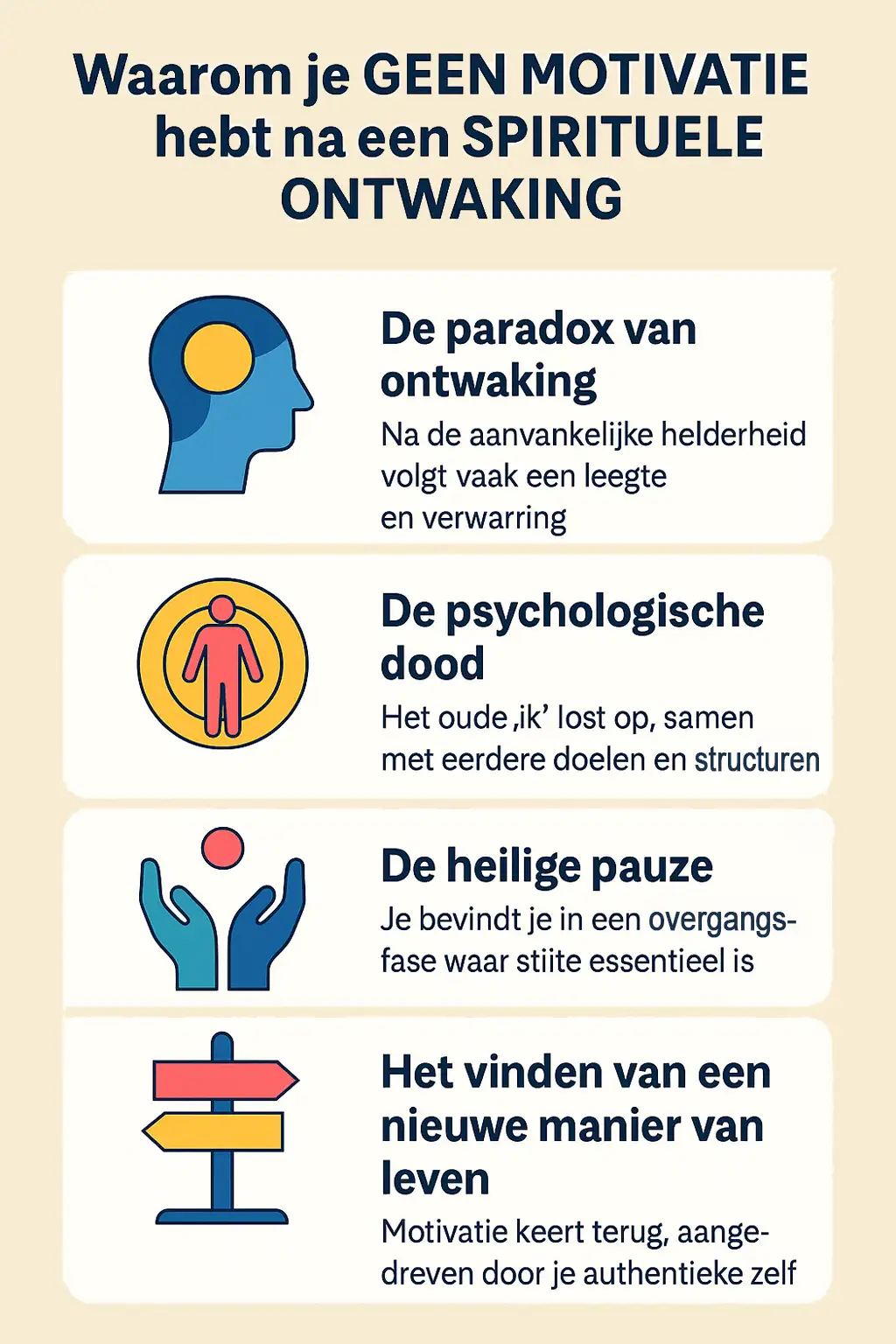
The Paradox of Spiritual Awakening
For many people — especially the sensitive ones, the thinkers, the seekers — awakening does something unexpected. It doesn’t make things lighter, it makes them empty. I think back to a friend: sharp-minded, attuned, devouring the right books — Eckhart Tolle, Alan Watts, Krishnamurti. She had just experienced a deep breakthrough, left a dark night of the soul behind her. She saw the game of the ego, saw through the drive for external validation.
And yet, two months later, she lay in bed, staring at the ceiling. No energy to get up. She said: “Before, I cried because I did too little, now it doesn’t matter to me whether I do anything at all. I thought awakening would lift me up, not leave me behind.” Carl Jung, founder of analytical psychology, knew this post-awakening fog long ago. He didn’t speak in popular spiritual terms, but he understood what happens when the unconscious presents itself to consciousness.
The Psychological Death After Awakening
Jung said: “Enlightenment comes not through fantasizing about figures of light, but through making the darkness conscious.” Beautiful words — until you experience them firsthand. Awakening is not completion. It’s the beginning of a psychological death: the crumbling of the version of yourself you believed in. The structures that gave direction — your ambitions, relationships, sense of time — lose their coherence.
And in that, Jung emphasized, the ego doesn’t get lost — it loses its way. Without a new map, the sense of direction disappears. You’re not in a depression, but in a no-man’s-land. Something has fallen away, but nothing new has appeared yet. And that’s precisely what’s often misunderstood.
The Sacred Pause: Essential for Individuation
What you’re feeling now is not wrong. It’s also not a disorder. It’s something old, something sacred. Jung saw how our culture tries to skip this phase at all costs: the in-between, the stilled nothingness, the phase without function. Yet that space is precisely what’s needed for true individuation — the process of becoming who you truly are at your core.
That’s why we look further. Not only at what you’ve left behind, but at what’s quietly approaching. Because maybe this loss of motivation isn’t a loss at all, but a shift in direction — an invitation to something more essential.
Reprogramming Your Operating System
So if you’ve ever wondered where your fire went, there in that post-awakening fog — no, you’re not crazy. You’re going through a psychological shift that’s hard to name, even for people used to exploring their inner landscape. It’s not an adjustment of thinking, it’s a rewriting of your inner structure. Your motivation, once fueled by checklists, future plans, and external stimuli, simply doesn’t resonate anymore. Not because you’re giving up — but because the entire system that drove you has come to a halt.
Carl Jung foresaw this long ago, well before the term “trending” appeared on social media. Most motivation, he argued, flows from the ego: the ‘I’ that wants to prove itself, that wants to be seen, that seeks its place through achievement. That’s understandable — it’s part of how people develop. Jung called this the persona: the mask with which we face the world.
Glossary
- Individuation: The process in which you come to your own core and develop an integrated, unique personality.
- Ego: The aspect of yourself concerned with appreciation, control, and how you come across to others.
- Persona: The adaptable mask you wear to function within social expectations.
- Shadow Integration: The courage to see and allow your imperfect, uncomfortable sides.
- Enantiodromia: A principle from Jungian psychology where an extreme movement naturally swings into its opposite.
Shedding the Mask
But awakening removes the mask. Suddenly you’re no longer trying to impress or defend your place — because you see the game for what it is. And with that, old goals lose their meaning. They fit a version of you that no longer exists. It’s as if you’ve stepped off the stage, but forgotten your lines — or rather: the role itself no longer fits. You don’t feel a lack of drive. You’ve outgrown the old fuel.
Jung didn’t believe we should reject the ego, but that we should transform it. Not erase it, but integrate it into something larger. He called that individuation: the process where your fragmented parts come together into a unified self. Not the small self that craves recognition, but the deeper self that doesn’t perform — but resonates. That doesn’t seek status, but truth.
Rejecting Everything That’s Fake
And so your system, sometimes almost imperceptibly, begins to shift from within. It rejects what doesn’t fit. Everything that feels forced, that’s out of step with your soul — it’s kept at a distance. Old jobs, relationships, even well-intentioned future visions suddenly feel empty. That’s why people sometimes call awakening both liberating and confusing. Jung warned: “If we get stuck here, we get trapped.”
Some get caught in spiritual bypassing: they declare everything unimportant, deny pain, lose touch with life itself. They confuse detachment with distance. But the Self — that larger, deeper field within you — doesn’t want to escape. It wants to descend. Not flee from life, but recreate it from within.
That asks for something uncomfortable: entering a transition zone that almost no one recognizes while they’re in it. A quiet, gray space without direction. It doesn’t look like meditating by the sea or wisdom quotes on Instagram. It looks like: sitting in silence, not knowing what to say, while life around you just goes on.
Finding a New Way of Living
In Carl Jung’s words: you’re not lost, you’re in transit. You’ve freed yourself from the ego, but you’re not yet living from the Self. That no-man’s-land feels empty, but it isn’t emptiness. It’s a passage. Only — in a world that confuses rest with passivity, that silence quickly becomes suspect. So you judge yourself. And that judgment is precisely what closes the door your soul was quietly knocking on.
Jung had a name for this psychological reversal: enantiodromia — the swinging of extremes into their opposites. When the ego sinks, the pendulum swings to the other extreme: silence at soul level. From ‘I must mean something’ to ‘why mean something?’ And that’s not a loss of direction. It’s a recalibration. In old stories, they called this the hermit phase, dying before rebirth. The cocoon. No longer a caterpillar, not yet a butterfly. In-between stage. Mush.
The Importance of Shadow Integration
And yes, mush does nothing. It doesn’t produce, it doesn’t shine. It dissolves. And that’s precisely what makes the ego restless. It wants grip, identity, purpose. But the Self whispers: let me build, from within. This is where much modern spirituality falls short. You’re taught to follow your light — but rarely your shadow. Yet Jung would say: if you ignore the darkness, you miss the gold.
For Jung, shadow integration wasn’t a side matter, but core work. Looking your uncomfortable, suppressed parts in the eye is part of being human. This phase of emptiness is where the unconscious finally gets breathing room. You’re not failing. You’re digesting. Your psyche knows what it’s doing. And yes — it deliberately holds back motivation, direction, and clarity so it can make you still. So you can feel. See. Remember what was once hidden away. That’s the real inner work.
Motivation From the Soul
And then — very gently — something returns. Not a drive, not an urge, but a movement from within. It doesn’t look like hunger or ambition. It looks like remembering. As if your soul remembers what it came here for. The motivation feels softer, older, quieter. No rush. No agenda. Just an inner pull, as if something calls you without words.
What you think, you become. What you feel, you attract. What you imagine, you create. ~ Buddha
Jung called this the rising of the Self — not as an idea, but as a living compass. If you’ve gone through the silence, through the pause, the no-man’s-land, then you recognize that moment. No fireworks, no revelation. Rather a subtle resonance, a renewed attunement. Not to return to who you were, but to embody something new. Something that fits, without you knowing why.
In that space, the Self begins to express itself. Not in grand plans, but in symbols, nudges, dreams. Jung called this the symbolic life: a way of being that’s not driven by role or expectation, but by attunement to something you can’t measure — only recognize.
From Survival to Meaning
That’s the turning point — when life no longer revolves around enduring, but around meaning. And that meaning is rarely grand or sweeping. Usually it’s quiet. Simple. When the Self begins to lead, the pressure to perform disappears. You no longer move out of fear of missing something, but because something within resonates. You no longer seek clarity — you recognize it when it appears.
Living from the Self doesn’t mean motivation always overwhelms you. There are still days when you’re tired, or doubtful. That’s part of being human. But what disappears is the feeling that you’re betraying yourself. That you’re dragging yourself through a life you once chose, but no longer fits. Instead, you might notice you feel like creating, even if no one’s watching. You say no more often, even to opportunities that look good on paper. You make room for curiosity — not an endless checklist. You choose peace over proving. And that feels different. Less rushed. More on course.
Driven by the Soul
That doesn’t mean ambition disappears. It changes form. Ambition becomes dedication to what’s true. To being present. To growing, rather than impressing. And ironically, that form of energy often proves much more powerful than the ego ever could muster. But now it’s sustainable. Now it’s attuned. Soul-powered! No need to prove, just expression. And that expression naturally moves you toward creating, contributing, healing, building — not because you have to, but because something in you simply wants to move in that direction.
Related Articles


Frequently Asked Questions
What did Carl Jung mean by psychological death?
Jung saw psychological death as letting go of the old identity and the beginning of transformation. Not literally, but symbolically: the ‘I’ as you knew it falls apart, so a deeper Self can come forward.
Why do I feel empty after spiritual awakening?
The emptiness after awakening is a well-known phenomenon. The ego loses its familiar structures, while the Self isn’t yet fully integrated. This in-between stage often feels like purposelessness, but is essentially a rite of passage.
What’s the difference between ego and Self in Jungian terms?
The ego is the conscious identity — how you see and present yourself. The Self encompasses the whole of your psyche, including the unconscious. According to Jung, true growth begins when the ego comes into service of the Self.
What does shadow integration involve?
Shadow integration is the process of recognizing and embracing your hidden, often unconscious qualities — precisely those parts you’d rather not face. This helps you become whole within.
How do I recognize motivation from the Self?
Motivation from the Self feels calm, quiet, and directional without force. It doesn’t come from fear or the need to prove, but from resonance and an inner knowing of what’s right for you.