Reality seems simple — until you start digging. Then it turns out that what you took for granted actually consists of multiple overlapping layers that influence each other and sometimes even contradict what they show.
From concrete matter to mystical experiences, from scientific models to the unknowable: the way we perceive the world depends on the level at which we look. Some layers are directly tangible, others require you to completely let go of your perspective. This article takes you through seven levels, each following its own logic.
The 5 Key Takeaways
- Consensus reality is less objective than you think — our senses all tell a different story
- Perception works as a filter: your brain reconstructs the world from fragments and assumptions
- Beliefs create realities that are just as powerful as physical laws, think of money or national borders
- Science reveals that matter is largely empty space and time is not a fixed flow
- Mystical traditions have pointed for centuries to a deeper layer behind everyday appearances
The Seven Levels of Reality: Overview
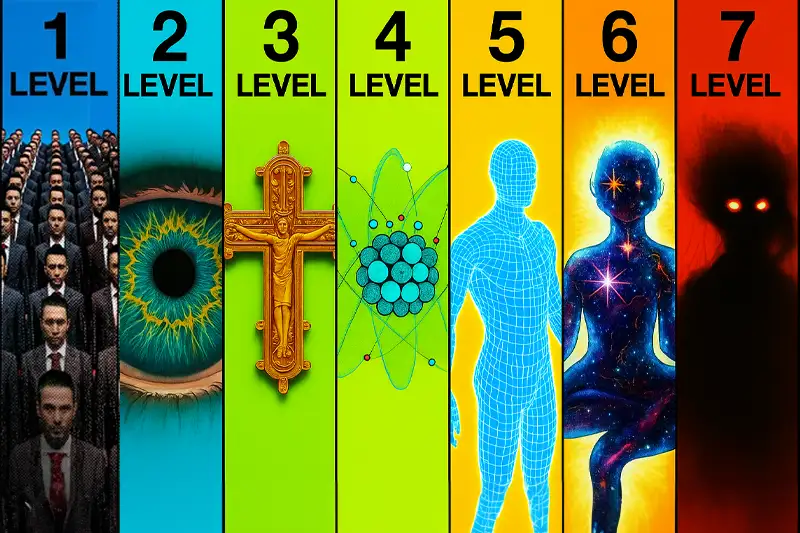
The division into seven layers helps explain why the same event feels concrete to one person and symbolic to another. Each level has its own rules. Level one revolves around shared experience: tables are hard, water is wet. Level two shows that your senses select and process. At level three, cultural agreements and social constructs determine what counts as true.
From level four onward it becomes more abstract. Science contradicts intuitions about matter and time. Level five speculates about simulations or nested realities. Level six refers to mystical unity, where boundaries blur. And level seven? That is the domain of the unnameable — what doesn’t fit into words and yet is experienced as present.
Level One: Shared Reality
This is the world you wake up into. You brush your teeth, grab your keys, step outside. Everything seems agreed upon: objects stay where you leave them, others navigate space the same way. Yet your senses are far from flawless. Optical illusions, color blindness, phantom pain — they all show that perception is not a direct representation of reality.
What we call consensus is actually a collection of signals that nervous systems share with each other. It feels solid, until you realize that someone else literally sees different colors or hears sounds you don’t pick up. That seemingly self-evident outside world turns out to be a shared construct — useful, but not necessarily absolute.
Level Two: The Domain of Perception
Here the focus shifts inward. Light entering your eye is converted into electrical pulses. Your brain flips the image, fills in blind spots, and makes it coherent. What you think you see is actually a reconstruction — not a live feed. Your brain even experiences time as a continuous stream, while it actually pastes separate moments together. That’s why you often don’t even notice your eye blinks.
Animals like dogs and bees have senses that register frequencies or colors we’re blind to. That makes clear your reality is just one version of what might exist. Your senses are not neutral cameras, but evolutionary tools that select what’s useful for survival — truth comes second.
Pros and Cons of Level Two
Pros
- Explains why people experience the same situation differently
- Creates room for empathy: what you see is not necessarily what another sees
- Helps understand how illusions and misinterpretations arise
- Debunks the myth of objective perception
Cons
- Can lead to relativism: if everything is reconstruction, what is still true
- Makes communication harder when you realize words don’t evoke identical images
- Raises uncertainty about what you can still trust
- Requires accepting that you never reach ‘reality itself’
Level Three: The Domain of Beliefs
At this level it becomes clear that ideas can be just as influential as stones. Money is paper or bits, but determines where you live and what you can do. National borders are imaginary lines, but they decide freedom or imprisonment. Morality and justice are also constructs that shift per culture and era. What one group calls sacred, another finds absurd. Yet people live within these symbolic realities as if they were as hard as concrete.
Anthropologist Clifford Geertz called it ‘webs of significance’ — networks of meaning in which we’re caught and which we ourselves spin. These layers are fragile: they can break with clashing views, revolutions, or new insights. Yet they’re enormously powerful: they drive wars, loves, identities. Reality here is no longer a given, but something you build and maintain together.
Level Four: The Domain of Science
Here the intuitive world definitively wavers. Matter feels solid, but atoms turn out to be mostly empty space. If you scaled an atom to a football stadium, the nucleus would be a grain of rice and electrons would hover somewhere in the stands. Solidity arises from electromagnetic forces pushing against each other — you never actually touch anything. Time also proves elastic: speed and gravity warp its passage. An astronaut orbiting Earth for months returns as someone who is fractionally younger than his Earth-bound twin brother.
Quantum mechanics adds another bizarre layer. Particles behave like waves of possibility until you measure. Only upon observation do they choose a position. As if reality waits to exist until someone looks. Entanglement shows that particles light-years apart can instantly influence each other. Scientist John Archibald Wheeler put it clearly: no phenomenon is a phenomenon until it is observed.
Theosophy and the Seven Planes of Existence
Within theosophy, reality gets a sevenfold structure again, but from a spiritual angle. The seven planes run from physical to divine, with each plane having its own vibrational frequency and properties. The physical plane is the densest and most concrete, followed by emotional and mental layers that are subtler. Higher up come the intuitive, spiritual, and ultimately pure consciousness planes — realms that elude both language and direct experience.
This division differs from scientific levels, but touches similar questions: what lies behind the visible, and how do different experiential layers relate? For theosophical thinkers it’s mainly about consciousness development. As you evolve inwardly, you may gain access to subtler planes. The model serves as a map, though the journey itself remains personal and elusive.
The Seven Hermetic Principles at a Glance
The hermetic tradition describes seven universal laws governing reality. The principle of mentalism holds that everything begins in consciousness. Correspondence emphasizes that patterns repeat at different scales: ‘as above, so below’. Vibration teaches that nothing stands still — everything vibrates, moves, changes. Polarity shows that opposites are actually extremes of the same spectrum. Rhythm points to the ebb and flow in all processes. Cause and effect recalls karma, action-reaction. And gender is not so much biological sex, but creative and receptive forces in everything.
These principles are ancient, yet sometimes sound surprisingly modern. Comparing them to quantum physics or systems theory, you see connections. Still, they remain mainly philosophical and symbolic — tools to understand the invisible, not as scientific formulas but as poetic laws that try to capture the coherence between microcosm and macrocosm.
Hawkins’ Consciousness Scale: Key Points
David Hawkins developed a scale measuring emotions and states of consciousness from low to high. At the bottom are feelings like shame, guilt, and apathy — heavy, energy-draining states. Midway you find courage, acceptance, and reason. At the top come love, joy, and peace. Each level has a numerical value, with enlightenment at the highest around 700. The higher you measure, the more capable you are of non-judgment and acting from clarity.
Hawkins linked his model to muscle-testing methods and claimed consciousness is measurable. This sparked criticism from scientific circles, but his scale remains popular in spiritual and personal development contexts. The strength lies less in exact numbers than in the idea that emotions are vibrational frequencies you can shift. It invites you to explore which level you typically operate at and whether you can consciously change it.
Glossary
- Consensus reality: The shared, everyday experience of the world most people agree on.
- Quantum entanglement: Phenomenon where particles at distance directly influence each other’s state, regardless of intervening space.
- Hermetic principles: Seven universal laws from ancient Egyptian wisdom tradition, described in the Kybalion.
- Consciousness scale: David Hawkins’ model ordering emotions and consciousness states from low (shame) to high (enlightenment).
Level Five: The Simulation Layer
This level plays with an idea that has outgrown science fiction: suppose this reality is a simulation. If an advanced civilization can run millions of virtual worlds, the odds that we’re in the ‘real’ one are statistically negligible. Philosopher Nick Bostrom framed this as a trilemma: either civilizations die out before creating such simulations, or they choose not to, or we very likely already live in one. The logic is simple, the implication dizzying.
From within a simulation you could never definitively determine you’re in one. Any anomaly can be explained away, any test runs within the same code. Some see it as metaphor: reality behaves as if there’s underlying code, with rules generating emergent complexity. Literally or figuratively, the idea forces you to reconsider what you call ‘fundamental’ — perhaps everything you know is merely an interface atop something inaccessible.
Level Six: Mystical Reality
For centuries, mystics have claimed the everyday world is a veil. Hinduism calls it Maya, Buddhism speaks of samsara, Gnostics saw it as false reality. Meditation, psychedelics, or spontaneous experiences can part that curtain. People then describe boundaries dissolving, subject and object merging, everything suddenly appearing as part of one field. Neuroscientists see the default mode network temporarily shutting down — the brain region spinning stories about the self falls silent.
What remains is often experienced as ‘more real’ than normal existence. Colors seem more intense, connection feels more direct. Aldous Huxley called it ‘mind at large’, a consciousness reaching beyond your personal identity. Whether you frame it spiritually or neurologically, the experience raises a question: if this level feels more authentic than level one, which layer is then actually real?
| Your Reality Level | Characteristic | Example |
| Level 1 | Shared reality | Tables are hard, water is wet |
| Level 2 | Perception as filter | Brain reconstructs images from electrical signals |
| Level 3 | Beliefs and symbols | Money, borders, morality |
| Level 4 | Science reveals emptiness | Atoms are mostly space, time is relative |
| Level 5 | Simulation hypothesis | Reality as nested code |
| Level 6 | Mystical unity | Boundaries blur, everything connected |
| Level 7 | The unknowable | What transcends language and concept |
Level Seven: The Unknowable Domain
This is the endpoint where all models stop. Philosophy gets stuck in paradox, science admits something lies where measurements can’t reach, spirituality speaks in metaphors because direct descriptions fail. The Tao Te Ching opens with: ‘The Tao that can be named is not the eternal Tao.’ Once you try to pin something down, you’ve missed it. The map is not the territory, the word water doesn’t make you wet.
Perhaps this level is the source of consciousness, the hidden laws generating universes, or something forever beyond reach. What remains is silence beneath thought, mystery beneath measurement, abyss beneath existence. Reality dissolves here into something you can only experience, never explain. It is at once the most abstract and most direct — the medium in which questions, answers, and everything else can manifest at all.
Practical Application: Reflection and Daily Exercise
All these levels may seem abstract, but you can work with them. Start with level two: notice how your brain fills in and interprets. See an optical illusion and realize your senses are editing. At level three ask yourself which beliefs drive your reality — about money, relationships, success. Some turn out to be learned, not absolute. Level four invites you not to see scientific insights as dry fact-material, but as an invitation to release your intuitions.
Levels five and six require a different approach. Meditation or contemplation help break patterns, step temporarily outside your own narrative. You don’t need to believe in simulations or mystical unity to notice that shifting perspective changes your relationship to reality. And level seven? That mainly asks for acceptance that not everything can be grasped. Letting go of the urge to understand can prove surprisingly liberating.
Conclusion
Reality turns out to be no simple matter. From shared outer world to the mystical and unknowable — each level reveals different rules, different questions. What seems solid at level one dissolves at level two. What level three presents as absolute shifts at level four. And so on, until you arrive at something that eludes every definition.
Perhaps the point isn’t to choose one level as ‘the real’ one. Perhaps reality is precisely the interplay of all those layers, the way they cover and cross each other. It demands curiosity without the illusion you’ll ever fully understand. And perhaps that — the willingness to keep asking without demanding answers — brings you closest to what reality truly is.
Verified Sources
- https://en.wikipedia.org/wiki/Plane_(theosophy) – Overview of seven planes of existence from esoteric traditions.
- https://en.wikipedia.org/wiki/Hawkins_map_of_consciousness – Frameworks and levels within Hawkins’ consciousness scale.
- https://www.britannica.com/topic/Kybalion – Explanation of seven hermetic principles.
- https://en.wikipedia.org/wiki/The_Kybalion – Context and list of seven hermetic principles.
- https://www.theosophy.world/encyclopedia/planes-theosophy – Explanation of seven planes within theosophy.
Related Articles


![The Illusion of Self: What If Your ‘I’ Doesn’t Exist? [Free E-Book].](https://liberteque.com/wp-content/uploads/2025/09/GoodFeeling.nl-xxx-7-300x200.webp "The 7 Levels of Reality Explained: From Hermetic Principles to Consciousness and Meaning 4")

Frequently Asked Questions
What are the seven hermetic principles?
The Kybalion describes seven principles: mentalism, correspondence, vibration, polarity, rhythm, cause and effect, and gender. These principles form a framework for understanding reality and experience from a hermetic tradition.
What is meant by the seven planes of existence in theosophy?
Theosophy distinguishes seven layers or planes of existence, often called physical, astral, mental/causal, buddhic, atmic, monadic, and logoic levels. These layers are seen as interpenetrating dimensions of experience and consciousness.
What is Hawkins’ consciousness scale about?
The scale orders human states of consciousness on a rising logarithmic scale with characteristic emotions and attitudes per level. Around 200 lies the shift toward constructive dynamics; higher levels refer to compassion, peace, and enlightenment.
How do ‘vibration’ and ‘energy’ connect with these levels?
Within hermetic and theosophical frameworks, everything is in motion. Vibration serves as a key concept to describe differences between planes and consciousness states, and to understand correspondences between inner and outer reality.
Is there scientific consensus on these divisions?
The divisions come from esoteric and spiritual traditions. In academic contexts they count as philosophical or spiritual frameworks without broad empirical backing. Yet they can serve as personal reflection language for meaning-making.
Continue reading
- What is Hermeticism? Discover the Hidden Forces of Consciousness, Aether, and Inner Guidance
- Why a Morning Walk Is Better Than Coffee
- How Your Word Choice Always Determines What the Universe Gives Back—Moving from ‘Fighting’ to ‘Receiving’
- New German Research Shows That Intermittent Fasting Alone Is Not a Miracle Cure