Anyone who has observed a sleeping cat may recognize it: that compact ball of fur usually lies on its left side. For researchers, this prompted the question of whether this is mere coincidence, convenience, or something deeper. An international team of behavioral scientists examined hundreds of YouTube videos of cats at rest. The conclusion is as surprising as it is evolutionarily explainable: this preference may be a remnant of a sophisticated survival mechanism.
The research was conducted by scientists from the University of Bari Aldo Moro (Italy), Ruhr University Bochum, Medical School Hamburg, and colleagues from Germany, Canada, Switzerland, and Turkey. Their findings were published in the journal Current Biology.
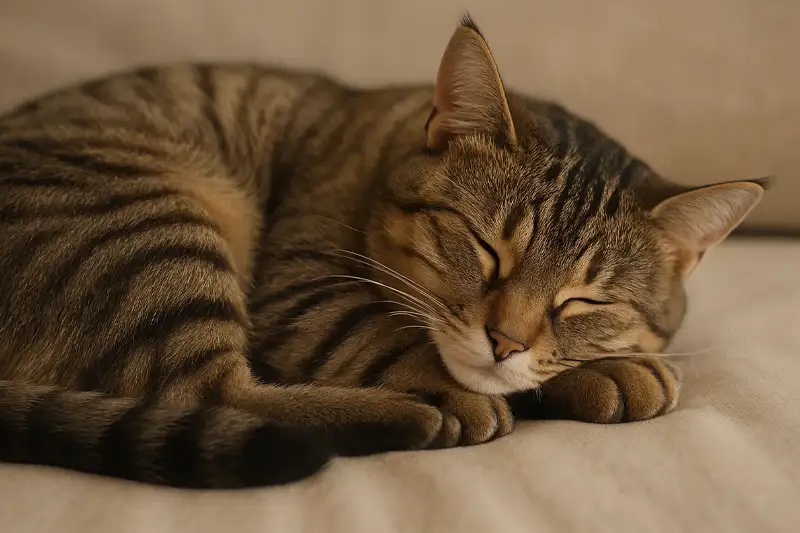
Cats sleep an average of 12 to 16 hours per day — often in elevated places where they feel less vulnerable. But even in their rest, they remain evolutionarily programmed for alertness. Professor Onur Güntürkün (Bochum) and Dr. Sevim Isparta (Bari) wondered whether the side on which cats sleep influences their ability to perceive threats upon waking.
“Behavioral symmetry can have functional Pros,” Güntürkün explains. “Both brain hemispheres are specialized in different tasks.”
The Left Eye Watches, the Right Brain Decides
The researchers analyzed 408 public YouTube videos in which a cat lay clearly visible on one side for at least ten seconds. Only unmanipulated footage was included — mirrors and edits were excluded to keep the data pure. The result: approximately two-thirds of cats slept on their left side.
What explains this preference? When a cat sleeps on its left side, the environment is first perceived with the left eye upon waking. And that visual field is processed in the right brain hemisphere — which specializes in spatial awareness, threat detection, and quick escape reflexes. In other words: this position optimizes the chances of a rapid response to danger.
According to the researchers, it is therefore plausible that cats sleep on their left side as an instinctive survival strategy. Perhaps that is precisely why their resting position is so remarkably consistent.
Verified Sources
- “Lateralized sleeping positions in domestic cats” by Sevim Isparta et al., published June 23, 2025 in Current Biology. DOI: 10.1016/j.cub.2025.04.043
Related Articles


Frequently Asked Questions
Why do cats sleep more often on their left side?
Research shows that cats sleep on their left side because their right brain hemisphere can then process visual information more quickly upon waking. This helps with rapidly detecting danger or prey.
Is there scientific evidence for this preference?
Yes, an international team analyzed 408 cat videos on YouTube. Approximately two-thirds of cats slept on their left side. The results were published in the journal Current Biology.
What does the right brain hemisphere do in cats?
The right brain hemisphere specializes in spatial awareness, processing threats, and controlling rapid responses such as fleeing. This makes it evolutionarily advantageous for cats to sleep in a way that activates this brain hemisphere upon waking.
Do all cats have this preference?
No, it is a clear majority, but not an absolute pattern. Approximately one in three cats appears to prefer sleeping on their right side.
Why was YouTube used as a source?
YouTube provides a large amount of spontaneous, unscripted observations. The researchers selected only videos with clear footage and without manipulation, making reliable analysis possible.
Continue reading
- This Is How Gut Bacteria Tell Your Brain Which Emotions You’re Feeling in Real Time
- Google Maps for the Human Body? How the HCA Is Changing Our View of Biology
- Why Virtual Nature Can Never Replace the Real Thing – Scientist Kondo Explains
- More Irritable Because of What You Eat? Omega-3 Makes the Difference