In a world where achievement seems to be the norm, showing your rough edges quickly feels like a risk. Yet more and more people are asking themselves whether those very rough edges don’t reveal something essential — about what drives us, about our humanity, about what truly moves us forward.
From a young age, we learn to stand out through success. We’re encouraged to prove ourselves, to be good — and preferably even better. At the same time, we develop the reflex to mask our weaknesses. That feels safer. But somewhere along the way, we might lose something. Perhaps that’s where a forgotten entrance to peace, authenticity, and fulfillment lies.
Authenticity doesn’t emerge from perfection, but from living through shortcomings
There’s something genuine in the messy, the unfinished. In searching, doubting, trying, and sometimes failing. That’s not a flaw — it’s what makes us human. And only there does real connection emerge.
When you no longer have to hide yourself, you experience space. Not space to become flawless, but to be yourself. That feels more open. Lighter. And often safer too — for others. It builds trust, extends an invitation, creates closeness. Growth that doesn’t come from performing, but from connection.
Acknowledging what troubles you opens the path to something better than perfection
Personal development rarely follows a straight line. There’s often a phase where everything feels rough. As if you don’t yet know what you’re letting go of — and also don’t yet know what you’ll get in return. And that in-between phase has value. That’s where movement happens.
When we stop hiding, energy is released. What once went into maintaining masks or correcting ourselves becomes available for something else: depth, direction, clarity. Flaws then shift from burden to gateway. Not to solve them, but to see what they’re trying to tell us.
Being professional and staying true to yourself doesn’t have to be a contradiction
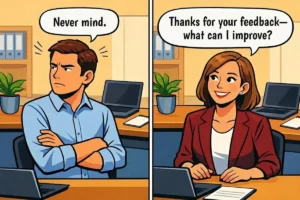
In work environments, much revolves around competence. Calm, knowledge, control — that’s what people expect. But no one is free from rough edges. And that doesn’t need to be. Precisely people who acknowledge this inspire trust.
Showing vulnerability doesn’t mean you’re incompetent. It means you’re grounded enough to be open about what still troubles you. Someone who dares to do that shows more than a resume. They show character.
When someone doesn’t need to hide behind a perfect image, space opens up. For genuine collaboration, for honest contact. The mask then becomes not a wall — but a canvas you can see through.
Vulnerability doesn’t have to undermine your professionalism — it can actually deepen it
Vulnerability often works more quietly than you think — but much deeper
Vulnerability doesn’t have to be a grand gesture. Sometimes it’s simply the choice to show something real. Something that’s not yet finished. But that rings true. And there’s strength in that — unexpected, sometimes even uncomfortable, but genuine.
Not everyone dares to do it. Showing yourself, even when it feels shaky, takes courage. Yet something often happens when you do. Conversations change. Masks fall. And what remains is contact that reaches beyond words.
It’s not about expressing emotions. It’s about daring to be present — with everything you bring. That’s what makes a relationship stronger. That’s what gives it depth.
- Mutual understanding becomes self-evident
- Emotional connection finds space
- Conversations become less controlled, more genuine
- Trust grows — slowly but steadily
- In difficult times, closeness is less something you have to earn
Sometimes openness hurts — and yet that’s not the end
When you speak up, you take a risk. There’s always a chance the other person will withdraw, or won’t know how to respond. And yes, that can hurt. But it says nothing about your worth. It says something about what that person can handle at that moment.
That’s why it’s good to see early where that boundary lies. Not to withdraw, but to know with whom you can truly build. Not everyone needs to be close — but those who stay count double.
Who stays when you no longer have to keep it together?
Finding someone who sees you without a filter takes time. And courage. But when that person is there, something rare happens: you no longer have to do anything to be ‘good enough.’ You can simply be who you are — without a role, without performance. And that feels like coming home.
Why vulnerability ultimately takes you further
Being open sometimes feels like a risk. But those who dare to take that risk discover something valuable. Connection, peace, and the realization that you’re not alone. Not all at once, not without doubt, but steadily. Each step makes you stronger.
There is fear, certainly. But what you get in return — the space to be yourself, the trust that doesn’t depend on performance — weighs more than the hesitation. Every time.
Failure as foundation — the power of detours
Success often looks linear from the outside. But for almost everyone, there’s roughness in it. Times when it doesn’t work. Choices you reconsider later. And that’s often where something new emerges. Something that lasts.
It might sound contradictory: that failure can be a gift. But sometimes it is. Because it stops you. Because it reveals something that success often hides.
What becomes visible when things fall apart
A failure feels hard. But in the silence that follows, you can look. At what troubles you. At what didn’t work. At who you are when the outside falls away. And that’s often more than you thought.
Those who dare to stay with that silence develop strength. Not hardness. But resilience. The ability to choose again. And that gives direction.
Making space for something that didn’t yet exist
Those who don’t fear mistakes dare to experiment. And that’s precisely what opens possibilities. Ideas that started somewhere in the margins suddenly get a chance to take shape.
Much of what later counts as insight originally emerged from discomfort. Not from certainty. But from continuing to look, continuing to search. Even when it seemed to be going wrong.
What you pick up when you stumble
There’s something formative in falling. Not for the fall itself, but for what comes after. The reorientation. The courage to get back up. Learning to see where you actually want to go — apart from expectations.
Those who allow themselves to fail occasionally learn more than those who remain flawless. A kind of integrity emerges. Not a mask, but a foundation. Quiet, solid, and real.
And perhaps that’s the only form of success that truly sticks.
Related Articles




Frequently Asked Questions
Why is it important to embrace weaknesses?
Embracing weaknesses helps us be authentic and true to ourselves, which leads to more trust, approachability, and inspiring relationships.
How can vulnerability strengthen relationships?
Vulnerability invites others to truly understand us and connect with us on a deeper level, which forms the foundation for strong relationships.
What are the benefits of failure?
Failure teaches us resilience, fosters creativity and innovation, and helps us build character and integrity, leading to personal growth and success.
How can I embrace my weaknesses without damaging my professional image?
By being open about our flaws, we demonstrate self-awareness and humanity, which can earn respect and trust from colleagues and clients.
Why is showing vulnerability a sign of courage?
Showing vulnerability takes courage because it means sharing our deepest thoughts and feelings, which can lead to deeper connection and understanding in relationships.