The Eightfold Path forms one of the pillars within Buddhism. It offers a practical route to living from wisdom, ethics, and mindfulness. Those who follow this path gradually reduce their suffering and find greater inner peace. The Eightfold Path emerged from the search for a solution to suffering and offers a way toward enlightenment. The origins of Buddhism lie in the teachings of Siddhartha Gautama, the Buddha, who shared his insights to help others reach this state of bliss. By walking the path, followers can develop a deeper connection with themselves and the world around them.
Those wondering how to live more consciously, how ethics translates into daily actions, or how meditation helps shape a calmer mind will find a concrete starting point in this path.
The 5 Key Takeaways
- Discover how the Eightfold Path can transform your life.
- Learn the basic principles of ethical conduct.
- Find inner peace through meditation.
- Understand the influence of karma on your life.
- Develop wisdom to see the world more clearly.
The Core of the Eightfold Path
The Noble Eightfold Path is the series of practical guidelines that the Buddha gave. They form part of the fourth of the Four Noble Truths. The first truth points to the inevitable dissatisfaction of the unenlightened life. The second and third offer perspective: suffering arises from our own attachments, but can be eliminated. The fourth truth describes the path that leads to that end—the Eightfold Path. This teaching is further explained in the Abhidharma.
The Path to Enlightenment
The path is called ‘noble’ because it is the way of people who have developed wisdom and clarity. Their actions are free from suffering, and their example shows what is possible when one lives according to this path. Those who follow that direction move step by step toward enlightenment.
The practice rests on three pillars: ethical living, meditation, and the development of insight. Together, these form the foundation of Buddhism. They lead to a calmer mind, greater emotional balance, and a deeper sense of peace. Following these principles is therefore a way to build a more stable and meaningful life.
Glossary
- Eightfold Path: The eight guidelines on the path to enlightenment within Buddhism.
- Karma: The law of cause and effect—actions determine future experiences.
- Mindfulness: Attention to the present moment, without judgment.
- Meditation: A practice through which the mind comes to rest and clarity.
- Enlightenment: A state of complete awareness and liberation from suffering.
The Impact of Good Karma
Those who live according to the Noble Eightfold Path generate merit and good karma. This creates favorable circumstances in this life and, according to Buddhist teaching, in future forms of existence. Even if you don’t believe in that, the essence remains the same: noble deeds have positive consequences, careless behavior creates tension and pain.
By acting consciously, you prevent yourself from creating new suffering. In this way, good karma becomes not an abstract concept, but something directly felt in your daily life.

The Elements as a Whole
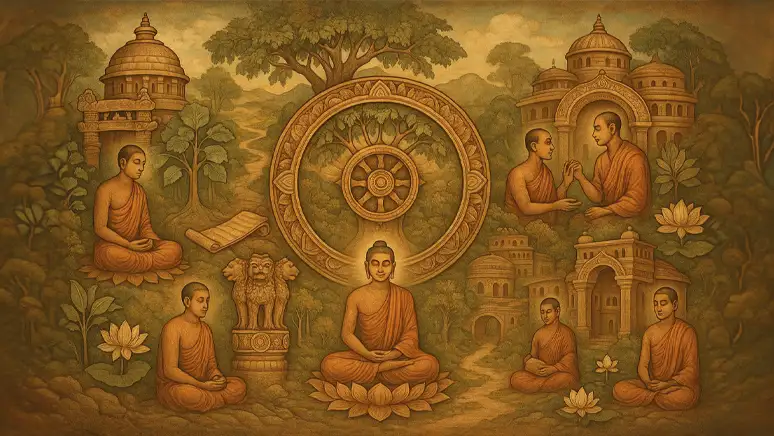
Although the Eightfold Path is often presented as a list of eight components, it is not a series of steps to check off one by one. The components strengthen each other and can be practiced simultaneously. To symbolize this, the path is often depicted as a Dharma Wheel—a wheel with eight spokes that turns when all parts are in balance.
No single spoke is more important than another; each movement supports the whole. In Pali, the word samma is often used, usually translated as ‘right’. It does not mean being morally correct, but acting in a way that is skillful, wise, and in harmony with insight.
Alternative Definitions
Those who find the word ‘right’ too rigid can better read it as ‘correct’, ‘skillful’, or ‘fitting’. It’s about intention and direction, not perfection. The eight components of this path are explained below.
1. Right View
Right view begins with the realization that every action has consequences. Because karma is part of reality, it is wise to live in a way that causes as little harm as possible. This forms the core of the Four Noble Truths: suffering arises from ignorance and can be reduced through conscious choices.
Those who understand this live more alertly. You become aware of every act of body, speech, and mind, and realize that every action has an echo. From that insight grows naturally the inclination to limit harm and promote well-being—for yourself and for others.
2. Right Intention
Right intention means that your actions come from clarity rather than impulse. It requires a calm, present mind that can discern why something is being done. This form of intention is rooted in love and compassion, not self-interest.
When the mind is stable, action naturally becomes purer. You choose more consciously, react less from emotion, and act with the well-being of others in mind. Right intention thus forms the bridge between insight and behavior.
3. Right Speech
From insight and intention arises right speech. It means speaking without harm, without lying or dividing. It requires honesty, care, and silence where words add nothing.
Right speech is not only what you say, but also how you listen. By communicating attentively and respectfully, you build trust and reduce unnecessary tension. Clear and truthful words thus form a direct practice of ethics.
4. Right Action
Right action refers to avoiding behavior that harms others. That means: not killing, not stealing, not abusing relationships, and respecting life in all its forms. Those who practice this actively support the well-being of others.
It is also the practice of generosity and respect. By recognizing the boundaries of others and handling relationships carefully, the quality of your own life grows. At its core, right action is about trust, dignity, and responsibility.
5. Right Livelihood
A large part of our lives revolves around work and sustaining an existence. Right livelihood means doing this in an honest and ethical way. In the original teaching, this meant that one does not earn income through trade in weapons, people, meat, alcohol, or poison—activities that directly cause harm.
The core remains relevant today: when your work requires deception, misleading, or exploitation, it falls out of balance with the spirit of the path. Right livelihood means choosing a profession that contributes to well-being without harming others. In this way, work becomes not only a means of survival, but also a form of practice.
6. Right Effort
Right effort has to do with the direction in which you direct your energy. It’s not just about stopping unhelpful behavior, but consciously nurturing qualities that support growth. In this way, you learn to distinguish between what calms the mind and what makes it restless.
The classic obstacles—distraction, doubt, craving, laziness, and restlessness—remain part of the process. By staying alert and seeking balance between tension and relaxation, you develop a mind that is steady and clear. That is the true practice of right effort.
7. Right Mindfulness
Right mindfulness means becoming aware of what is truly going on within you. Many people live largely on autopilot; this practice breaks that pattern. By directing attention to breath, thoughts, and emotions, you learn how habits arise and how you can free yourself from them.
Mindfulness makes you aware of subtle tendencies to judge, react, or escape. That clarity offers freedom of choice. Instead of being swept along, you can act from rest and insight.
8. Right Concentration
When effort and mindfulness come into balance, right concentration naturally grows. The mind gathers around one point, freed from distraction and noise. In meditation, this is experienced as deep rest—not by forcing anything, but by letting go of what is unnecessary.
In that state of concentration, clear awareness and a sense of freedom arise. Meditation is the tool that supports you in stabilizing the mind and easing suffering. Ultimately, this concentration forms the foundation upon which insight can ripen.
Verified Sources
- https://nl.wikipedia.org/wiki/Edele_achtvoudige_pad – Overview of meaning, 8 components, and interconnection.
- https://bodhitv.nl/de-tien-lijstjes-achtvoudige-pad/ – Accessible explanation and context for the path.
- https://meditatieinstituut.nl/boeddhisme/het-achtvoudige-pad-in-het-boeddhisme/ – Division into three categories and practical explanation.
- https://www.theravadaboeddhisme.nl/faq.html – FAQ-style definitions and lists.
- https://boeddhistischdagblad.nl/boeddhisme/196993-over-de-lotus-soetra-9-het-achtvoudige-pad/ – Practical nuances in ‘right speech’ and conduct.
Related Articles





Frequently Asked Questions
What is the Noble Eightfold Path?
The Noble Eightfold Path is the Buddhist way to liberation from suffering, consisting of eight interconnected factors that you develop as a unified whole.
What are the 8 components of the Eightfold Path?
Right view, right intention, right speech, right action, right livelihood, right effort, right mindfulness, and right concentration.
Why is the Eightfold Path called the ‘Middle Way’?
Because the path avoids extremes—such as sensual hedonism and self-mortification—and invites a balanced, ethical, and mindful way of living.
How do you apply the Eightfold Path in daily life?
By making conscious choices in language and behavior, working constructively, training attention in small moments, and regularly examining your intentions.
What three categories belong to the Eightfold Path?
The eight factors are often organized as wisdom (view, intention), ethics (speech, action, livelihood), and meditation (effort, mindfulness, concentration).