The history of Buddhism spans more than 2,600 years and has now spread across the entire world. Yet it remains remarkably relevant today, as its teachings continue to guide the daily lives of people. But how did Buddhism actually originate? Below you’ll find a brief overview of its origins and development.
The 5 Key Takeaways
The 5 Key Takeaways
- The birth of a prince and the discovery of suffering.
- The essence of the three jewels.
- The first teaching and its spread.
- The division into different schools.
- The Buddha nature within each of us.
What is Buddhism? A Definition
Buddhism takes many forms: it can be seen as a religion, a philosophy, a spiritual path, or a way of life. What it means exactly depends on the person practicing it.
For some, it’s a form of spiritual training; for others, more of a belief system. There are also people who identify culturally as Buddhist without actively practicing, while still others view it primarily as a philosophical approach—a way of looking at life.
Buddhist teaching offers a practical guide for a way of thinking and acting that helps reduce suffering and develop lasting contentment. Whatever name one gives it, the core always revolves around taking refuge in the three jewels of Buddha, dharma, and sangha.
Taking refuge means following a path that leads to inner peace and ultimately to enlightenment. The Buddha serves as an example of a human being who, like anyone else, achieved a state of complete awakening.
Dharma encompasses the Buddha’s teachings—insight into how reality truly functions. Sangha refers to the community of practitioners who follow this path and support each other in their practice.
The Foundations of the Teaching
Siddhartha’s quest for truth shows how a human being, despite hardships, can grow in insight and inner peace. His choice to leave behind the luxurious court life and dedicate himself to spiritual practice demonstrated clear understanding: true happiness lies not in possessions, but in understanding.
Beneath the Bodhi tree, he realized that suffering is not random, but arises from attachment and ignorance. His realization of the Four Noble Truths formed the foundation of Buddhism—a path that guides those seeking meaning and freedom of mind.
How Did Buddhism Begin?
After his enlightenment, the Buddha doubted whether others would understand what he had experienced. Yet he knew there were people receptive to these insights. To them he gave his first teaching—an explanation of the Four Noble Truths and the Eightfold Path, which laid out the way to liberation step by step.
That first discourse is known as the ‘turning of the wheel of dharma.’ It began a period of more than 45 years in which the Buddha taught how the mind could be trained to transcend suffering. His disciples, the sangha, passed these teachings on orally.
What began in Northern India grew into a vibrant tradition. The origins of Buddhism in India form the root of a movement that slowly spread across the Ganges Valley. In the centuries that followed, it found its way via trade routes and traveling monks to Sri Lanka, Southeast Asia, China, and later to the West.
Growth and Spread
The Buddha’s decision to share his insight was an act of compassion. He chose not to keep his wisdom to himself, but to use it to help others find the path to inner freedom. In doing so, he laid the foundation for what would later become one of the most influential spiritual movements in the world.
The spread of Buddhism throughout the world shows how flexible the teaching is. It adapts to the culture and context of a society without losing its core. That core—wisdom, compassion, and insight into how the mind works—remained intact, regardless of where the teaching took root.
What Are the Major Schools Within Buddhism?
As the community grew, different interpretations emerged about how a monk should live and how the Buddha’s words should be understood. About two centuries after his death, this led to a split within the tradition.
The two largest schools are Theravada and Mahayana Buddhism. Theravada Buddhism, primarily found in Sri Lanka and Southeast Asia, focuses on personal enlightenment through discipline, meditation, and insight. Mahayana Buddhism, which spread to China, Japan, and Tibet, emphasizes the path of the bodhisattva—someone who strives for liberation for all beings.
Although the expressions differ, both schools share the same foundation: the insight that suffering has a cause, and that it’s possible to eliminate that cause by cultivating the mind in wisdom and compassion. That remains the core of the path the Buddha once taught.
Mahayana Buddhism distinguishes itself from Theravada Buddhism through its emphasis on the bodhisattva path. A bodhisattva is someone who strives for liberation, not only for themselves, but with the intention to serve the well-being of all living beings. This attitude of compassion and altruism forms the heart of the Mahayana vision.
The Diversity in the Buddhist Tradition
The variety of schools within Buddhism reflects how rich and multifaceted the teaching has been interpreted and transmitted. Each school emphasizes a different aspect of the path: some focus on insight and meditation, others on rituals, moral discipline, or devotion. Yet they all share the same goal: cultivating wisdom, compassion, and clear awareness.
The emphasis on the bodhisattva path within Mahayana Buddhism shows how deeply the value of selflessness is rooted in this tradition. By dedicating themselves to the well-being of others, practitioners develop insight into the interconnectedness of all life—an understanding that directly touches the core of the teaching about samsara and nirvana. This insight stimulates a deeper connection with the ‘power of mindfulness in the present moment’, enabling practitioners to live with full attention and compassion. By being present in the moment, they can better respond to the needs of others and create a positive impact on the world around them. This approach enriches not only their own lives but also strengthens community bonds.
What Does the Buddha Represent?
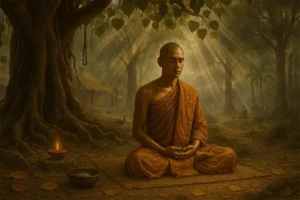
The man we know as the Buddha was born as Prince Siddhartha Gautama. When he meditated beneath the Bodhi tree, he reached a state of complete awakening—freed from the ignorance and mental veils that cause suffering. The word ‘Buddha’ literally means ‘the awakened one’ or ‘the enlightened one,’ someone who has realized Bodhi: insight into the true nature of reality.
His life story, including the moment of enlightenment, remains a source of inspiration. It reminds us that liberation is possible, even for those in the midst of ordinary life. Old age, illness, and death are part of our existence—but they need not be a source of despair if we learn to understand the nature of suffering.
The Buddha was a human being, not a god. That’s precisely what makes him so relatable. He embodied the potential present in every human: the Buddha-nature. This inner capacity for clarity and compassion lies dormant in each of us, waiting to be developed through practice and insight. Training the mind therefore forms the heart of the Buddhist path.
The Buddha as Guide and Inspiration
The transformation of Siddhartha into the Buddha shows what a human being is capable of when insight and discipline come together. His life story offers hope for anyone who longs for a life with more balance and meaning.
The Buddha’s teaching encourages self-examination and the conscious development of qualities such as compassion, kindness, and mindfulness. By practicing these values in daily life, we learn to calm the mind and see more clearly. From that insight, we can contribute to a world that feels calmer, kinder, and more humane. In this quest for inner peace, we can also use practical tools, such as learning to listen again with sound bowls. The sound of the bowls helps us stay present in the moment and opens the door to a deeper understanding of ourselves and our surroundings. In this way, we strengthen not only our personal growth but also our connections with others.
Glossary
- Dharma: The collection of the Buddha’s teachings or the truth about how things really are.
- Sangha: The community of wise practitioners who have committed themselves to this path.
- Bodhisattva: Someone who is motivated to achieve liberation, not only for themselves, but for the well-being of all beings.
- Enlightenment: A state of deep insight and freedom from suffering.
- Buddha nature: The inherent purity and potential for awakening that each of us possesses.
Verified Sources
- https://en.wikipedia.org/wiki/History_of_Buddhism – Overview of origins and spread.
- https://www.britannica.com/topic/Buddhism – Authoritative background on teaching, origins, and schools.
- https://tricycle.org/beginners/decks/traditions-overview/ – Comparison of Theravada, Mahayana, and Vajrayana.
- https://www.britannica.com/topic/Buddhism – Short history, core concepts, and context.
Related Articles




Frequently Asked Questions
What is Buddhism?
A worldview tradition from India, based on the teaching of Gautama Buddha. Central to it is ending suffering through insight, ethics, and meditation. Buddhism emphasizes the need for personal experience and practice on the path to enlightenment. Hatha yoga and spiritual growth are important elements within this tradition, using physical postures and breathing techniques to calm the mind and unlock inner wisdom. Through this combination of techniques, practitioners can gain deeper insight into the nature of existence and their own mind.
Who is the founder of Buddhism?
Siddhartha Gautama (Gautama Buddha), who lived and taught in the 6th–5th century BCE in the region of Northern India and Nepal.
What are the Four Noble Truths?
(1) There is suffering, (2) suffering has a cause (craving/attachment), (3) cessation is possible (nirvana), (4) the Eightfold Path leads there.
What is the Eightfold Path?
Right view, intention, speech, action, livelihood, effort, mindfulness, and concentration: eight interconnected fields of practice toward liberation.
What is the difference between Theravada and Mahayana?
Theravada emphasizes liberation as an arhat and is based on the Pali Canon; Mahayana emphasizes the bodhisattva ideal with supplementary sutras and is primarily spread in East Asia.