How can a loving God allow a child to be hit by a car?
That question points not to a flaw in God, but to a limitation in our understanding of unconditional love. We often confuse love with protection — with a world in which pain is absent.
We think that if there is truly divine love, suffering would not exist. That idea says more about how limited our image of love is: we see it as something that only allows the pleasant. While true unconditional love encompasses everything — the soft and the hard, the joyful and the heartbreaking, the orderly and the chaotic.
The hardest to accept: divine love lets everything be exactly as it is. That is not indifference, but deep respect for existence itself. The purest form of love there is. Steadfast, unwavering — like a house.
The Paradox of Allowing
Unconditional love allows everything to exist without resistance. It does not intervene, even where we instinctively would. That feels harsh, especially with something terrible like a child being hit by a car. Our judgment comes naturally. Yet that judgment only touches the surface; it misses the greater compassion that excludes nothing.
The 5 Key Takeaways
- Unconditional love does not protect against pain, but encompasses it — both the light and the dark.
- Divine love lets everything be as it is; that is not indifference but a form of respect for existence.
- True compassion does not judge, but makes room for the whole situation, without wishing it were different.
- Suffering arises from resistance to what is; in that resistance, we make the pain greater than it already was.
- Resistance to existence is futile. Reality, whether you call it God or life itself, always moves forward.
The Difference Between Genuine Compassion and Judgment
Allowing everything is not approval of suffering, but an acknowledgment that everything is allowed to be. It does not take away the grief of parents, but it does open a deeper layer of understanding. Their pain is real, and at the same time, it is part of something greater than we can comprehend.
True compassion sees that whole. It excludes no one — not the parents, not the child, not the driver. It does not demand that things should have gone differently. It brings gentleness to what seems unbearable, without judgment or resistance.
Glossary
- Anti-natalism: A philosophical view that is critical of procreation, often based on the idea that life inevitably brings suffering with it.
- Paradox: An apparent contradiction that, upon deeper insight, proves to be true.
- Integration: The process by which different aspects of yourself or of reality come together into a whole.
- Conceptual: Relating to ideas or concepts, as opposed to what is directly experienced.
- Opposition: Resistance or objection to something or someone.
The anti-natalist perspective sees tragedy as proof that existence is fundamentally wrong. From that conviction, parents are condemned and suffering is used as an argument against life itself. In that lies a certain arrogance: the idea that we can determine what should or should not exist. It is a confusion of intellectual understanding with reality as it unfolds.
The Source of Suffering
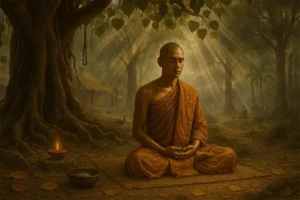
Buddha taught that suffering arises from resistance to what is. In a tragedy, there is pain — the loss itself — and there is the thought that it should not have happened. The first is inevitable; the second we add ourselves.
The Futility of Resisting Existence
When we condemn reality, we place ourselves above it. That resistance only increases suffering. We become separated from what is, as if our judgment could override the order of existence. In that separation lies the source of our unrest: the illusion that our perspective is decisive.
The Claim That It Is Better Never to Have Been Born
That idea represents the ultimate form of resistance to life. It positions human thinking as judge over existence. Yet non-being cannot exist; what lives merely changes form. Existence cannot be denied.
The mind that turns against life is itself an expression of that same life. That is why resistance is ultimately exhausting. You cannot win against reality. It moves without struggle, without violence — and remains standing, no matter how fiercely we oppose it.
The Invitation of Love
Unconditional love invites us to let go of judgment. That does not mean we ignore suffering or do not want to make a difference, but that our actions come from attunement rather than struggle. It is the difference between moving with the current or constantly rowing against the wind.
When we release our need for control, peace arises. Not because pain disappears, but because we learn to carry it differently — from connection rather than resistance. In that space, grief is not solved but absorbed. Even our resistance is allowed to exist. Ultimately, love embraces everything, even that which resists. And again and again it proves: what we call love keeps winning — quietly, but inevitably.
Sadhguru speaking:
Related Articles

Frequently Asked Questions
What is unconditional love?
Unconditional love means loving without conditions or expectations. It does not mean you approve of everything, but that the connection remains — even when behavior or circumstances are difficult.
Why does God allow suffering?
According to many spiritual traditions, humans have been given free will. This creates situations in which pain and suffering are possible. Suffering is therefore not a punishment or wish of God, but a consequence of the way life unfolds.
How can I cope with suffering?
By allowing pain rather than avoiding it. Suffering often decreases when we stop fighting what has already happened. True acceptance does not mean giving up, but facing reality without resistance.
Is God’s love unconditional?
Yes. God’s love is not limited by what we do or do not do. That does not mean everything is without consequence, but that love itself does not disappear. It remains present, even where we cannot feel it.
What is the difference between pain and suffering?
Pain is part of life — in loss, disappointment, or change. Suffering arises when we resist that pain, when we think it should not have happened. In that resistance, pain grows into inner struggle.