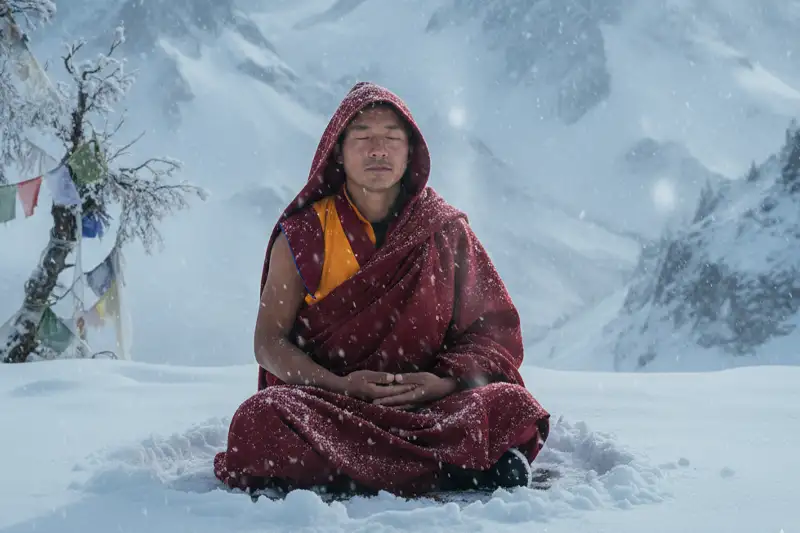
In 1981, Harvard cardiologist Dr. Herbert Benson proved that Tibetan monks can increase their body temperature using specific breathing techniques. What had long been considered impossible suddenly became measurable.
Monks wore only shorts at temperatures between 30°F and 39°F (-1 to 4°C). Their fingers and toes became more than 14°F (8°C) warmer during meditation. The human body apparently follows different rules than we thought—if you simply know how. Let’s explore this further.
The 5 Key Takeaways
- Tibetan monks reduce their oxygen consumption by 64%—compared to just 10% during normal sleep
- Their brains display a unique pattern: half relaxed, half hyperfocused during meditation
- Soaked sheets at 48°F (9°C) were completely dried by body heat in freezing rooms
- Vase breathing combines powerful inhalations with extreme visualization techniques
- Even inexperienced practitioners can increase their body temperature using these techniques
Dr. Benson Discovers Impossible Physiology in the Himalayas
With permission from the Dalai Lama, Dr. Herbert Benson and his team traveled to the Himalayas. They conducted experiments over ten years with Tibetan monks. Meditating monks in shorts showed temperature increases in their fingers and toes of more than 14°F (8°C)—while the body normally restricts blood flow to extremities in cold.
The team initially suspected measurement error. For days, they calibrated equipment and checked for leaks in oxygen masks. The results remained identical: these monks consumed 64% less oxygen during meditation—nearly unimaginable compared to the 17% achieved by Western meditators.
Half Brain Relaxed, Half Brain Focused
Benson had previously studied Western meditators and measured calm alpha wave activity in the brain. He wrote the book “The Relaxation Response” about it. With the Tibetan monks, he observed something entirely different: one brain hemisphere showed calm alpha waves, the other hyperactive beta waves.
This asymmetrical brain activity meant the monks were simultaneously deeply relaxed and extremely concentrated. Western meditation centered on letting go—the Tibetan variant on directed alertness. Two different approaches, two completely different effects on the nervous system.
Pros and Cons of Tummo Breathing
Pros
- Measurable increase in body temperature possible
- Oxygen consumption drops significantly with correct execution
- Combines deep relaxation with sharp focus
- Even beginners can experience effects
Cons
- Requires years of training for complete mastery
- Traditionally taught only after extensive preparation
- Visualization component demands extreme concentration
- Risk of incorrect application without guidance
Soaked Sheets Dry on Bare Skin at Freezing Temperatures
Toward the end of their research, Benson’s team witnessed something incredible. Monks dipped sheets in 48°F (9°C) water and wrapped them around their bodies. The room temperature was 39°F (4°C)—normally life-threateningly cold for soaked clothing.
Any normal body would begin uncontrollable shivering and potentially develop hypothermia. These monks remained calm, breathing and visualizing. Their core temperature even rose—and within hours, all sheets were completely dry. In Ladakh, yogis still organize competitions: who can dry between 16 and 34 wet sheets per night at temperatures of -12 to -29°F (-12 to -29°C).
Vase Breathing Creates Inner Fire
The Tummo technique Benson observed consists of two components. First, vase breathing: five powerful inhalations through the nose, exhaling through the mouth. On the fifth inhalation, you swallow the air, hold it in your belly, and tense your pelvic and abdominal muscles—your body takes on a pot-like shape.
Then comes intense visualization: you close your eyes and imagine fire rising from your core up your spine. This focus requires decades of training. Monks sometimes train for thirty years before reaching this depth of concentration—it’s not a trick you pick up in a weekend.
Glossary
- Alpha waves: Brain waves indicating relaxation and inner peace
- Beta waves: Brain waves associated with active concentration and alertness
- Tummo: Tibetan word for “inner fire,” an advanced meditation technique
- Vase breathing: Specific breathing technique where the belly takes on a pot-like shape
Skeptical Neuroscientist Becomes Convinced in Tibet
Dr. Maria Kozhevnikov, neuroscientist at Harvard and the National University of Singapore, was skeptical. She found Benson’s results about rising finger temperatures unremarkable—anyone can do that, she said. In an interview with The New Yorker, she stated: “Imagine putting your hands in warm water—eventually the temperature rises on its own.”
In January 2012, she traveled to the Omdo region in Tibet, known for Tummo practitioners. Inside the house where experiments took place, it was 35°F (1.5°C). She attached state-of-the-art thermometers to meditating monks and nuns. One monk raised his core temperature to 100.8°F (38.2°C)—a mild fever. Her skepticism vanished completely.
Modern Science Meets Ancient Wisdom
Alexandra David-Néel was the first Western woman to observe these practices. She described in her book “My Journey to Lhasa” how Tummo saved her own life during a snowstorm. Her lighter was soaked—with body heat, she dried her fire-starting equipment and managed to start a fire anyway.
Today, universities like Stanford, Yale, and Dartmouth systematically study these techniques. Wim Hof brought a variant of Tummo to the West—his method proves accessible even for beginners. Even inexperienced practitioners can increase their body temperature, though they don’t reach the extreme levels of monks trained for years.
| Researcher | Year | Key Finding |
| Dr. Herbert Benson | 1981-1991 | 64% reduction in oxygen consumption in monks |
| Alexandra David-Néel | 1911-1925 | First Western observations of Tummo |
| Dr. Maria Kozhevnikov | 2012 | Core temperature measured up to 100.8°F (38.2°C) |
Rhythmic Breathing Works Like a Pump
Danny and Jake from the YouTube channel “Breathe and Think Better” have practiced the Wim Hof Method for three years. They explain that rhythmic breathing functions like a pump. When you build momentum, you oxygenate every cell in your body more efficiently—similar to how shivering creates heat.
The difference: you stay calm and use your lungs as a heat generator. In Kozhevnikov’s research too, inexperienced meditators saw their temperature rise—purely through breathing patterns, without the visualization component. The techniques work partially even without years of training, though less extremely.
Conclusion
What seemed impossible for decades proves measurable and repeatable. Tibetan monks demonstrate that body and mind work together in ways that still astound modern science.
Whether you’re drying soaked sheets in the snow or simply improving your concentration—the underlying principles remain the same. Breathing and focused attention give more control over physiological processes than we ever thought possible. Perhaps this is only the beginning of what the human body truly can do.
Verified Sources
- https://news.harvard.edu/gazette/story/2002/04/meditation-changes-temperatures/ – Harvard research describes g-tummo and drying wet sheets at low ambient temperatures.
- https://www.nature.com/articles/295234a0 – Classic study (1982) on temperature increase in extremities during g-tummo.
- https://pmc.ncbi.nlm.nih.gov/articles/PMC3612090/ – PLoS ONE (2013): neurocognitive and somatic components of temperature increase during g-tummo.
- https://www.medicalnewstoday.com/articles/tummo-breathing – Accessible explanation of tummo, safety, and comparison with Wim Hof.
- https://www.sciencedaily.com/releases/2013/04/130408084858.htm – Summary of research on core temperature increase through meditation.
Related Articles





Frequently Asked Questions
What is Tummo meditation?
Tummo is a Vajrayana practice combining focused breath retention, muscle tension, and visualization to cultivate “inner heat”; the warmth is a known side effect, not the spiritual end goal.
Can you increase your body temperature through meditation?
Yes, advanced practitioners show skin and sometimes core temperature increases in studies; for beginners, effects are more limited and heavily dependent on technique and training.
How do Tibetan monks increase their body temperature?
Via g-tummo: cycles of powerful breathing and breath retention (vase breath), light muscle contractions, and intense visualization around the navel area, with years of guided training.
Is the Wim Hof Method the same as Tummo?
No. There are similarities in breathing and cold exposure training, but Tummo has a tantric-Buddhist context with strong visualization; the Wim Hof Method is secular and focused on performance and health.
Is Tummo meditation safe to practice on your own?
Only under guidance. Incorrect execution can cause dizziness or shortness of breath; avoid it with heart or lung problems, pregnancy, and don’t combine it with water or driving.