Training changes far more than what’s visible in muscle mass or fitness level. What movement does at the molecular level is becoming increasingly detailed thanks to research showing how physical exertion directly impacts your cellular function and genetic regulation.
Over the past two decades, it’s become clear that muscle activity reaches far beyond local strain. During exercise, muscles produce substances that influence organs like your brain and liver. At the same time, gene expression and mitochondrial activity change measurably within a timeframe of minutes to weeks. Adaptation happens on multiple levels simultaneously — structural, functional, and biochemical.
The 5 Key Takeaways
- Muscles release signaling molecules during training that influence organs like the brain, liver, and fat tissue
- Your DNA structure remains the same, but genes are read differently through shifts in methylation patterns
- Mitochondria increase in number and become more efficient after repeated training stimuli
- Strength and endurance training each trigger their own molecular processes
- Some adaptations occur almost immediately, while others only appear after prolonged exertion
The Molecular Response to Movement: From Signal to Gene
Every muscle contraction triggers a chain reaction of biochemical processes. Enzymes are activated, calcium ions flow in, and energy stores are tapped. All these signals force your cells to adjust their operations. How quickly gene expression changes after exercise depends on intensity, volume, and repetition, but initial changes are measurable in blood tests within half an hour.
The impact of intense exercise on muscles is substantial, as it leads to both structural and functional adaptations in muscle tissue. As time progresses, biochemical changes continue to accumulate, resulting in improved performance and recovery capacity. This process underscores the importance of consistent training and the role of adequate nutrition in athletic performance.
The MoTrPAC project has identified thousands of molecules that respond to movement. This data shows that your body doesn’t react in one place, but as an interconnected system. Muscles, the immune system, the liver, and the brain are linked through a network of signaling molecules. Which response occurs depends heavily on the type and duration of training.
Myokines as Muscle Messengers: Communication Between Organs
Muscles function not only as movement organs but also behave like hormonal glands. They produce so-called myokines — proteins that reach other organs via the bloodstream. Interleukin-6, for example, plays a role in fat burning, while irisin is involved in conversion to brown fat, which contributes to heat production and better blood sugar regulation.
Thanks to these signaling molecules, movement has effects throughout your entire body. Omics analyses show that a single workout can influence the composition of hundreds of circulating proteins. Some of these work as anti-inflammatory agents, while others support brain function or influence metabolic processes in the liver and fat tissue.
DNA Methylation and Histone Adjustments After Exertion
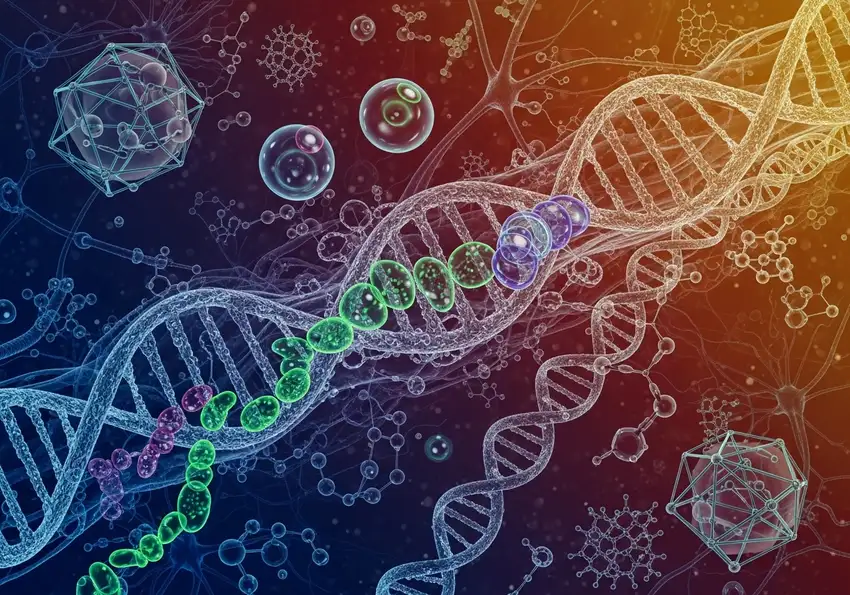
Your DNA itself remains identical, but the way certain genes are expressed changes through chemical markers. How exercise changes DNA methylation has now been thoroughly researched. During and after exertion, methyl groups attach to specific locations on DNA, determining which genes are temporarily suppressed or made more accessible for reading.
A systematic review from 2024 shows that both short and prolonged exertion influence methylation patterns. Genes involved in energy production, inflammatory processes, and recovery are particularly responsive. These adaptations don’t disappear immediately when you stop training — they often remain measurable for months, pointing to a form of biological memory in your cells.
Mitochondria and Energy Management: Training as an ‘Upgrade’
Mitochondria are your cells’ energy factories. How many you have and how well they function largely determines what you’re physically capable of. The effect of movement on mitochondrial function shows itself in both numbers and performance: you create more mitochondria and existing structures become more efficient at converting fuel into usable energy (ATP).
Training activates the protein PGC-1α, which plays a key role in mitochondrial production. Multi-omics analyses show that this adaptation comes with changes in enzymes essential for oxygen use. Especially with endurance training, fiber types with higher mitochondrial density develop. Strength training follows a different route with different cellular responses.
Pros and Cons of Molecularly-Targeted Training
Pros
- Long-lasting changes in gene expression and metabolism without medication
- Increased mitochondrial capacity improves endurance and recovery
- Anti-inflammatory myokines reduce risk of chronic disease
- Epigenetic adaptations can sustain positive health effects over longer periods
Cons
- Overtraining can overstimulate inflammatory pathways and disrupt recovery
- Individual genetic variation determines how strongly someone responds to training
- Adaptations require consistency — stopping leads to partial loss within weeks
- Not all molecular changes are fully understood or predictable
Difference Between Strength Training and Endurance Training at the Cellular Level
The difference between strength training and endurance training in cells lies in the signaling pathways that are activated. Strength training under high load primarily activates mTOR, leading to muscle growth and increased protein synthesis. Endurance training, on the other hand, activates AMPK, which promotes energy conservation and stimulates the creation of new mitochondria.
Both processes can coexist as long as your training schedule is designed accordingly. Physiological models confirm that combination programs are effective — provided timing is carefully chosen. Someone training for maximum strength follows a different path than someone focused on endurance capacity or recovery ability.
Brain Plasticity and Cognitive Pathways Through Exercise
Movement also affects how your brain works. Through circulating growth factors like BDNF, more connections form between nerve cells. This factor supports the creation of new nerve structures and strengthens existing networks. How exercise affects the brain and memory is increasingly well-researched — endurance training appears to raise BDNF levels, which correlates with sharper thinking and better memory.
Additionally, myokines like cathepsin B influence inflammatory processes in the central nervous system. This may offer protection against cognitive decline in later life. This interplay between muscle and brain — via chemical messengers — underscores that physical training triggers a system-wide response that extends beyond muscle mass or fitness level.
Glossary
- Myokine: Signaling protein secreted by muscles that influences other organs
- DNA methylation: Epigenetic adaptation in which methyl groups attach to DNA and regulate gene expression
- Mitochondrion: Cell organelle that produces ATP through oxidative phosphorylation
- PGC-1α: Protein that coordinates mitochondrial biogenesis and energy metabolism
Practical Protocol: How to Activate Health Pathways Through Training
To make optimal use of which myokines are released during exertion, you need a thoughtful schedule. Three to four sessions per week provide a workable foundation. Combine short interval bursts with longer cardio blocks. Intervals stimulate AMPK and prompt your body toward rapid energy provision. Endurance training, by contrast, increases mitochondrial density, providing sustained energy delivery.
Add strength training on different days or as a finisher after your endurance work, so mTOR signaling isn’t activated simultaneously with AMPK. Rest periods are essential during this process. Recovery isn’t optional — it’s when your body actually changes. Structural overload causes dysregulation instead, undermining health rather than supporting it.
| Training Type | Primary Signaling Pathway | Key Molecular Effect |
| HIIT (high intensity) | AMPK / PGC-1α | Increased mitochondrial biogenesis, improved glucose uptake |
| Endurance training (moderate pace) | AMPK / oxidative enzymes | Greater mitochondrial density, increased fat metabolism |
| Strength training (heavy load) | mTOR / IGF-1 | Muscle hypertrophy, increased protein synthesis |
| Combined program | AMPK + mTOR (phased) | Broad adaptation in both strength and endurance |
Timing and Dose: When Molecular Changes Occur
Certain responses happen almost immediately. Calcium signaling and myokine release begin within minutes of starting a workout. Gene expression typically shifts after about half an hour. Genes involved in inflammation control and energy balance respond especially strongly.
Epigenetic adaptations require a longer timeframe. Only after several weeks do DNA methylation patterns become more stable. For mitochondrial improvements, the turning point falls between 6 and 8 weeks (42–56 days) of consistent training. Stop abruptly after that, and you’ll lose some gains. Yet some traces of cellular memory persist longer than measurable performance improvements suggest.
Conclusion
Training changes your biological settings without altering your genetic material. What movement does at the molecular level is now well-mapped: an interplay of signaling pathways, gene expression, and epigenetic adaptation that explains why movement has such broad effects.
Those who understand these processes can better tailor training to their desired goal — whether that’s muscle strength, endurance, mental sharpness, or metabolic health. What matters is keeping load and recovery in balance. Only then do biochemical signals translate into lasting, physical change.
Verified Sources
- https://www.nature.com/articles/s41586-023-06877-w – Nature paper (MoTrPAC) with a time-dynamic multi-omics map of training response.
- https://www.cell.com/cell-metabolism/fulltext/S1550-4131%2823%2900472-2 – Cell Metabolism: mitochondrial multi-omics response to training.
- https://motrpac.org/ – Official MoTrPAC site with background on the program and datasets.
- https://pubmed.ncbi.nlm.nih.gov/38839665/ – Systematic review (2024) on effects of movement on DNA methylation.
- https://www.allesoversport.nl/thema/gezonde-leefstijl/wat-gebeurt-er-in-je-lichaam-bij-bewegen/ – Explanation of body processes during movement.
Related Articles





Frequently Asked Questions
Does movement and exercise change your DNA? How does that work and what are the effects?
Exercise doesn’t change your DNA code, but it does change the ‘on/off’ switch of genes through epigenetic processes like DNA methylation and histone modification. This allows cells to adapt and improve energy management and recovery, among other things.
What happens in your body when you move?
Within minutes, heart rate, breathing, and blood flow increase; muscles release signaling molecules (myokines), and at the cellular level, pathways are activated that stimulate energy production, recovery, and adaptation.
How movement affects your brain: does exercise make you smarter?
Exercise increases blood flow and activates myokines and neurotrophic factors that support learning, memory, and mood; regular training is associated with better cognitive function.
What are myokines and why are they so important?
Myokines are proteins secreted by contracting muscles. They send signals to organs like the liver, fat tissue, and brain and play a role in inflammation reduction, metabolism, and recovery.
What happens in your body during exercise?
Your body shifts to higher energy demand: glucose and fat burning increase, mitochondria work harder, and molecular triggers emerge that lead to greater endurance and strength after repeated training.
Continue reading
- Eaten Too Much Ultra-Processed Food? Use This Step-by-Step Plan to Reset Your Gut Flora and Brain in Time – Junkfood Defense!
- Creatine at 50: Facts and Misconceptions Explained + Creatine Calculator
- Oops! Does Chronic Stress Really Shut Down Your Immune System and Digestion?
- TB-500 (Thymosin Beta 4) Explained: How It Works, Benefits, and Dosing of This Peptide