
Anyone who thought whey protein was unbeatable now faces an old acquaintance in fresh packaging. Beta-lactoglobuline turns out to deliver far more leucine — and that sounds promising for those serious about muscle building.
Yet recent research shows that more leucine in your bloodstream doesn’t automatically mean you’ll build more muscle tissue. The theory checks out, but the practice is more nuanced. And that’s exactly what makes this story interesting for anyone who wants to strategically manage their protein intake.
The 5 Key Takeaways
- BLG contains more leucine than standard whey protein — why that still doesn’t always lead to more muscle growth
- Younger athletes seem to gain little extra benefit, older athletes possibly more
- The leucine threshold varies significantly by age group
- BLG-100 is often presented as a purer alternative, but the question is: for whom?
- Allergenic properties are comparable to regular whey — but individual tolerance plays a role
Beta-lactoglobuline: definition, origin, and role within whey
BLG is actually no stranger. It makes up approximately 50 to 60 percent of the protein content in whey, meaning you’ve been consuming it for years if you use whey protein. Only now it’s being isolated and concentrated and sold as a separate supplement. This is comparable to how casein was once filtered from milk — technically nothing new, but a commercial shift nonetheless.
What distinguishes BLG is that it belongs to the lipocaline family. These are transport proteins that can naturally carry smaller molecules, which in theory could contribute to bioavailability. In practice, it’s a protein fraction that absorbs faster and contains less lactose than standard whey isolate.
BLG-100: composition, purity, and leucine profile
BLG-100 is presented as the purest possible form of beta-lactoglobuline, often above 95 percent purity. The key assumption: because leucine is crucial for triggering muscle protein synthesis, higher leucine intake should automatically be better. In practice, research on young men showed that BLG indeed raised blood leucine more than an isonitrogenous dose of whey isolate.
Yet this didn’t lead to measurable differences in muscle growth or strength after eight weeks of resistance training. Even muscle protein synthesis — the direct measure of protein production — showed no difference. This raises the question: is the added value in a different mechanism, or is it mainly a matter of timing and target population?
Pros for muscle building and recovery at low doses
Here’s where it gets interesting. Older adults have an elevated leucine threshold — they need more leucine to achieve the same muscle protein synthesis as younger people. Research on men under catabolic conditions showed that BLG has a stronger insulin-stimulating effect than casein or standard whey protein. This suggests it may have value particularly in older individuals or during recovery periods.
The hypothesis: if you meet the leucine sensitivity threshold — for example, above age sixty — then that extra leucine spike could make a difference. But that’s still speculation. The available data focused mainly on young, healthy men who were already getting sufficient leucine from regular whey protein.

Allergenic properties and practical tolerance tips
BLG is one of the major allergens in cow’s milk. Those sensitive to whey protein often react specifically to this protein. This means that BLG-100 in isolated form provides essential amino acids, but simultaneously carries higher risk for those with milk protein allergies. Whey isolate still contains BLG, but in lower concentrations and often mixed with other fractions.
For those who are only lactose intolerant, this matters less — BLG contains minimal lactose. Still, it’s wise to build up gradually if you’ve previously had digestive issues with whey protein. Start with half a serving, see how your body responds, and only then decide whether you want to fully switch.
Comparison: BLG vs. whey isolate vs. casein
Whey absorbs quickly, casein slowly, and BLG sits somewhere in between — with a slightly faster peak leucine uptake than standard whey. Their amino acid profiles are comparable, but the ratios differ slightly. Whey isolate often contains other fractions like lactoferrin and immunoglobulins, which may contribute to immune support. BLG is purer, but therefore also narrower in function.
Casein remains interesting for overnight recovery or longer periods without food. Those who want to benefit immediately after training from a quick leucine boost would instead choose whey or BLG. The question is whether that extra percentage of leucine actually makes a difference for someone already eating and training adequately — and I doubt it.
Pros and cons of beta-lactoglobuline (BLG-100)
Pros
- Higher leucine uptake than standard whey protein
- Possibly more effective in older athletes with reduced leucine sensitivity
- Fast absorption, comparable to whey isolate
- Lower lactose content than standard whey concentrate
Cons
- No proven added value in young, healthy athletes
- Higher allergen risk for those sensitive to milk protein
- Considerably more expensive than regular whey isolate
- Limited studies in older populations or sarcopenia
Leucine threshold and age-related sensitivity
Young athletes experience a significant increase in muscle protein synthesis at relatively low leucine intake. Above a certain point, extra leucine provides little to nothing — that’s called the ceiling effect. Older people actually need a higher threshold to trigger that synthesis at all. This means the same serving of whey protein may be less effective in a sixty-year-old than in a twenty-year-old.
This is where BLG could theoretically play a role. The higher leucine spike might make it easier for older people to reach the threshold. Only: that hasn’t been firmly established through research yet. Most studies focused on young subjects, where the difference turned out to be negligible. A study comparing BLG versus whey in people over sixty would finally provide real answers.
Practical application and dosing
For those who still want to experiment: a standard dose is around 20 to 25 grams of BLG per shake, comparable to a standard whey serving. You can take it right after training, or spread it throughout the day if you have trouble with larger portions. The leucine uptake peaks within an hour, so timing around your training can be worthwhile — though the effect in healthy young people is probably minimal.
If you’re older and notice recovery is slower, you might consider replacing part of your whey intake with BLG. Keep in mind that this is more expensive, and you might achieve the same effect simply by taking a bit more regular whey protein. It’s a personal choice, not a miracle cure.
Glossary
- Beta-lactoglobuline (BLG): The primary protein fraction in whey, accounting for approximately 50–60% of total protein content
- Leucine: An essential amino acid that activates muscle tissue production via the mTOR signaling pathway
- Muscle protein synthesis: The process by which cells create new proteins for muscle repair and growth
- Isonitrogenous dose: Equal amounts of nitrogen (and therefore protein) in different foods or supplements
Scientific context and limitations
Current research does show higher leucine uptake with BLG, but the translation to actual muscle growth is largely absent. One study lasted eight weeks, which is long enough to see adaptations — yet no differences were found in lean mass or strength. This suggests that the leucine threshold in young athletes is already met with standard whey protein.
Furthermore, there are no long-term studies examining effects on sarcopenia or in people with insulin resistance. The hypothesis that BLG is especially valuable for older populations remains unproven for now. In fact, comparative data is lacking to make firm statements about who truly benefits.
| Feature | BLG-100 | Whey Isolate | Casein |
|---|---|---|---|
| Absorption speed | Fast | Fast | Slow |
| Leucine content | High | Medium-high | Medium |
| Allergen risk | High | Medium | Low |
| Price per serving | High | Medium | Low |
| Suitable for older adults | Possibly | Yes | Yes |
Conclusion
BLG does deliver more leucine than standard whey protein, and that sounds convincing on paper. Yet available studies show that in young, healthy athletes, this doesn’t lead to measurably more muscle growth or strength — the leucine threshold is apparently already met with whey protein.
For older athletes or people with reduced leucine sensitivity, BLG could be interesting, though hard evidence is still lacking. Until then, whey protein remains the most logical choice for most people — effective, affordable, and widely available. BLG is no revolution, but perhaps a refinement for a specific group.
Consulted sources:
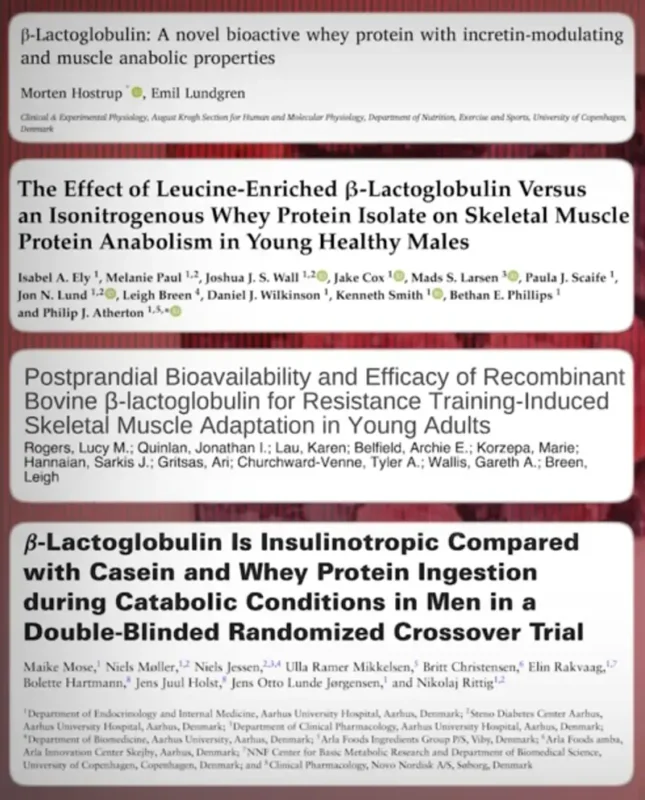
- https://doi.org/10.1016/j.jnphys.2025.100007 – Review article on bioactive properties of beta-lactoglobuline
- https://doi.org/10.3390/nu17213410 – Comparative study between leucine-enriched BLG and whey isolate in young men
- https://doi.org/10.1249/MSS.0000000000003756 – Research on bioavailability and effectiveness of BLG in resistance training
- https://doi.org/10.1093/jn/nxab010 – Study on insulinotropic effects of BLG under catabolic conditions
Related Articles





Frequently Asked Questions
What is beta-lactoglobuline (BLG)?
Beta-lactoglobuline (BLG) is the primary whey protein in cow’s milk. It belongs to the lipocalins and provides essential amino acids, with a relatively high leucine content.
Is beta-lactoglobuline the same as whey?
Whey is a mixture of multiple protein fractions. BLG is one specific fraction within whey and makes up the largest portion of it.
What is the difference between BLG and regular whey protein?
BLG is an isolated fraction from whey and contains more leucine per gram of protein. Regular whey protein consists of multiple fractions, such as BLG, lactoferrin, and immunoglobulins. The potential advantage of BLG is described mainly in theory; in practice, young athletes usually see no clear difference in muscle growth.
How does BLG-100 differ from whey isolate?
BLG-100 consists almost entirely of beta-lactoglobuline. Due to its higher leucine and BCAA content, an equal protein dose can produce a stronger amino acid peak. The practical relevance depends on age, total protein intake, and training context.
How much leucine is in a standard serving of BLG?
A 25-gram serving of BLG-100 contains approximately 3.5 to 4 grams of leucine, depending on purity. Whey isolate delivers around 2.5 to 3 grams of leucine in the same serving.
Can BLG help with sarcopenia or muscle mass loss in older age?
As we age, the leucine threshold increases. Therefore, a higher leucine spike could theoretically contribute to the protein response. Targeted intervention studies in older adults are still lacking, so conclusions remain cautious for now.
Is BLG suitable for people with a milk allergy?
BLG is a known milk protein allergen. People with milk protein allergies often react specifically to beta-lactoglobuline. Lactose intolerance is separate from this, since BLG contains virtually no lactose.
Is BLG worth the money if you already use whey isolate?
For many athletes, BLG provides no clearly measurable advantage when total protein intake is already sufficient. The higher cost and limited practical support make it mainly relevant in specific situations, such as reduced appetite or higher leucine requirements.