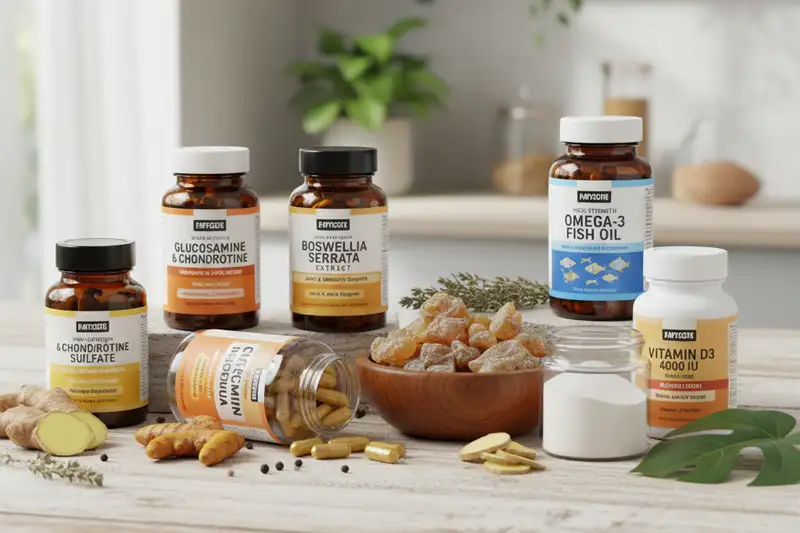
Joint pain and osteoarthritis affect millions of people worldwide, but not all joint supplements are truly effective. Science shows that some natural remedies can indeed help with inflammation and pain.
From curcumine to collagen: there’s supposedly a confusing array of products with promises. But which supplements actually have proven benefits and which are mostly marketing? We break down the facts based on the latest scientific research.
The 5 Key Takeaways
- One supplement performs as well as painkillers in studies, but without side effects
- Collagen actually works, but only in the right form and dosage
- Most people take vitamin D incorrectly and miss the benefits
- Two ancient herbs outperform modern supplements in clinical studies
- Combinations often work better than single supplements, but timing matters
1. Curcumine
Curcumine, the active compound in turmeric, emerges from research as a real winner. Studies show this anti-inflammatory supplement achieves comparable results to ibuprofen and naproxen, but without stomach and heart risks. It works through important inflammation pathways like NF-κB and COX-2.
The biggest hurdle is absorption by the body. Curcumine is barely absorbed without helper compounds like piperine from black pepper. Always choose supplements with proven absorption technology like liposomal formulas.
2. Boswellia Serrata
This Indian frankincense tree may deliver the most underrated joint supplement. Scientific research confirms that Boswellia extract effectively reduces pain and improves mobility, especially for knee osteoarthritis. Effects typically appear after four weeks of consistent use.
Boswellia inhibits the enzyme 5-lipoxygenase, which produces inflammatory compounds that damage cartilage. Because it works through a different pathway than curcumine, both natural pain relievers can be combined well without interactions.
3. Collagen
Hydrolyzed collagen has shown remarkably positive results in recent studies. It apparently stimulates new cartilage production and inhibits inflammatory factors. Type II collagen likely works best through immune modulation, while hydrolyzed collagen is better absorbed.
The optimal dosage is between 8-12 grams per day, preferably on an empty stomach. Marine collagen (fish) is also being studied, but has less scientific support than beef or pork collagen.
Pros and Cons
Benefits of Natural Supplements
- Fewer side effects than synthetic painkillers
- Addresses underlying inflammation processes
- Possible protection against further joint damage
- Often compatible with regular medication
Drawbacks of Supplements
- Effects take longer than medications
- Quality varies significantly by brand
- Not always covered by health insurance
- Possible interactions with blood thinners
4. Glucosamine and Chondroitin
This combination has been used for decades and has moderate but consistent effects on pain and joint function. Meta-analyses confirm that glucosamine sulfate is preferred over glucosamine HCl due to better stability and absorption.
Chondroitin helps retain water in the joint space and inhibits enzymes that break down cartilage. The effect is especially noticeable in milder forms of osteoarthritis and in people who supplement consistently for months.
5. Omega-3 Fatty Acids
EPA and DHA from fish oil have proven anti-inflammatory properties, but their effect on joints is more modest than often claimed. Research shows small but statistically significant improvements in pain and mobility with regular use of omega-3 supplements.
The dosage must be significantly higher than for heart health: at least 2-3 grams of EPA/DHA per day. Plant-based omega-3 from algae likely works equally well, but requires higher doses because conversion in the body is less efficient.
Glossary
- Curcumine: Active anti-inflammatory compound from turmeric
- Boswellia: Resin extract from the Indian frankincense tree
- Hydrolyzed collagen: Pre-digested protein that supports cartilage
- Glucosamine: Building block of cartilage and joint fluid
6. Vitamin D
Vitamin D deficiency is linked to more joint pain and faster cartilage loss. Supplementation provides small but measurable improvements, especially in people with low blood levels. Studies suggest that vitamin D3 works better than D2.
However, most people take far too low doses. For joint health, 2000-4000 IU per day is often needed, depending on body weight and blood levels. Get your levels tested and aim for a blood value of 75-125 nmol/L.
7. Ginger
Ginger contains anti-inflammatory compounds like gingerol, but clinical studies show mixed results. Bioavailability is low and higher doses can cause stomach issues. Ginger supplements perform worse than curcumine or Boswellia in direct comparisons.
In fresh form as tea or cooking spice, ginger is a valuable addition to an anti-inflammatory diet. As a main joint supplement, however, it falls short of expectations.
Conclusion
Curcumine and Boswellia emerge as clear winners from scientific research, followed by collagen supplements and the classic glucosamine-chondroitin combination. Vitamin D works mainly preventively in people with a deficiency.
Quality varies enormously between brands, so choose standardized extracts with proven absorption technology. Combine different supplements for optimal effect, but give each remedy at least 6-8 weeks to work. For serious complaints, consultation with your doctor or specialist remains essential.
Related Articles





Frequently Asked Questions
How long does it take for joint supplements to work?
Most people notice first improvements after 4-6 weeks. Curcumine and Boswellia can show effects after 2 weeks, while collagen and glucosamine often require 2-3 months of consistent use for optimal results.
Can supplements reverse joint damage?
Supplements can reduce inflammation and slow further damage, but they cannot fully repair damaged cartilage. They work mainly preventively and for pain relief, not curatively for advanced osteoarthritis.
Are there side effects from natural joint supplements?
Most natural supplements have few side effects, but curcumine and ginger can cause stomach issues. Boswellia and omega-3 can have blood-thinning effects, which is relevant when taking medications.
Which supplements should I combine?
Curcumine with Boswellia work excellently together because they work through different pathways. Add collagen if desired and preferably omega-3 for broad anti-inflammatory coverage.
Are expensive brands better than cheap alternatives?
Price doesn’t tell the whole story, but quality does vary significantly. Look for standardized extracts, absorption technology, and independent test results. Cheap supplements often contain too-low concentrations of active compounds.
Continue reading
- Arthritis and Collagen: Small Step Forward or Just Another Marketing Story?
- Holistic Health: More Than Just Your Body – A Life in Balance Between Body, Mind, and Soul
- Everything You Need to Know About Glycine and More
- What is Mindfulness? Practical Explanation, All Benefits Listed + Practical Exercises