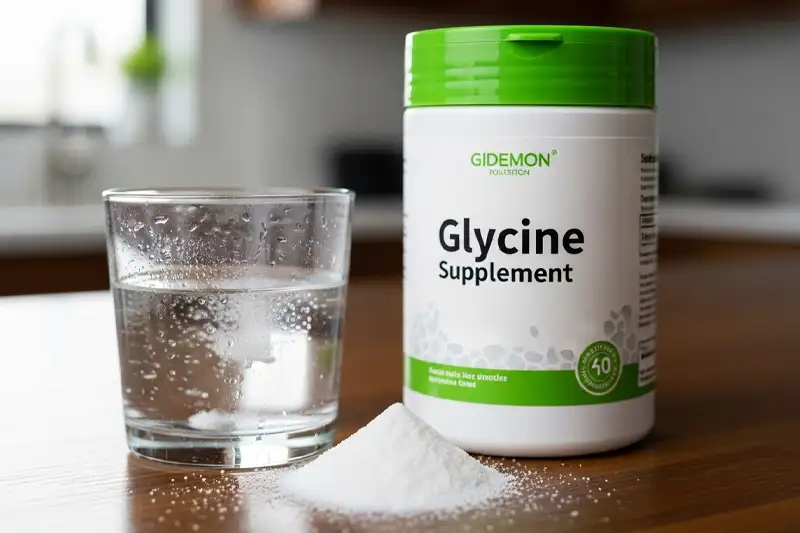
Glycine is an amino acid you probably haven’t heard much about, but it plays an indispensable role in your body. From muscle recovery to sleep quality: this small molecule does far more than you might think.
It’s found in every protein you eat, broken down into individual building blocks, and reassembled wherever your body needs it. Yet glycine often flies under the radar, even though it’s involved in processes that affect you daily. Time to set the record straight.
The 5 Key Takeaways
- Glycine forms the foundation of a crucial antioxidant that protects your cells
- It supports muscle recovery and is therefore essential after training or surgery
- This amino acid helps keep your blood sugar levels stable
- As a neurotransmitter, it can calm your brain and promote sleep
- In some people, glycine actually has a stimulating effect due to genetic variation
Introduction to Glycine
When you eat proteins, your digestion breaks them down into peptides and then into individual amino acids. Glycine is one such amino acid that travels through your bloodstream to your liver, where it enters a kind of reserve pool. From that pool, amino acids can be recombined into the specific proteins your body needs.
It’s essentially a clever recycling system: what you eat gets dismantled and rebuilt according to your unique needs. Glycine takes a central position in that process, precisely because it’s so versatile.
Glycine and Glutathione
One of glycine’s most important jobs is participating in the production of glutathione. This tripeptide consists of three amino acids—glycine, glutamine, and cysteine—and is often called the master antioxidant. Glutathione protects your cells against oxidative damage and helps break down toxic substances.
Without enough glycine, glutathione production stalls, which means your immune system may work less effectively. That makes glycine essentially indispensable for your overall resilience.
Protein Synthesis and the Amino Acid Pool
After entering your bloodstream, amino acids that aren’t used immediately go to your liver. There they form an amino acid pool, a strategic reserve your body draws from when it wants to build new proteins. Glycine plays an active role in this.
That reserve makes it possible for your body to respond quickly to changing needs—for example, after intense training or while recovering from an injury. Protein synthesis therefore depends not only on what you eat, but also on how efficiently your body stores and reuses amino acids.
Glycine Pros and Cons
Pros
- Supports the production of glutathione, your most important antioxidant
- Promotes muscle recovery and tissue repair after exercise or surgery
- Can help stabilize blood sugar levels
- Acts as a calming neurotransmitter in most people
Cons
- In certain genetic variants, it’s stimulating rather than calming
- Can cause unwanted effects when magnesium levels are low
- Effects vary significantly from person to person
- Less researched than other sleep supplements
Glycine for Strong Muscles and Recovery
Muscle recovery requires more than just rest. Glycine is an essential part of the entire recovery process, especially for people who train intensively or are recovering from surgery. The amino acid provides building blocks for new muscle tissue and supports the repair of damaged fibers.
Orthopedic procedures, for example, require extra glycine because bone and muscle tissue need to be rebuilt. While glycine is just one piece of the larger puzzle, it’s definitely an important piece you can’t afford to miss.
Blood Sugar and Insulin Balance
Your blood sugar levels fluctuate throughout the day, depending on what you eat and how your body responds. After a carbohydrate-rich meal, your blood sugar rises, then your pancreas releases insulin to get that sugar into your cells. Glycine plays a supporting role in this delicate balance.
The amino acid may help dampen those fluctuations and contribute to more stable energy levels throughout the day. That doesn’t mean glycine solves diabetes problems, but it can support a blood sugar balance that’s already reasonably in order.
Glossary
- Amino acid: Building block of proteins, needed for countless processes in the body
- Glutathione: Powerful antioxidant consisting of three amino acids
- Neurotransmitter: Chemical substance that transmits signals between nerve cells
- Chloride channel: Structure in cells that opens to allow chlorine through, producing a calming effect
Glycine as a Neurotransmitter
Beyond its role in protein synthesis, glycine also functions as a neurotransmitter. It belongs to a small group of substances that open chloride channels in your brain cells. That opening inhibits electrical activity, allowing your nervous system to calm down—similar to how GABA works, but through a different mechanism.
GABA may be better known because there are medications based on it, but glycine essentially does the same thing. It opens a chloride channel, slowing the transmission of nerve impulses. That’s why it can have a calming effect, especially in the evening.
Glycine and Sleep Support
Many people use glycine specifically for better sleep. The theory is simple: by opening chloride channels, it dampens activity in your brain and makes it easier to fall asleep. In practice, this works reasonably well for a large portion of users.
A common dose is between 500 and 1000 milligrams (0.018–0.035 oz), often taken with some tea before bed. It tastes slightly sweet and dissolves easily. Still, glycine is no miracle cure—individual reactions vary enormously.
| Dosage | Timing | Expected Effect |
|---|---|---|
| 500–1000 mg (0.018–0.035 oz) | 30–60 min before sleep | Calming, better sleep onset |
| 1000–3000 mg (0.035–0.106 oz) | Before bed or spread throughout the day | Deeper sleep, muscle recovery |
| 3000+ mg (0.106+ oz) | Spread across multiple times | Research purposes, medical advice needed |
Genetics and Different Responses
Here’s where it gets interesting: not everyone has a calming response to glycine. In a smaller portion of the population, the amino acid actually activates an excitatory receptor, leading to the opposite effect. Instead of becoming sleepy, you become alert and nervous.
This is genetically determined and not something you can easily test beforehand. That’s why it’s wise to start with a low dose—500 milligrams (0.018 oz)—and see how you respond. Do you feel calm or tired? Then it’s probably working as intended. Do you feel energized instead? Then glycine for sleep support probably isn’t right for you.
Glycine with Magnesium
Glycine works closely with magnesium. If your magnesium levels are too low, glycine may not work as well—or may even be slightly stimulating instead of calming. Magnesium helps nerve cells stay calm and supports the function of inhibitory neurotransmitters.
Many people who use glycine therefore combine it with magnesium, especially forms like magnesium glycinate or magnesium threonate. That combination often works more effectively than glycine alone, especially if you’re deficient in both substances.
How Is Glycine Produced?
Industrially, glycine is produced primarily through chemical synthesis. Additionally, classical methods exist such as the Strecker synthesis, and there is growing interest in biotechnological fermentation processes. Historically, glycine was also isolated from protein hydrolysates like gelatin, but that route has limited relevance today.
Core Production Routes
-
Amination of monochloroacetic acid (chemical route) — In this process, monochloroacetic acid reacts with ammonia. The resulting product is then purified and crystallized. This is the most widely used method globally due to scalability and high yield. patents.google.com+1
-
Strecker synthesis (classical organic route) — A mixture of an aldehyde, ammonia, and cyanide forms an aminonitrile that is converted into an amino acid via hydrolysis. For glycine, this route is historically important and still found in industrial literature. Wikipedia
-
Verified Sources
Process Details and Byproducts
-
Chemical routes often produce salts such as ammonium chloride or hydrochloric acid as byproducts. These are usually recycled or processed. Purification occurs through neutralization, filtration, crystallization, and drying. patents.google.com+1
Application and Quality Levels
For nutritional and pharmaceutical applications, glycine is brought to a higher purity level than the technical variant used in industrial processes. The choice of route and purification is therefore closely tied to the intended end use. Wikipedia
Conclusion
Glycine isn’t a household name in the supplement world, but it actually deserves more attention. It supports your antioxidant system, helps with muscle recovery, and can improve your sleep—provided you’re genetically inclined to have a calming response to it.
What stands out is the variation in individual response. Where one person sleeps excellently on it, another becomes agitated. That makes it all the more important to start cautiously and carefully observe how your body reacts. Expert advice, but without false promises.
- https://www.webmd.com/vitamins/ai/ingredientmono-1072/glycine – Overview of safety, side effects, and short-term dosing.
- https://www.sohf.nl/nutrienten/glycine – Information sheet on function, sleep, and possible side effects.
- https://pmc.ncbi.nlm.nih.gov/articles/PMC10828290/ – Review of effects including sleep and fatigue.
- https://sleepdoctor.com/pages/sleep-aids/glycine-for-sleep – Sleep-specific background and usage context.
- https://en.wikipedia.org/wiki/Glycine – Basic information about the amino acid (structure, function, collagen).
Related Articles


Frequently Asked Questions
What does glycine do in the body?
Glycine is an amino acid involved in the production of glutathione, muscle recovery, protein synthesis, and blood sugar regulation. It also functions as a neurotransmitter that can calm your nervous system.
How much glycine per day is safe?
For sleep support, 500 to 1000 milligrams (0.018–0.035 oz) are typically recommended, taken before bed. Higher doses up to 3000 milligrams (0.106 oz) are sometimes used, but consult an expert if in doubt.
Does glycine help with sleep?
In many people, glycine works by opening chloride channels in the brain, which inhibits nerve activity. However, not everyone responds the same way—some feel stimulated due to a genetic variant.
When should you take glycine?
For sleep, take glycine best 30 to 60 minutes before bed. For muscle recovery, it can be spread throughout the day, for example after training or with meals.
What side effects does glycine have?
Most people experience no side effects at normal doses. Occasionally mild digestive discomfort occurs, and in a small group, glycine is stimulating rather than calming due to genetic differences.