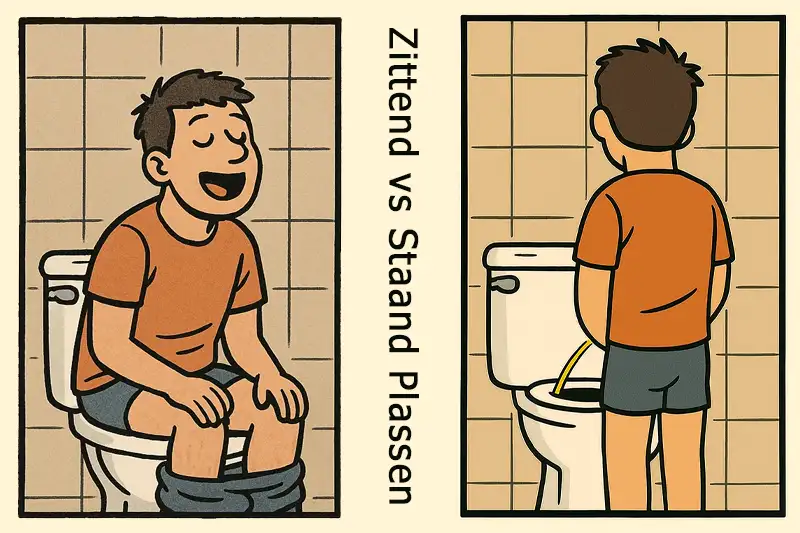
Many opinions about urination posture are culturally determined. Historically and evolutionarily, there is no innate rule that men must stand and women must sit while urinating. Our closest relatives (apes) urinate both standing and squatting — and simply keep walking while doing so (The Guardian).
Only modern Western culture has strongly standardized standing urination for men (partly due to clothing and toilet design). Biologist Ben Garrod argues that standing urination has no proven evolutionary advantage: “Great apes don’t mark territory” and “it doesn’t matter evolutionarily how we urinate” (same source).
In antiquity as well, both men and women typically urinated in a squatting position, and it was only with the rise of modern trousers and sanitary facilities that the habit of standing upright developed primarily among men.
Have men worldwide always urinated standing up, or is that a modern Western practice?
The claim that “only modern Western culture has standardized standing urination for men” is actually stated too definitively.
When we look at anthropological and historical data, the truth is more nuanced:
1. Prehistory and indigenous peoples
There is no evidence that men in hunter-gatherer cultures routinely urinated sitting down. Observations of contemporary tribal groups (e.g., the San in South Africa, the Yanomami in South America, and various peoples in Papua New Guinea) show that men typically urinate in a squatting or half-standing position — depending on terrain and clothing, not cultural rules.
Standing urination is therefore not “modern,” but rather the practical default in situations without a toilet.
2. Ancient civilizations
Ancient texts and images from Egypt, Mesopotamia, and Rome depict standing urination, particularly outdoors. At the time, there was no distinction in hygiene norms between men and women. Squatting was practiced in certain ritual or bathhouse settings.
The difference was not “Western versus non-Western,” but rather location — field, home, or temple.
3. Development of toilets
The “normalization” of standing urination for men really took hold with the 19th-century urinal and the rise of modern clothing with a fly. That is indeed a Western phenomenon, primarily urban. Urinals suited factory workers, soldiers, and urban sanitation projects well.
From that point on, standing urination became socially reinforced as “masculine behavior” — something that was functional rather than evolutionarily determined.
4. Non-Western patterns
In Asia, Africa, and South America, standing urination is equally widespread among men, especially outdoors. In many countries without Western-style toilets, squatting (which is functionally “sitting”) is common, though not “seated” in the chair-like sense.
Squatting is a neutral, practical position — not culturally feminine or masculine.
Conclusion:
-
Standing urination in men is not an invention of modern Western culture; it is found worldwide and throughout history.
-
What is accurate: it is in the West where standing urination was first institutionalized (through urinals and clothing design), and seated urination came to be seen as “deviant” or “feminine.”
-
Evolutionarily and anthropologically, the natural posture for men is variable: squatting, half-standing, or fully standing, depending on environment and circumstances — not cultural boundaries.
Urodynamics and urine flow
Scientific research shows that for healthy men, the difference between standing and sitting urination is small. A meta-analysis from Leiden University Medical Center (de Jong et al., 2014) found no statistically significant differences in maximum urine flow (Qmax), voiding duration, or residual urine between sitting and standing urination in healthy men. In men with voiding complaints (such as an enlarged prostate or LUTS), differences did emerge: sitting produced lower residual volume and slightly higher flow, indicating a more favorable urodynamic profile. In plain terms: healthy men notice no meaningful loss of stream strength when sitting, while men with a weaker stream (due to prostate enlargement) actually void more easily and completely in a seated position. The researchers noted that the effect in men with voiding complaints is comparable to that of alpha-blockers.
The flow itself does not experience any significant “extra bends” from sitting. In fact, seated urination is often more beneficial for men with some degree of reduced stream strength: the pelvic floor is more relaxed, which allows the bladder muscle (detrusor) to work more effectively. Part of this effect stems from the fact that when standing, men unconsciously tense their calf and pelvic muscles to maintain balance — particularly older men who fear falling. Sitting allows those muscles to relax, which supports the urine stream. The supposed “bending” of the penis in a seated position has not been studied directly, but there is no indication that the stream becomes weaker or less controlled as a result — on the contrary, science points toward better bladder emptying in a seated position when voiding difficulties are present (Men’s Health NL).
Hygiene and urine dispersal
Beyond flow dynamics, hygiene is a frequently cited consideration. In a standing position, the urine stream must travel a greater distance, inevitably producing more microdroplets and splatter in the surrounding area (Andros Clinics, Gezondheid.be). Medical sources confirm that when standing, urine droplets can splatter onto clothing, walls, or the floor (Gezondheid.be). Seated urination shortens the drop distance, allowing the stream to land directly in the water. Popular sources therefore emphasize that sitting keeps the toilet cleaner — less splashback on the seat, wall, or floor. An award-winning physicist confirms this mechanically in an article in The Guardian: urine exits the penis straight downward and breaks apart into small droplets after just a few inches, which would otherwise scatter widely. Although urine itself is typically sterile, droplets on a contaminated toilet bowl can carry bacteria. In short, from a hygiene standpoint, seated urination reduces the risk of unwanted splatter around the toilet, though accurate aim remains important.
The role of the prostate and the effect of age
The prostate gland (which surrounds the urethra in men) plays an increasingly important role with age. In young boys and men, the prostate is small, but from around age 50, benign enlargement (BPH) begins to develop. This can weaken the urine stream and make complete voiding more difficult. Urological research, including the PLOS ONE meta-analysis from LUMC, concludes that men with an enlarged prostate clearly benefit from sitting: the stream is stronger and the bladder empties more effectively in a seated position. Popular media outlets, such as The Guardian and Men’s Health NL, reference the Leiden study and describe it as a “more favorable urodynamic profile.” This is because sitting allows the pelvic floor and pelvic structures to relax more fully, reducing resistance to the already limited urine flow. Medically, sitting is therefore sometimes recommended as a simple lifestyle measure alongside medication for BPH. Statistics show that around age 60, approximately half of all men have some degree of prostate enlargement, and by age 85, that figure rises to around 90% (Andros Clinics). This explains why older men are more frequently advised to urinate in a seated position.
Life stage and advice by age group
Urination habits change from childhood through old age. Boys typically begin potty training around ages 2–3, usually on a potty or toilet seat — meaning they start out sitting. This ensures the pelvic floor can relax and the bladder is fully emptied (and prevents mess during training). It is only around ages 4–5, once a child can aim reliably, that some learn to urinate standing up. From puberty and young adulthood onward, standing at a regular toilet is the norm; abdominal and leg muscles pose no obstacle at that stage.
As men age, circumstances change. Men from around age 40 onward often experience increased prostate volume; when noticeable voiding problems arise (poor emptying, frequent urges), sitting is often recommended. Physical factors also play a role: age-related pain or arthritis can make standing less comfortable, making the seated position preferable (Andros Clinics). For men over 60 or those with mobility limitations, seated urination is often the norm for reasons of both safety and better bladder emptying. The bottom line: for young, healthy men, standing is perfectly fine; for those with prostate complaints or limited mobility, seated urination can provide meaningful relief, according to the PLOS ONE study and clinical guidelines on voiding complaints in men.
- Peer-reviewed studies: de Jong et al., 2014 (PLOS ONE) – systematic review/meta-analysis that found no difference between sitting and standing posture in healthy men, but less residual urine and better flow in a seated position in men with LUTS.
- Reputable popular sources: Andros Clinics; Gezondheid.be; The Guardian (2023); Men’s Health NL (2020); MedicalDaily (2014).
All sources emphasize the same core points: standing urination is not harmful for healthy men, but for older men with voiding complaints, seated urination can improve bladder emptying. The claim that seated urination is “far more natural” for men is rejected by evolutionary specialists, as cited in The Guardian.
Was the research on male urination posture conducted exclusively by women? (A rumor examined)
De Jong et al. (2014, PLOS ONE) – Systematic review (LUMC)
- Authors: Ype de Jong, Johannes Pinckaers, Robin ten Brinck, Augustinus à Nijeholt, and Olaf Dekkers (PubMed).
- Gender and affiliation: All authors are men. They were affiliated with Leiden University Medical Center (LUMC); four are urologists (de Jong, Pinckaers, ten Brinck, à Nijeholt) and one (Dekkers) is a specialist in clinical epidemiology.
- Specialization: Urology and clinical epidemiology, with no commercial interests.
- Findings: The authors concluded that in healthy men, no difference exists in bladder strength or residual urine between sitting and standing urination, but that men with prostate enlargement or LUTS benefit from seated urination (less residual urine, trend toward higher flow). Seated urination was primarily recommended for more significant voiding complaints.
- Bias: No competing interests declared; the study is considered a neutral meta-analysis conducted by urologists and epidemiologists (PubMed).
Goel et al. (2017, World Journal of Men’s Health) – Prospective study (India)
- Authors: Apul Goel, Gautam Kanodia, Ashok K. Sokhal, Kawaljit Singh, Monica Agrawal, and Satyanarayan Sankhwar (PubMed).
- Gender and affiliation: Five men and one woman (Monica Agrawal), all affiliated with the Department of Urology at King George’s Medical University, India.
- Specialization: Clinical urology.
- Findings: In 740 men (ages 18–77, healthy and BPH), no difference was found in men aged 50 and under. In men over 50, residual urine was significantly lower with seated urination and voiding duration was slightly longer, with no difference in flow. Conclusion: seated urination is beneficial for older men with mild prostate enlargement.
- Bias: No conflicting interests; the team was predominantly male with one female co-author, and there are no indications of ideological influence (PubMed).
Koc et al. (2013, Canadian Urological Association Journal) – Observational study (Turkey)
- Authors: Gokhan Koc, Yuksel Yilmaz, Sitki Un, Kaan Akbay, and Firat Akdeniz (PubMed).
- Gender and affiliation: All authors are men, affiliated with Tepecik Teaching and University Hospital.
- Specialization: Urology, with a focus on BPH patients with and without alpha-blockers.
- Findings: In 110 men with BPH (over age 50), higher maximum and average urine flow during seated urination was measured compared to standing, both in patients with and without alpha-blockers. Conclusion: seated urination produces a stronger stream (higher Qmax and Qave) and is a practical complement to medication.
- Bias: No conflicting interests; the study is clinical in nature and shows no commercial or ideological influence (PubMed).
Alrabadi et al. (2020, American Journal of Men’s Health) – Prospective study (Jordan)
- Authors: Adel Alrabadi, Saddam Al Demour, Hammam Mansi, Sohaib Al Hamss, and Lujain Al Omari (PubMed).
- Gender and affiliation: Four men and one woman (Lujain Al Omari), affiliated with the Urology Clinic at the University of Jordan, Amman.
- Specialization: Clinical urology.
- Findings: In 116 BPH patients and 78 healthy men, all measured parameters were better with standing urination: higher flow (Qmax) and less residual urine. Healthy men showed no difference. The authors concluded that standing was more favorable for this group, in contrast to earlier studies.
- Bias: No conflicts of interest declared; results are described neutrally with no indication of external bias (PubMed).
Van Heuveln (2010, Trouw) – Popular article (Amsterdam UMC)
- Author: Tineke van Heuveln, pelvic floor physical therapist at Amsterdam Medical Center (AMC), known from an interview on urination posture at ZittendPlassen.nl.
- Gender and affiliation: Female, working as a uro- and pelvic floor physical therapist at AMC, as well as an educator and researcher.
- Specialization: Pelvic floor muscles and urination posture, for both men and women.
- Findings: In her interview, she describes standing urination as “unhealthy” and states that the bladder empties more effectively in a seated position. In a seated posture, the pelvic floor muscles can relax optimally, whereas standing causes them to contract. Her recommendation: both men and women should urinate in an upright seated position for complete voiding (ZittendPlassen.nl).
- Bias: Her statements are based on anatomical knowledge and general health education. There is no commercial or ideological motive.
Kiewiet de Jonge (2025, Andros Clinics blog)
- Author: Dr. Michiel Kiewiet de Jonge, urologist at Andros Clinics, former academic urologist.
- Gender and affiliation: Male, experienced specialist in prostate conditions.
- Specialization: Urology and prostate health.
- Findings: In his blog post, he explains that scientific research generally shows that seated urination is somewhat better for men with prostate enlargement. The differences, however, are small and arise under controlled conditions. His practical advice: men with complaints can try seated urination to see whether it provides relief.
- Bias: The blog is informational and based on recognized literature, including the PLOS ONE study by de Jong et al. There is no commercial or ideological angle (Andros Clinics).
Conclusion
The available literature provides no evidence that seated urination is primarily advocated by female researchers. Most studies were conducted by male urologists, sometimes with one or a few female co-authors, such as Monica Agrawal in the Goel et al. (2017) study and Lujain Al Omari in the Alrabadi et al. (2020) study. Both male and female authors report mixed findings: some studies support seated urination in men with BPH — such as de Jong et al. (2014), Goel et al. (2017), Van Heuveln (2010), and Kiewiet de Jonge (2025) — while others indicate that standing urination is equally good or even better, for example Koc et al. (2013) and Alrabadi et al. (2020). There is therefore no identifiable feminist bias; recommendations follow clinical findings. The claim that seated urination is primarily promoted by women is not supported by the available evidence.
Sources: de Jong et al. 2014 (PLOS ONE), Goel et al. 2017, Koc et al. 2013, Alrabadi et al. 2020, ZittendPlassen.nl (Van Heuveln), Andros Clinics (Kiewiet de Jonge).
How To Urinate During or After a Morning Erection
For men who wake up with an erection or have had a prolonged erection during the night, seated urination is often impossible and painful. Why is that?
The short answer: during an erection, nerve reflexes close the “bladder neck” (internal sphincter) and the erectile tissue surrounding the urethra is under tension. This makes urination difficult or sometimes painful — especially in a seated position, where the angle and direction are anatomically unfavorable.
What happens physiologically?
- During sexual arousal and particularly approaching ejaculation, the internal sphincter at the bladder neck contracts. This prevents semen from flowing back into the bladder and simultaneously blocks the flow of urine (Healthline).
- The erectile tissue (primarily the corpora cavernosa and, to a lesser extent, the corpus spongiosum surrounding the urethra) is engorged, increasing resistance in and around the urethra. Urologists note that this noticeably restricts the urine stream (Men’s Health).
- Upon waking, nocturnal penile tumescence (NPT) is often also a factor; a full bladder can trigger this reflex (Cleveland Clinic).
Why does seated urination feel “impossible” or painful?
- When seated, the penis is typically pointed upward. To aim into the bowl, you must force the shaft down or bend the urethra, which further restricts flow and can be uncomfortable. This specific bending effect has been little studied, but literature on the prostatic urethral angle shows that sharp angles impede flow (National Library of Medicine).
- If you strain anyway, bladder pressure builds against high outflow resistance. This can produce a burning or painful sensation; medical guidance therefore advises against forcing urination (Healthline).
Practical tips
- Wait for the erection to subside; a cool stimulus (running cold water, a damp cloth on the lower abdomen) can help with relaxation (Healthline).
- Standing, leaning slightly forward often provides the most control and less “kinking” than seated. Many urologists recommend this position when urination is truly necessary (Healthline).
- Breathe calmly and do not strain. If only partial flow is possible, pause and try “double voiding”: allow a little to flow, relax, then finish (Healthline).
Age and the prostate
- As men age, LUTS and prostate enlargement (BPH) become more common. The additional resistance from prostatic tissue, combined with erection-related pressure, makes urinating with an erection even more difficult. Once the erection subsides, the reflex normalizes and urination becomes possible again (ScienceDirect).
When is it a problem?
- Being unable to urinate during an erection is normal. If the problem persists after detumescence or pain occurs, urinary retention may be present and medical evaluation is warranted (Healthline).
- A painful, rigid erection lasting longer than four hours, regardless of whether urination is possible, is a medical emergency (priapism) (NCBI).
In summary: the closure of the bladder outlet and the tension of the erectile tissue both increase outflow resistance. Seated urination therefore often feels awkward and painful due to the anatomical angle involved. Waiting it out, standing with a slight forward lean, and not straining is the safest approach (Healthline, Cleveland Clinic).
Verified Sources
- PLOS ONE – de Jong et al. (2014) – Meta-analysis on urination posture and urine flow in men.
- Andros Clinics – Urologist blog on standing vs. seated urination in prostate conditions.
- Gezondheid.be – Hygiene benefits of seated urination.
- The Guardian – Cultural and hygiene aspects of urination posture.
- Men’s Health NL – Explanation of flow and comfort in different positions.
- MedicalDaily – Seated urination in LUTS and prostate conditions.
- Goel et al. (2017) – PubMed – Study on the influence of posture in older men.
- Koc et al. (2013) – PubMed – Flow measurements during seated urination with BPH.
- Alrabadi et al. (2020) – PubMed – Study finding favorable results for standing urination.
- ZittendPlassen.nl – Interview with pelvic floor physical therapist Van Heuveln.
Related Articles




Frequently Asked Questions
Standing or sitting — which is better for urination?
For healthy individuals, it often makes little difference, but seated urination helps relax the pelvic floor and can make complete voiding easier, especially when voiding complaints are present.
Fact or myth: Is seated urination better than standing?
Partly fact: in men with complaints (such as those caused by an enlarged prostate), research shows that seated urination reduces residual urine and produces a more favorable urine stream.
Should boys and men urinate standing up or sitting down?
For hygiene and splash reduction, sitting scores better; medically, seated urination is most relevant when voiding complaints exist or when complete bladder emptying is difficult.
What is better for you: standing or seated urination?
Sitting promotes pelvic floor relaxation and can support complete bladder emptying; standing is not inherently “bad,” but tends to produce more splatter and sometimes more tension.
Should men urinate standing up or sitting down?
There is no absolute rule; the recommendation is to urinate seated when complaints are present, at night, or at home — for comfort, hygiene, and better bladder emptying.