A new analysis of the VITAL study suggests that daily vitamin D₃ supplements may help slow down cell aging by reducing the shortening of telomeres in white blood cells.
This study offers promising insights into how we can influence the effects of aging at the cellular level. Want to learn more about the findings?
The 5 Key Takeaways
- Daily vitamin D₃ intake can slow telomere shortening in immune cells in older adults, offering interesting possibilities.
- The VITAL study provides the strongest evidence to date that vitamin D₃ can support and protect genome stability.
- Telomeres, the protective ends of our chromosomes, play a crucial role in aging and preventing chronic diseases.
- Vitamin D has a significant impact on telomere length, while omega-3 fatty acids appear to play no direct role.
- These results show that vitamin D is a promising candidate for promoting a healthy and long life.
The Role of Telomeres in Aging
Telomeres are essential for maintaining cell stability. As you age, these telomeres become shorter, leading to cellular aging and an increased risk of various diseases.
It’s crucial to understand how to maintain telomere length, because this directly affects your health and lifespan. An active lifestyle and healthy diet are important factors.
Research Methods of the VITAL Study
The VITAL study involved more than 25,000 adults in the United States to investigate the long-term effects of vitamin D₃ (2,000 IU/day) and marine omega-3 fatty acids (1 gram/day) on major health outcomes, including cancer and cardiovascular disease. Within this larger study, a research group of 1,106 participants (mostly healthy older adults) was included in a sub-study on telomeres.
Participants were randomly assigned to one of four groups: vitamin D alone, omega-3 fatty acids alone, both supplements combined, or placebo. Blood samples were taken at the beginning of the study and again four years later to evaluate changes in leukocyte telomere length using quantitative polymerase chain reaction (qPCR), a standard method for assessing relative telomere length. This method is crucial for measuring telomere length and examining the effects of the supplements.
Glossary
- Telomeres: Protective ends of chromosomes in cells.
- Leukocytes: White blood cells, essential for immune function.
- Genome: The complete set of genes in a cell or organism.
- Senescence: A state in which a cell stops dividing.
- Epigenetic clocks: Markers that measure the biological age of a cell.
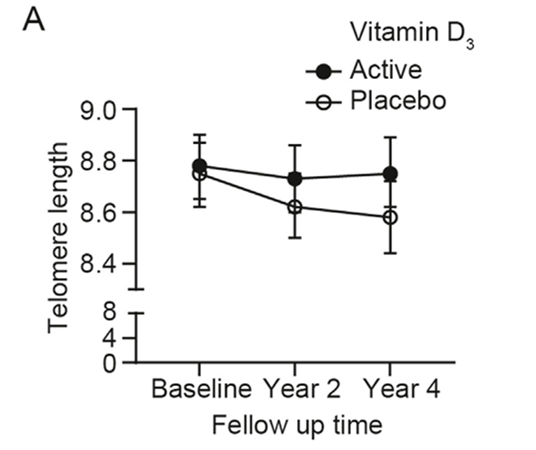
A new analysis of the Vitamin D and Omega-3 TriaL (VITAL), published in The American Journal of Clinical Nutrition, provides reliable evidence that daily vitamin D₃ supplements can help slow down cell aging. Researchers found that four years of vitamin D₃ supplementation at 2,000 IU per day preserved approximately 140 base pairs (bp) of telomere length in leukocytes, or white blood cells, which are essential for immune function. This finding suggests a possible protective effect against age-related cellular decline.
In adults, telomeres – the protective ends of repetitive DNA at the end of chromosomes – naturally shorten by approximately 25 to 27 base pairs per year. The telomere preservation observed in this study may therefore be equivalent to slowing down cell aging by nearly three years, which strengthens the idea that vitamin D may play an important role in maintaining genome stability as you age.
The Importance of Telomeres for Aging and Health
Telomeres function like the plastic tips on shoelaces, preventing chromosomes from fraying or sticking together. As cells divide over time, telomeres gradually wear down. When they become too short, the cell dies or enters a state called senescence, in which the cell stops dividing and begins to release harmful inflammatory molecules. Telomere shortening is widely recognized as a hallmark of biological aging and has been linked to an increased risk of chronic diseases such as cancer, cardiovascular disease, and type 2 diabetes. Maintaining telomere length is considered a promising way to promote a long life and delay the onset of age-related dysfunction. Good health and the prevention of chronic diseases are of great importance!
Telomeres are essential for maintaining cell stability. As you age, these telomeres become shorter, leading to cellular aging and an increased risk of various diseases. It’s crucial to understand how to maintain telomere length, because this directly affects your health and lifespan. An active lifestyle and healthy diet are important.
Research Methods of the VITAL Study
The VITAL study involved more than 25,000 adults in the United States to investigate the long-term effects of vitamin D₃ (2,000 IU/day) and marine omega-3 fatty acids (1 gram/day) on major health outcomes, including cancer and cardiovascular disease. Within this larger study, a research group of 1,106 participants (mostly healthy older adults) was included in a sub-study on telomeres.
Participants were randomly assigned to one of four groups: vitamin D alone, omega-3 fatty acids alone, both supplements combined, or placebo. Blood samples were taken at the beginning of the study and again four years later to evaluate changes in leukocyte telomere length using quantitative polymerase chain reaction (qPCR), a standard method for assessing relative telomere length. This method is crucial for measuring telomere length and examining the effects of the supplements.
Vitamin D Preserves Telomeres Over Time, Omega-3s Do Not
The results showed that participants who received vitamin D₃ alone experienced significantly less telomere shortening than those who received placebo. On average, vitamin D preserved approximately 140 base pairs of the base pair sequence in the telomere over the four-year period. This effect remained statistically significant even after adjusting for factors such as age, sex, race, and body mass index, indicating that the benefit was independent of these variables. The protective effect of vitamin D was also observed regardless of whether participants simultaneously received omega-3 supplements. It is therefore important to look at vitamin D as a protective factor and its significant results.
In contrast, supplementation with omega-3 fatty acids alone had no significant effect on telomere length. This suggests that while omega-3s may have beneficial effects on cardiovascular health and inflammation, they do not appear to have a direct impact on telomere dynamics over the observed period. The finding contributes to ongoing discussions about the role of omega-3s in cellular aging and highlights the specificity of vitamin D’s potential in this context. There is a beneficial effect on cardiovascular health but no impact on telomeres.
How Can Vitamin D Protect Telomeres?
While no definitive mechanism linking vitamin D to telomere preservation has been established, emerging evidence suggests a possible relationship through its role in regulating immune system function and genome maintenance. Vitamin D₃, once converted to its active form, binds to the vitamin D receptor (VDR), which regulates genes involved in inflammation, oxidative stress, and DNA repair – all processes that can affect telomere stability. It is important that vitamin D plays a role in immune modulation and genome maintenance.
Epidemiological studies have supported this relationship: a large UK Biobank study of more than 148,000 adults showed that low vitamin D levels were associated with shorter leukocyte telomere length. Similarly, earlier research in the American Journal of Clinical Nutrition reported that women with the highest vitamin D levels had significantly longer telomeres, corresponding to approximately five years of reduced cellular aging compared to those with baseline levels. While these findings do not establish causality, they are consistent with the observed slowing of telomere shortening after vitamin D₃ supplementation in the VITAL study. There is therefore a clear relationship between vitamin D levels and telomere length.
Strengths, Limitations, and Future Research
This study is one of the first large-scale, long-term randomized controlled trials to provide evidence that daily vitamin D supplementation can reduce the rate of telomere shortening in humans. The robust design of the study, including randomized assignment, long follow-up period, and large sample size, contributes to confidence in the results. However, some limitations remain. It is a large-scale study with a robust design but also has some limitations.
While the effect was modest, it remains unclear whether this degree of telomere preservation will lead to reduced disease risk or extended lifespan. Moreover, since the study cohort consisted primarily of older adults with relatively adequate vitamin D levels at baseline, the findings may not be generalizable to younger individuals or people with severe deficiencies. The effect size was modest and the study is not necessarily representative of younger individuals.
Conclusion
Looking ahead, further research is needed to determine whether higher doses of vitamin D or longer treatment duration could lead to more substantial benefits. It would also be valuable to investigate whether combining vitamin D with other lifestyle or pharmacological interventions could enhance its effects on telomere length and cell aging. Studies that include more advanced biomarkers, such as epigenetic clocks or direct markers of senescent cell accumulation, may help clarify vitamin D’s ability to provide protection against aging. More research is needed to determine the benefits and clarify the broader potential.
Model and Dosage
- Model: Healthy older adults
- Dosage: Vitamin D 2,000 IU/day
Verified Sources
- Vitamin D3 and marine ω-3 fatty acids supplementation and leukocyte telomere length: 4-year findings from the VITamin D and OmegA-3 TriaL (VITAL) randomized controlled trial, The American Journal of Clinical Nutrition, 2025, ISSN 0002-9165, https://doi.org/10.1016/j.ajcnut.2025.05.003.
- Shammas MA. Telomeres, lifestyle, cancer, and aging. Curr Opin Clin Nutr Metab Care. 2011 Jan;14(1):28-34. doi: 10.1097/MCO.0b013e32834121b1. PMID: 21102320; PMCID: PMC3370421.
- Kuo CL, Kirk B, Xiang M, Pilling LC, Kuchel GA, Kremer R, Duque G. Very Low and High Levels of Vitamin D Are Associated with Shorter Leukocyte Telomere Length in 148,321 UK Biobank Participants. Nutrients. 2023 Mar 19;15(6):1474. doi: 10.3390/nu15061474. PMID: 36986204; PMCID: PMC10059691.
- Richards JB, Valdes AM, Gardner JP, Paximadas D, Kimura M, Nessa A, Lu X, Surdulescu GL, Swaminathan R, Spector TD, Aviv A. Higher serum vitamin D concentrations are associated with longer leukocyte telomere length in women. Am J Clin Nutr. 2007 Nov;86(5):1420-5. doi: 10.1093/ajcn/86.5.1420. PMID: 17991655; PMCID: PMC2196219.
- The American Journal of Clinical Nutrition: VITAL Study on Vitamin D and Telomere Length – Clinical study on vitamin D supplementation and telomere preservation.
- PMC: Telomeres, Lifestyle, and Aging – Review of the influence of lifestyle on telomeres.
- PubMed: UK Biobank Study on Vitamin D and Telomeres – Observational study of 148,000 participants.
- PubMed: Serum Vitamin D and Telomere Length in Women – Study showing relationship between high vitamin D levels and longer telomeres.
- (Zhu et al., 2025 | The American Journal of Clinical Nutrition)
Related Articles


Frequently Asked Questions
What are telomeres and why are they important?
Telomeres are the protective ends of chromosomes. They prevent DNA damage and play a crucial role in aging.
How does vitamin D affect telomere length?
Vitamin D can help maintain telomere length. It plays a role in reducing inflammation and oxidative stress.
What is the recommended dose of vitamin D for older adults?
The VITAL study used 2,000 IU of vitamin D per day. Always consult a doctor for the right dosage.
Can omega-3 fatty acids also affect telomere length?
Omega-3 fatty acids appear to have no direct effect on telomere length. They do have other health benefits.
What are the key findings of the VITAL study?
The VITAL study showed that vitamin D supplementation can slow telomere shortening. This may potentially slow cellular aging.