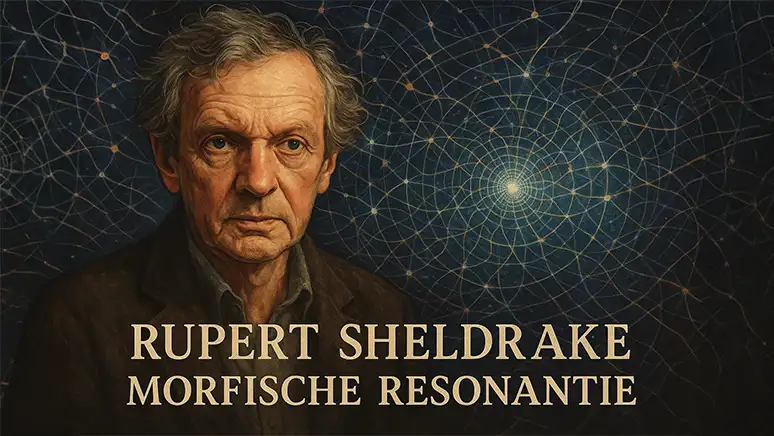
The theory of morphic resonance has remained outside mainstream scientific view for over half a century. Yet things are slowly beginning to shift. Interest is growing, albeit cautiously.
British biologist Rupert Sheldrake has been working on this theory for decades, proposing that learning skills or acquiring knowledge occurs not only through direct transmission — but also through an invisible field that extends across time and space.
The 5 Key Takeaways
- According to the morphic resonance hypothesis, new skills like skateboarding or programming become progressively easier to master.
- The Flynn Effect — the global rise in IQ scores by roughly 30% in the 20th century — is sometimes cited as indirect evidence.
- In the popular word game Wordle, a remarkably high number of players guess the correct word on the first try.
- To test his hypothesis, Sheldrake collaborates with commercial laboratories that feel less bound by academic dogma.
- Even the familiar QWERTY keyboard layout is sometimes mentioned as an example.
What is Morphic Resonance?
Morphic resonance is a hypothesis based on the existence of a collective memory in nature. According to this idea, experiences or learned skills of one organism can influence the learning process of other, similar organisms — even if they are located elsewhere. The concept is that learning experiences leave a trace that becomes accessible again.
A Controversial Research Area
Rupert Sheldrake has spent years trying to get this hypothesis scientifically investigated. It proved more difficult than expected. Within academic circles, the topic encounters considerable resistance. Researchers are hesitant to engage with it, fearing reputational damage, loss of funding, or harsh criticism from skeptics. In many institutions, it is simply dismissed as unscientific — a difficult label to overcome.
Pros of Morphic Resonance Theory
- Offers an explanation for unexplained learning effects in society
- Can contribute to deeper understanding of epidemiology and disease transmission
- Challenges us to think differently about how knowledge spreads
- Could explain why some new skills are learned increasingly faster
Cons of Morphic Resonance Theory
- Scientifically difficult to test due to many influencing factors
- Rejected by many scientists as pseudoscience
- Test results are often subject to multiple interpretations
- Could spread both good and bad habits throughout society
The Flynn Effect as Evidence
One of the most striking examples associated with morphic resonance is the so-called Flynn Effect. Psychologist James Flynn discovered that average IQ scores worldwide since 1918 have increased significantly — by roughly 30% in a single century.
Remarkably, this increase is not accompanied by convincing evidence that people have actually become more intelligent. Explanations such as improved nutrition, greater exposure to testing, or educational media provide only part of the answer. The phenomenon seems to carry something that falls outside conventional models.
Also Read: Can Thoughts Travel Without Words? | Rupert Sheldrake on Silent Communication
New Research Directions
After years of resistance from the academic world, Sheldrake is seeking alternative routes. Commercial laboratories — particularly active in the pharmaceutical sector — routinely conduct experiments without academic pressure or reputational risks. That independence provides room to test his hypothesis.
One ongoing project focuses on the emergence of antibiotic resistance in E. coli bacteria. The central question: does resistance develop faster in other locations once it has emerged elsewhere? A commercial lab in the United Kingdom is conducting this research according to a fixed protocol, as Sheldrake prefers scientific work to be: precise, independent, and testable.
Recognizable Patterns in Daily Life
Outside the laboratory, situations also emerge that suggest morphic resonance. Take the word game Wordle from The New York Times. The number of players who guess the correct word on the first try is remarkably high — higher than you would expect based on probability calculations. It suggests a form of collective learning ability, though there is little scientific evidence for it yet.
The QWERTY keyboard layout is another example often cited. Originally designed to slow down mechanical typewriters and prevent jamming, this illogical arrangement has nonetheless firmly embedded itself in our motor memory. Alternative, ergonomically superior layouts are available, but prove much harder to learn. Why that is remains difficult to explain.
Glossary
- Morphic Resonance: Hypothesis that a kind of collective memory exists in nature through which knowledge and skills spread invisibly
- Flynn Effect: Phenomenon where IQ scores rise globally without people actually becoming more intelligent
- E. coli: Bacterium often used in scientific research
- Antibiotic Resistance: The ability of bacteria to survive despite antibiotic treatment
Applications in Health and Epidemiology
If morphic resonance actually exists, it would have far-reaching consequences for how we understand disease transmission and resistance. Suppose a bacterium like E. coli develops resistance to an antibiotic in one location — then that resistance could manifest faster in other places, even without direct transfer of genetic material.
The same could apply to viruses like COVID-19. Once enough people have recovered, their immune response could leave a kind of blueprint that becomes unconsciously available to others. According to this hypothesis, recovery thus contributes not only to individual immunity but also to collective information that spreads invisibly.
Also Read: New Evidence for Morphic Resonance – Rupert Sheldrake
Also Read: Is Morphic Resonance the True Structure of Our Reality? – Rupert Sheldrake
A Hypothesis on Hold
What distinguishes this theory from other alternative explanations is that it is a scientific hypothesis. Sheldrake does not claim his idea is proven. What he does emphasize is that it is testable — provided there is sufficient willingness to conduct that experiment.
The challenge lies in designing controlled experiments that can isolate the influence of morphic resonance from other explanatory factors. If that succeeds, and the results confirm the effect, then we would need to revise our understanding of natural laws. Rather than rigid laws, they would then resemble habit formation over time.
Also Read: Are Our Memories Stored in Our Brains? – Rupert Sheldrake
Conclusion
After fifty years, morphic resonance remains an intriguing question. The clues are there, but definitive proof is lacking. And as long as that remains the case, the theory continues to balance at the intersection of curiosity and skepticism.
Yet interest is growing. New research methods, outside classical academic structures, create space for what was once dismissed. Whether morphic resonance truly exists remains to be seen. But the willingness to ask the question again might just be the first real step forward.
About Rupert Sheldrake
Rupert Sheldrake, Ph.D., is a biologist and author of more than 90 scientific publications and 9 books, and co-author of 6 books. His work has been translated into 28 languages. In 2013, he was ranked among the top 100 Global Thought Leaders by the Duttweiler Institute, a leading think tank from Zurich, Switzerland.
Verified Sources
For ten consecutive years, he has been recognized as one of the ‘most spiritually influential living people in the world’ by Watkins Mind Body Spirit magazine. His work has been featured in numerous journals, newspapers, and other media, including New Scientist, The Guardian, Discover magazine, The Spectator, The Washington Post, Die Zeit, and on BBC radio and television.
Related Articles





Frequently Asked Questions
What exactly does morphic resonance entail?
Morphic resonance is a hypothesis by biologist Rupert Sheldrake. He proposes that a kind of collective memory exists in nature. When an organism learns or develops something, according to this theory, it becomes easier for other members of the same species to do the same — without direct contact being necessary. Experiences leave traces that others can pick up.
Is there scientific evidence for this phenomenon?
There are mainly indirect indications, such as the Flynn Effect or patterns in learning new skills. Strict scientific proof is lacking, partly because it is difficult to design experiments that can demonstrate morphic resonance separate from other factors. That methodological challenge is why many scientists remain skeptical.
Why does this theory spark so much discussion?
The theory fits poorly within the classical scientific worldview, in which natural laws are fixed and universal. Sheldrake instead proposes that those laws resemble habits — and that clashes with fundamental assumptions in the natural sciences. Many researchers avoid the topic to prevent reputational damage or financial risks.
How is the theory being tested?
Sheldrake has experiments conducted at commercial laboratories. For example, researchers are investigating whether antibiotic resistance in E. coli develops faster in places where it has already been observed. Behavioral patterns in games like Wordle are also being analyzed, where a remarkably high number of people seem to guess the correct word on the first try.
What if morphic resonance turns out to be real?
That would impact multiple fields — from biology and psychology to physics and medicine. It could provide explanations for collective learning patterns, the decline in virulence of infectious diseases, and even how technological skills spread through society. In short: it would fundamentally change our view of knowledge transfer.