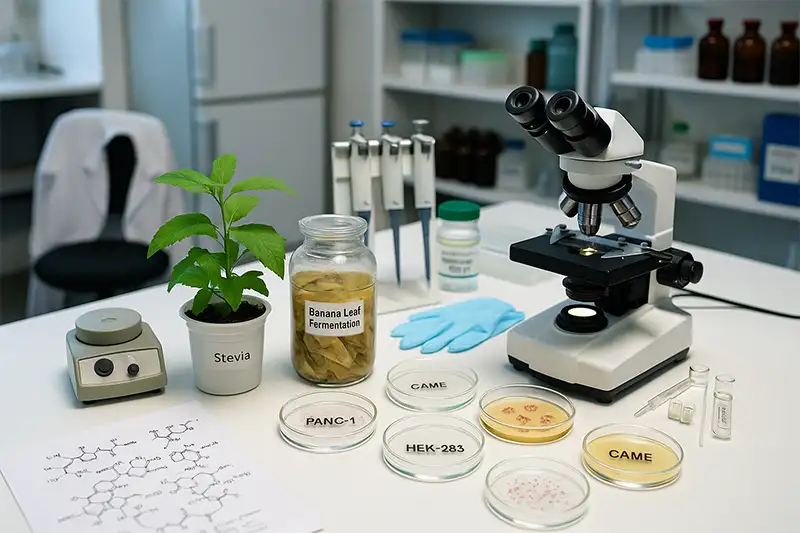
Researchers at Hiroshima University discovered that stevia, fermented with bacteria from banana leaves, is capable of killing pancreatic cancer cells without damaging healthy kidney cells.
Through microbial biotransformation, the plant gains new properties, including the formation of a powerful compound: chlorogenic acid methyl ester (CAME). In laboratory tests, the fermented stevia extract showed remarkably strong effects against cancer cells, indicating a possible new direction in research on probiotic treatments for cancer.
The 5 Key Takeaways
- Fermented stevia with Lactobacillus plantarum SN13T proved toxic to pancreatic cancer cells, but not to healthy kidney cells.
- The active compound released is chlorogenic acid methyl ester (CAME), created through microbial conversion.
- Fermentation was performed with bacteria naturally found on banana leaves.
- The study emphasizes the potential of probiotics in future cancer therapies.
- Follow-up research focuses on animal models to study CAME’s effects throughout the entire body.
The Unexpected Cancer-Fighting Potential of Stevia
Stevia is primarily known as a calorie-free sweetener, but according to researchers at Hiroshima University, there’s more to this little plant. When stevia extract is fermented with bacteria from banana leaves, it proves capable of killing pancreatic cancer cells without damaging healthy kidney cells.
The results of this research were published in the International Journal of Molecular Sciences.
“Globally, both the number of cases and deaths from pancreatic cancer are increasing, with a five-year survival rate of less than 10%,” said co-author Narandalai Danshiitsoodol, associate professor in the Department of Probiotic Sciences for Preventive Medicine at the Graduate School of Biomedical and Health Sciences.
“Pancreatic cancer is particularly aggressive and spreads rapidly. Moreover, it responds poorly to existing treatments such as surgery, radiation, and chemotherapy. Therefore, there is an urgent need for new and effective substances with a natural origin.”

Fermentation Activates Bioactive Compounds
Earlier research suggested that stevia may have cancer-fighting properties, but it was difficult to isolate the exact active compounds. According to Danshiitsoodol, fermentation changes the structure of the extract, creating new bioactive compounds — substances that influence biological processes.
“Microbial biotransformation is an effective method to enhance the activity of natural plant extracts,” says lead researcher Masanori Sugiyama, professor at the same faculty.
Sugiyama’s lab has now examined more than 1,300 lactic acid bacterial strains, sourced from fruits, vegetables, flowers, and medicinal plants. “In this study, we compared fermented and non-fermented extracts to discover which compounds are responsible for increased bioactivity. This way, we hope to improve the therapeutic value of plant-based remedies for cancer.”
Fermented Stevia Extract Targets Cancer Cells
The research team fermented stevia leaf extract with a plant-derived lactic acid bacterium: Lactobacillus plantarum SN13T (abbreviated FSLE). They then compared the effects of this fermented extract with a non-fermented variant. They used both pancreatic cancer cells (PANC-1) and healthy human kidney cells (HEK-293) from reliable commercial cell banks.
“Our findings show that FSLE is much more toxic to cancer cells than the non-fermented extract at equal concentrations,” says Sugiyama. “Notably, FSLE had only minimal effects on healthy HEK-293 cells — even at the highest dosage we tested.”

Discovery of a Powerful Active Compound
Follow-up research revealed that chlorogenic acid methyl ester (CAME) is the primary active compound after fermentation. The amount of chlorogenic acid in the extract decreased by a factor of six, which according to Danshiitsoodol indicates a microbial conversion process.
“This conversion is likely the result of enzymes present in the bacterial strain used,” explains Danshiitsoodol. “Our data shows that CAME works more powerfully than chlorogenic acid alone. It has stronger toxic effects on cancer cells and activates the process of programmed cell death (apoptosis).”
Preparation for Future Animal Research
The researchers indicated they want to take the next step in animal trials, specifically with mouse models. With this, they hope to better understand how different dosages of the fermented stevia extract work in a complete body system.
“This study has significantly deepened our understanding of the mechanism of action of Lactobacillus plantarum SN13T in the fermentation of plant extracts,” says Danshiitsoodol. “At the same time, this research opens perspectives on the use of probiotics as natural support in cancer treatment.”
Verified Sources
- “Stevia Leaf Extract Fermented with Plant-Derived Lactobacillus plantarum SN13T Displays Anticancer Activity to Pancreatic Cancer PANC-1 Cell Line” – authors: Rentao Zhang, Narandalai Danshiitsoodol, Masafumi Noda, Sayaka Yonezawa, Keishi Kanno and Masanori Sugiyama, published April 27, 2025 in the International Journal of Molecular Sciences. DOI: 10.3390/ijms26094186
- Thanks to SciTechDaily
Other contributors to the research are Rentao Zhang and Masafumi Noda (Department of Probiotic Sciences for Preventive Medicine, Hiroshima University) and Sayaka Yonezawa and Keishi Kanno (Department of Internal Medicine, Hiroshima University Hospital).
Related Articles


Frequently Asked Questions
What is the difference between fermented and regular stevia?
Regular stevia is a natural calorie-free sweetener. When stevia is fermented with specific bacteria, new bioactive compounds are created that under certain conditions can slow down or kill cancer cells.
How does chlorogenic acid methyl ester (CAME) work against cancer?
CAME proved effective against pancreatic cancer cells in laboratory tests. It promotes the process of apoptosis, where damaged or unwanted cells clean themselves up — without harming healthy cells.
Is this a proven treatment for pancreatic cancer?
No, this involves early laboratory studies. The results are promising, but further research with animal models and eventually humans is needed before clinical application is possible.
Why do scientists use bacteria from banana leaves?
Banana leaves naturally contain certain lactic acid bacteria. These bacteria can produce enzymes during fermentation that change the structure of plant compounds and create new active substances.
What are the possible applications of this research in the future?
This type of fermentation research can contribute to the development of new probiotic-based therapies — where natural bacteria are used to make plant compounds more effective against diseases such as cancer.