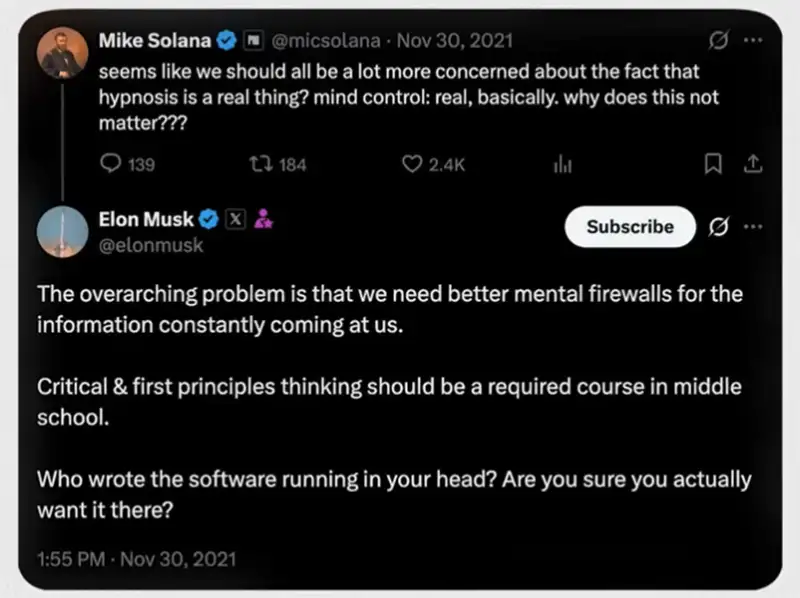
Most people believe they choose their own thoughts, when in reality they’re running on software written by others. Parents, school, media, social pressure — these are programs installed in your head since childhood.
This unconscious conditioning determines how you think, what you value, and which choices you make. Only when you realize that most of your behavior runs automatically do you get the chance to reprogram those patterns. And it starts with understanding the system itself.
The 5 Key Takeaways
- Conscious thinking processes only 50 bits per second — your unconscious processes 11 million bits
- Language itself limits which thoughts you can even think
- The education system was designed to train obedience, not independent thinking
- Social media amplifies mimetic desire — you want what others appear to have
- Automatic success emerges by reprogramming your unconscious toward self-chosen goals
The Conscious Versus Unconscious Brain
Your conscious attention can process only about 50 bits of information per second. Your unconscious brain, on the other hand, processes roughly 11 million bits per second. This explains why most of your behavior runs automatically without your control.
Carl Jung said it best: until you make the unconscious conscious, it will direct your life and you’ll call it fate. Most people live on autopilot, executing scripts written by others long ago. If you truly want to change, you must first understand what’s happening deep in that unconscious mind.
How the Social Matrix Works
The social matrix isn’t a conspiracy theory. It’s simply how culture propagates from generation to generation. Parents unconsciously pass their worldview to children because they received it from their own parents. Social conditioning begins in the cradle.
Children conform because they want to survive — literally and socially. You learn which behaviors get rewarded and which don’t. Those patterns become so deeply ingrained that later they feel like ‘your own opinion,’ when really they come from outside. The cycle repeats endlessly.
Pros and Cons of: Becoming Aware of Conditioning
Pros
- You gain control over automatic reactions that hold you back
- Setting your own goals becomes possible instead of chasing someone else’s dreams
- More mental space by clearing out useless beliefs
- Increased neuroplasticity through new challenges and goals
Cons
- Confronting process where you realize how little control you actually had
- Social resistance when you deviate from group norms
- Requires continuous self-reflection and accepting discomfort
- Risk of landing in a different dogmatic way of thinking
Language Determines How You Think
Glossary
Cultural norms get embedded before you can think critically. Children learn mainly that they get approval by conforming to authority. This mechanism stays active in your adult life, often without your awareness. You interpret the world through filters imposed on you long ago.
The Education System as an Obedience Machine
The Prussian education model was designed to produce obedient soldiers, compliant citizens, and disciplined workers. That system was imported to other countries during industrialization. Mandatory attendance, national curricula, age-based classrooms — the goal was mass education, not critical thinking.
Frequently Asked Questions
- Mimetic desire: The desire for what others have, not because you actually want it yourself
- Neuroplasticity: Your brain’s ability to reorganize itself and form new connections
- Flow state: Optimal experience where you’re completely absorbed in a challenge just above your skill level
- Agency: The ability to act without permission and make your own choices
Verified Sources
Social media creates echo chambers that reinforce existing beliefs. Entertainment subtly programs values and worldviews. Scientists rely on thousands of studies they haven’t personally verified. Research funding comes from corporations and governments with their own agendas. It’s circular validation — everything points back to the same system.
Social Media and AI Amplify Unconsciousness
Social media functions as a mimetic desire amplifier. Algorithms claim to show you what you want to see, but they actually program you to want what others appear to have. Every scroll reinforces neural pathways that make you think you need the highlights from someone else’s life.
In 2024, the Max Planck Institute found evidence that ChatGPT changes human speech patterns. Words that AI uses frequently, people start using more often too. So you end up talking like the machine that learned to talk like you. As language narrows through AI and immature social media jargon, your thinking capacity shrinks too. Future generations will get AI as base programming — before parents and school.
Society Works Against You
Your job forces you to conform to your boss’s worldview, who went through the same system. Marketing manipulates desires from childhood. The food industry is designed to poison you with hyperpalatable products you become addicted to, which damages your mental clarity.
| Domain | Conditioning Mechanism | Result |
|---|---|---|
| Education | Obedience to authority | Critical thinking gets suppressed |
| Media | Repeated exposure | Unconscious influence on preferences |
| Work | Economic dependence | Conformity to hierarchy |
| Social circles | Threat of exclusion | Groupthink and fear of deviation |
How to Reprogram Your Unconscious
Your brain functions as a goal-directed mechanism. Depending on how you operate it, it works as either a success or failure mechanism. The unconscious evolves through stages of increasing complexity, making life more interesting. However, you can just as easily get stuck at a low level.
Flow experience comes from a self-chosen goal, complete clarity about how you’ll reach it, and a challenge just above your skill level. Your brain interprets the world through a lens of psychological survival. Your identity forms around the values and beliefs of the culture you grew up in. Threats to that identity feel like existential attacks.
Create Your Own Matrix
The brain craves order and certainty. That’s why we so quickly adopt the psychological infrastructure others assign to us. We chase goals society deems important, which influences what we learn, which choices we make, and which habits we form.
This all starts with a goal — a clear picture of the future you generate yourself. Replace “school, job, retirement” with something that truly means something to you. But many people fail because the fear of ending up like everyone else doesn’t outweigh the fear of discomfort. You have to become so disgusted with your current path that change becomes the only option.
Follow Passion-Driven Education
The education system fails precisely where it should succeed: actually educating. It helps with socialization and basic skills like reading and writing, but discovery — real education — doesn’t happen there. You learn the same subjects as everyone, choose from the same courses, and Google the same well-paying careers.
Self-education changes this. Write down the problems in your life — health, finances, relationships. Pick one. Explore the internet as a curator, not a consumer. Experiment with different methods without becoming dogmatic. Spend at least 30–60 minutes daily learning that directly correlates with your self-chosen goals. Throw yourself into a completely different environment and let your beliefs be challenged.
Develop Agency
Agency is the ability to act without permission. It’s the belief that difficult tasks can become easy. Goals fall into three categories: easy (already achievable now), impossible (physically impossible), and difficult (achievable if you gain the right skills).
Say someone forces you to bench press 308 lbs (140 kg) within a year. You interpret that either as impossible and give up, or you do everything to achieve it — and you probably succeed. That reveals two problems: an external locus of control (believing success is mostly luck) and the absence of the intersection between urgency and importance. Without a clear goal, people get tossed around like puppets.
Discipline is what you do when no one is watching. ~ David Goggins
Become a Creator
Humans are tool builders. When we were cold, hungry, or in danger, we created fire, shelter, and weapons. Once those tools existed, better versions made the society we have now possible. Nature is brutal — without human transformation, we’d have gone extinct long ago.
Becoming a creator is central to a good life. Happiness combines progress with contributing to something bigger than yourself. You achieve both by solving problems for yourself and others. The intersection of purpose and profit lies in solving problems you find interesting, and passing those solutions to humanity. The internet is currently the place with the highest leverage — you don’t need permission to make and share something.
Conclusion
The social matrix isn’t an abstract concept. It’s the mechanism through which culture, beliefs, and behavioral programs get transmitted. You were born into it without choosing it, and it runs mostly unconsciously.
Escaping begins with awareness — recognizing how deeply external programming drives your thinking. Then comes reprogramming: self-chosen goals, interest-driven learning, developing agency, and creating value. It’s not a one-time step but a continuous process of observing, evaluating, and adjusting. Once you make the unconscious conscious, you finally get control of your own life.
Gerelateerde artikelen


How does the social matrix affect my life?
The social matrix conditions you through parents, school, and media, causing you to unconsciously adopt patterns and beliefs. This conditioning determines your thoughts, values, and choices, often without your awareness. Becoming conscious of this influence is the first step toward change.
Why is it important to reprogram my unconscious?
Your conscious brain processes only a small portion of information, while your unconscious drives most of your behavior. Reprogramming your unconscious allows you to change automatic reactions, set your own goals, and create more mental space. This leads to a more authentic and purposeful life.
How can I reprogram my unconscious?
Reprogramming involves becoming aware of conditioning, setting self-chosen goals, pursuing interest-driven learning, and developing agency. Create a clear picture of the future you want, challenge your beliefs, and embrace discomfort. Focus on solving problems you find interesting and share your solutions with others.