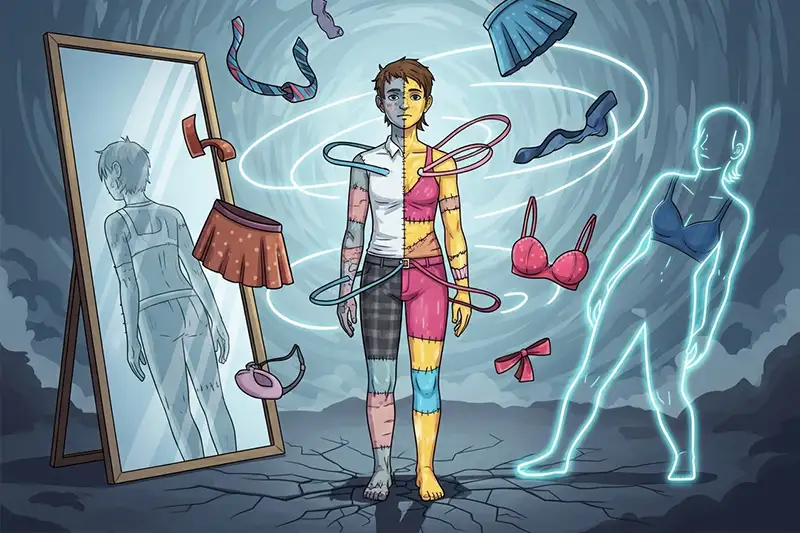
{‘introduction’: “In current discussions about gender dysphoria in children and adolescents, puberty is often portrayed as a looming crisis—a biological process that must be slowed with medical interventions to avoid psychological pain. Puberty blockers (GnRH analogs) are presented as a so-called ‘pause button,’ a neutral intervention that would buy time. In reality, puberty is not a condition to be treated, but a fundamental and formative phase that can play an important role in finding stability. When we suppress this process, we deprive young people of the chance to grow in their physical, psychological, and social development. It is precisely in this phase that a foundation is laid for self-image, sexuality, and adult identity. Puberty thus forms a natural trajectory toward adulthood. This article explains why protecting this process, in line with the right to an open future, is the most careful and ethical approach for young people struggling with their gender identity.”, ‘sections’: [{‘heading’: ‘Terminology of Terms Used in This Article’, ‘content’: ‘Child: a person under 18 years old. Adolescent/Adolescence: used for the maturation changes during puberty or for consistency with cited studies. GnRH analogs: medications such as leuprorelin, triptorelin, and histrelin; administered every 1–6 months or via annual implant. Start of GnRH analogs: can occur from Tanner stage 2 of puberty (from approximately age 9) in gender dysphoria. Detransitioner: a person who has ended or attempted to reverse medical or surgical transition. Desistance: the disappearance of gender dysphoria in children before medical or surgical interventions occur.’}, {‘heading’: “The ‘Gender-Affirming’ Model and the Right to an Open Future”, ‘content’: “The current debate is strongly influenced by the so-called ‘gender-affirming’ care model. This model starts from the idea that there is a deeply felt, innate gender identity and that the task of parents and caregivers lies primarily in affirming it. Medical interventions are presented as a logical next step to make the body align as much as possible with the experienced identity.”}, {‘heading’: ‘The Promise of Self-Determination and the Limits of Adolescence’, ‘content’: “Proponents of this model emphasize young people’s right to self-determination. They argue that no one can better determine who a child is than the child themselves. At the same time, this premise conflicts with the ethical principle of the right to an open future, as described by philosopher Joel Feinberg. This principle calls for caution in decisions that irreversibly limit a child’s future possibilities. Treatments that permanently exclude fertility or sexual development remove choices that can only be fully understood in adulthood. Adolescence is a phase of extremes. Young people often have a strong and vital body, but also display impulsive behavior, emotional peaks, and poor risk assessment. The prefrontal cortex—the brain region responsible for long-term planning and weighing consequences—is not fully developed until well into the twenties. Expecting an eleven- or twelve-year-old to consent to a medical intervention that has lifelong effects on fertility and sexuality is asking for a choice they cannot actually comprehend.”}, {‘heading’: ‘The Myth of Reversibility and the Medical Cascade’, ‘content’: ‘One of the central claims about puberty blockers is that their effects would be completely reversible. This gives parents and young people the impression that treatment can be stopped without lasting consequences. Reality proves less reassuring.’}, {‘heading’: “More Than a ‘Pause Button'”, ‘content’: ‘Although hormonal suppression can theoretically be reversed, in practice the treatment rarely functions as a neutral interruption. For most young people, it is the first step in a medical cascade that almost automatically leads to further, permanent interventions. Research shows that the majority of children who start puberty blockers eventually proceed to cross-sex hormones. Doctors themselves compare this trajectory to a train that, once departed, rarely changes course.’}, {‘heading’: ‘Entrenching Gender Dysphoria’, ‘content’: “A second concern is that blocking puberty can actually entrench gender dysphoria. Before the ‘affirming’ model became dominant, research showed high rates of desistance: a large portion of children with gender dysphoria (61–98%) found a way toward acceptance of their own body during puberty. The hormonal and physical changes of this life phase play a decisive role. When this process is halted, a young person remains stuck in a childlike state in which body and identity can barely meet.”}, {‘heading’: ‘A Critical Look at Risks and Benefits’, ‘content’: ‘When the possible benefits—temporarily alleviating psychological distress—are weighed against the risks, a concerning picture emerges. The evidence for benefits is weak, while evidence of lasting harm continues to accumulate.’}, {‘heading’: ‘Uncertain Benefits and Tangible Risks’, ‘content’: “Health authorities such as Britain’s NICE (National Institute for Health and Care Excellence) concluded in systematic literature reviews that evidence for the effectiveness of puberty blockers is of ‘very low quality.’ There is no convincing evidence that they improve mental health long-term or reduce gender dysphoria. Meanwhile, the risks are concrete and serious: Brain development—puberty is a crucial phase for brain restructuring. Slowing natural hormone peaks can disrupt cognitive and emotional maturation. Animal research points to lasting effects on spatial memory. Bone density—a large portion of peak bone mass is built during this life stage. Young people using puberty blockers miss this buildup, significantly increasing the risk of osteoporosis and fractures later in life. Fertility and sexuality—children who start blockers early (Tanner stage 2) and then proceed directly to cross-sex hormones lose the possibility of natural fertility. The sex glands never develop to the stage where eggs or sperm can be formed. Additionally, there are growing concerns about lasting limitations in sexual pleasure and the ability to orgasm, removing one of the most fundamental human experiences.”}, {‘heading’: ‘International Turning Point: A Growing Call for Caution’, ‘content’: “While organizations like WPATH in the United States have further embraced the ‘affirming’ model, several European countries have chosen restraint. After critical evaluation of available evidence, the course has visibly changed there.”}, {‘heading’: ‘The Netherlands: From Pioneer to Reconsideration?’, ‘content’: “The Netherlands is considered the birthplace of the ‘Dutch Protocol,’ the first structured treatment pathway for young people with gender dysphoria. Yet studies from this very work highlight uncertainties and complexity. Dutch researchers have extensively described how doctors and parents question whether a child can truly comprehend the lifelong consequences of this treatment, especially regarding fertility. This critical reflection from the country where the approach was originally developed is a clear signal that initial certainties are under pressure.”}, {‘heading’: ‘Europe Chooses a Different Path’, ‘content’: “A series of European countries has chosen a course change in recent years. The emphasis shifts from medical interventions to psychological care and support: England—after the groundbreaking Cass Review, puberty blockers are no longer routinely prescribed and are only provided within research settings. The focus is now on a broad approach that also considers common comorbidities such as autism and depression. Sweden—the Swedish National Board of Health stated in 2022 that the risks currently outweigh possible benefits and has therefore severely limited the use of puberty blockers. Finland—designated the use of puberty blockers as an ‘experimental practice’ and prioritizes psychotherapy as the first treatment option. France, Norway, and Denmark—medical academies and health authorities here have also called for great caution. Instead of rapid medicalization, emphasis is placed on therapeutic support.”}, {‘heading’: “The Myth of the ‘Tragic Choice’: Suicide and Medical Necessity”, ‘content’: “One of the weightiest arguments for rapid medical intervention is the threat of suicide. Parents are regularly told that their child must either pursue a transgender pathway or risk taking their own life. This message creates panic and is often presented as a so-called ‘tragic compromise.’ This framing is misleading. Young people with gender dysphoria do have a higher risk of suicidal thoughts, but there is no convincing evidence that puberty blockers reduce this risk. A large-scale national study from Finland found no reduction in suicidality with medical transition. While suicide statistics are sad and above average, absolute numbers are fortunately low. When all of a young person’s problems are attributed solely to gender, other causes of their psychological distress—such as depression, trauma, autism, or family tensions—easily slip out of view. For such problems, evidence-based treatment does exist, something that is lacking for gender dysphoria treated with puberty blockers.”}, {‘heading’: ‘Conclusion: Puberty as Solution’, ‘content’: “It is necessary to reconsider our perspective. Puberty is not a medical emergency, but a purposeful, natural process that guides a child toward adulthood. It is the phase in which brains continue to mature, the body reaches its adult form, and the psyche is challenged to bring identity, sexuality, and physicality together into a whole. When this process is interrupted with heavy medication whose long-term effects are uncertain and whose risks are clear, we are gambling with a young person’s future. Doors are closed forever, while it is precisely in this phase that natural space often emerges for inner reconciliation. A careful and ethical approach requires seeing puberty as an ally. That means prioritizing psychological guidance, attention to any comorbid conditions, and a safe environment in which young people have the chance to grow and mature. Puberty is not the problem, puberty is the solution!”}]}
9
minutes read time
169 times read since