I. The anatomy of the crisis: statistical overlap and recognition of the premise
1.1 The demographic convergence: divorce peaks and the biological timeline
The hypothesis that women divorce as a result of unrecognized hormonal changes — whereby symptoms are wrongly attributed to the quality of the marriage — finds significant support in demographic and experiential data from Western countries. The life stage in which perimenopause typically begins — from the mid-forties — coincides strikingly with the peak in divorce rates.
In the United Kingdom, divorce rates peak for couples aged 45 to 49. The average age of divorce for women in the UK is 43.9 years. This statistical clustering in the forties and early fifties mirrors the period during which the hormonal fluctuations and declines characteristic of the transition are most pronounced.
Although the United States has historically had a higher divorce rate than Europe, trends in the Netherlands also point to an increasing frequency of divorces among those over fifty, often referred to as the ‘gray divorce revolution.’ While sociologists partly attribute this to growing social acceptance of divorce in this age group, the close chronological overlap with perimenopause is an undeniable phenomenon that compels closer examination of biological causality.

1.2 The quantified experience and the misattribution error
The most compelling support for the central premise comes from research in which women reflect retrospectively on their divorce. Recent British studies show that an overwhelming majority of divorced women (73% to 77%) identify the menopause or perimenopause as a contributing factor in the breakdown of their marriage.
These high percentages imply a widespread misattribution error. The symptoms — extreme fatigue, mood swings, or unexplained apathy — were not recognized at the time as biological and therefore treatable in nature. Instead, these behavioral changes were interpreted by both the woman and her partner as profound, insurmountable relationship problems. The woman may conclude that she has fundamentally changed and no longer fits with her partner, or that her partner “doesn’t understand her.” This leads to a relationship crisis based on an incorrect causal analysis.
The relational stressors become most visible in the area of intimacy. Research confirms that the loss of physical intimacy is the most negatively affected area of the relationship during menopause. Women’s concerns are considerable; 50% of respondents feared that a lack of sex could lead to the end of their relationship. Without adequate knowledge and treatment, the decline in sexual desire and the increase in discomfort rapidly evolve into emotional distance, breaking a fundamental connection between partners and paving the way for divorce.
Read also: Is the menopause a phase in which you are forced to learn to LIVE rather than SURVIVE?
II. Clinical mechanisms: how hormonal imbalance causes relational damage
2.1 The neuro-endocrine cascade: impact on cognition and mood
Perimenopause is a period of intense neuro-endocrine shifts, particularly the fluctuations and ultimate decline of estrogen and progesterone. This hormonal volatility has a direct link to a range of psychological complaints, including anxiety, panic, insecurity, depressive feelings, and the development of a shorter fuse or extreme mood swings.
A critical but often underestimated factor in relational stress is disrupted sleep. Hormonal changes affect sleep architecture. Chronic poor sleep — often exacerbated by night sweats (vasomotor symptoms) — leads to exhaustion, poor concentration, and reduced resilience. A partner who is constantly exhausted and irritable becomes a persistent source of tension in the household. This undermines the ability of both partners to show empathy, be patient, and resolve conflicts effectively.

2.2 Sexual dissonance and physical suffering
The impact on sexual health is a primary driver of relational breakdown in this life stage. The decline in progesterone is directly linked to loss of libido. However, the challenge extends far beyond reduced desire.
Physiological changes in the vagina and vulva complicate intimacy. Women may experience vaginal atrophy, leading to pain during intercourse (dyspareunia). The prevailing assumption in popular culture — and sometimes even in primary care — is that the use of lubricant resolves these problems. However, this is a medical myth that must be systematically refuted.
Research indicates that becoming aroused is a signal of deeper physiological changes (such as clitoral engorgement and vaginal lengthening). Lubricant is not an adequate solution for the failure to become naturally lubricated, because it does not restore the altered physiology. If the woman does not become naturally lubricated, penetrative sex is physiologically inappropriate and painful.
This lack of satisfying, pain-free sex inevitably leads to avoidance of intimacy. The woman associates sex with discomfort or pain, leading to total avoidance. The partner interprets this chronic rejection as a structural breakdown of the relationship or emotional withdrawal, plunging the relationship into a deep, often irreparable, crisis.
Healthcare providers have a duty to proactively assess the sexual concerns of women in menopause, so that targeted and effective treatments can be initiated. Vague but persistent complaints such as chronic fatigue or irritability are often attributed to the stress of the life stage (career, children, caregiving), causing the underlying hormonal cause to be overlooked and the chronic relational burden to persist.

III. The Dutch and Belgian reality: the failure of primary and secondary care
3.1 Diagnostic confusion: the menopause masquerade in the Benelux
The most urgent clinical challenge within the Benelux is the routine misidentification of perimenopausal symptoms. Women suffering from severe mental health complaints due to hormonal imbalance are often diagnosed with depression or burnout and treated with antidepressants, rather than receiving hormonal treatment.
Gynecologists emphasize that physicians often look no further than the classic symptoms (such as hot flashes and cessation of menstruation), causing the deeper hormonal context of mental and emotional complaints to be missed. This demonstrates a systemic lack of multidisciplinary knowledge in primary care. This diagnostic failure has far-reaching social consequences. The combination of work-related stress and untreated menopausal symptoms leads to a considerable risk of sick leave, with CNV research showing that 17% of women experience burnout as a result. These stressors exacerbate tension at home, further undermining relational and financial stability.
3.2 Consequences of inadequate treatment
The consequences of this misdiagnosis are twofold. First, the woman does not receive optimal treatment. Antidepressants (SSRIs and SNRIs) are discouraged in clinical guidelines as a first-line treatment for vasomotor symptoms when there are no contraindications to Hormone Replacement Therapy (HRT). Second, these psychopharmaceuticals can themselves cause side effects, including loss of libido, which worsens the existing relational problems stemming from menopause.
The woman withdraws, suffers from extreme mood swings, and sometimes displays aggressive behavior toward her partner and children. Notably, it is often the partner who acts as the catalyst for seeking specialist help; men send their wives to the doctor or menopause consultant. This indicates that the disruptive behavior is more clearly observable to the partner than to the woman herself, who internalizes or rationalizes her symptoms.
The failure of care in the Netherlands and Belgium structurally creates two victims: the woman suffering from untreated biological problems and the partner bearing the burden of a ‘bad’ marriage that is in reality symptom-driven. This underscores the urgent need for specialized therapeutic protocols that recognize the biological cause.
The table below illustrates the discrepancy between symptom presentation and the prevailing diagnostic labels in Benelux primary care, along with the relational consequences that result:
Table III.1: The menopause masquerade — differential diagnosis in the Benelux
| Behavioral presentation | Common, often incorrect, diagnosis (primary care) | Menopause-related cause (hormonal) | Consequence for the relationship | Reference |
| Exhaustion, concentration problems, withdrawal | Burnout, chronic fatigue | Estrogen and progesterone decline, chronic sleep disorder (due to VMS/hormones) | Emotional distance, shared responsibilities neglected, partner assumes caregiving role | LINDA.nl, Care for Women, CNV |
| Aggression, crying, unreasonable arguments, combativeness | Major Depressive Disorder (MDD), anxiety disorder | Fluctuating hormone levels, PMS/PMDD-like symptoms during perimenopause | Unsafe/toxic home environment, partner feels rejected or attacked | LINDA.nl, Care for Women |
| Rejection of intimacy, lack of desire | Structural relationship problems (‘boring marriage’) | Loss of libido, pain during intercourse (dyspareunia due to atrophy), negative self-image | Loss of connection, fear of infidelity, divorce | Stowe Family Law, Vrouwen in de Overgang, Libresse |
IV. Prevention and recovery: therapeutic interventions for the relationship
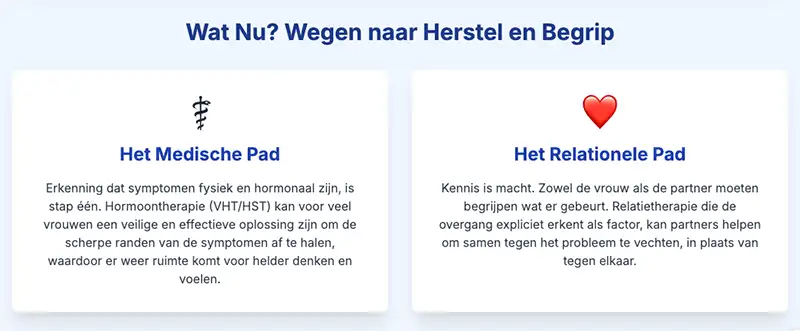
4.1 Hormone therapy (HRT) as primary intervention
Hormone Replacement Therapy (HRT) is considered the most effective treatment for alleviating many menopausal symptoms. The impact can be significant, with improvements often becoming noticeable within two months. The potential role of HRT as a preventive measure against relationship breakdown is substantial: 70% of women who had received no support or treatment indicated that the right treatment would have had a positive influence on their relationship and could potentially have prevented the divorce.
There is, however, a clinical nuance. Some cross-sectional studies suggest that current HRT use is associated with worse psychological wellbeing and mental health. This phenomenon is likely the result of selection bias, whereby women with the most severe and persistent psychological complaints are those who seek HRT. This does not mean that HRT fails, but that this subgroup requires specialized psychiatric and endocrinological support during the transition period.
When weighing HRT, physicians must set the risks (such as cardiovascular risks and colorectal cancer) against the mental and relational benefits. The emphasis lies on the improvement of overall psychosocial quality of life achieved through effective treatment.
Read also: Is the menopause a phase in which you are forced to learn to LIVE rather than SURVIVE?
4.2 Relationship therapy specialized in hormonal transitions
Although medical intervention is essential, it cannot resolve the communication problems and accumulated resentment that arose during the untreated phase. Relationship therapy is crucial for distinguishing between pre-existing relational problems and behavioral changes directly caused by hormonal symptoms.
Open and honest conversations form the basis for recovery. The partner often feels powerless when the woman responds listlessly or irritably. Through understanding, patience, and initiative in open communication, however, the partner can be a valuable preventive factor. The core of the therapeutic approach lies in shifting the question of blame. By educating both partners about the physiological basis of the complaints, the problem is transformed from ‘you are being difficult’ to ‘we have a hormonal challenge that we are solving together.’
For therapists in the Benelux (such as sexologists and relationship therapists), it is essential to use a specialized protocol that breaks through the recursive, problem-maintaining behavioral patterns resulting from hormonal mood swings. Even in cases where HRT is contraindicated or refused, communication alone and the validation of symptoms through partner education can prevent the relational breakdown, because the feeling of being misunderstood — a key factor in relationship problems — is removed.
Menopause can, paradoxically, also act as a catalyst for autonomy. Research among postmenopausal women shows that divorced women sometimes demonstrate an improvement in health behaviors (such as better nutrition and more physical activity) compared to those who remain married. This suggests that divorce, although painful, is sometimes an expression of a necessary self-reflection and reassessment of personal needs in a relationship that was already structurally unhealthy. In that case, menopause functions as the breaking point, not as the original cause.
Table VI.1: The quantified impact and the HRT prevention potential
| Factor | Quantitative finding (Western data) | Implication for NL/BE prevention | Reference |
| Divorce peak age | 45–49 years (UK) | Clear overlap with perimenopause. This is the critical intervention age. | Stowe Family Law |
| Women who attribute divorce to menopause | 73%–77% | High level of unawareness during the crisis. Need for partner education. | Balance-Menopause |
| Primary relational complaint | Loss of physical intimacy (50% concerned) | Targeted interventions (sex therapy, local estrogens) can save the relationship. | Anja Pairoux, Vrouwen in de Overgang |
| HRT prevention potential | 70% believe HRT could have prevented divorce | Crucial role for early, appropriate medical intervention in the Benelux. | Balance-Menopause |
V. A global perspective: cultural influences on the relational impact of menopause
5.1 Western devaluation versus traditional elevation
Although the biological transition of menopause is universal, the extent to which this transition leads to relational breakdown is strongly mediated by the socio-cultural context. In Western patriarchal cultures, the older woman is often socially devalued, labeled as “unattractive, unhappy, useless.” This negative social framework reinforces the psychological symptoms of menopause, such as a negative self-image and insecurity. The transition becomes a source of shame and internal stress that inevitably puts pressure on the relationship.
In sharp contrast, in many other cultures menopause represents a transformation into “a more powerful version of ourselves” and can lead to an increase in social and spiritual status. This social respect acts as a psychological buffer.
5.2 The Asian experience: symptom differences and social support
The Asian context offers specific insights into the cultural moderation of menopause. Although some earlier thinking suggested that menopausal symptoms were unique to the West, more recent studies show that menopause and its consequences are comparable worldwide, albeit with variations in prevalence and type of symptoms.
The incidence of vasomotor symptoms (VMS), such as hot flashes, appears to be significantly lower in Asian women than in their Western counterparts. The absence of these acute physiological stressors reduces the primary source of chronic sleep disturbances and the resulting irritability and relational friction.
Although Asian women also experience physical and psychological changes that affect their sexual and social lives, the emphasis lies on the need for support from family and friends. When marriage in cultures with strong family ties serves as a vital emotional and social anchor, the likelihood that menopause is the direct cause of a divorce is structurally lower.
The social respect buffer and the physiologically milder onset of symptoms create an environment in which the relationship can absorb biological changes more effectively. The premise of “unrecognized menopause leading to divorce” is therefore primarily a crisis of Western society, reinforced by cultural devaluation and a high VMS profile.
VI. Strategic conclusions and policy recommendations for the Benelux
6.1 The clinical, legal, and social costs of ignorance
The detailed analysis confirms the validity of the premise: a significant proportion of divorces in the 40–55 age group in Western countries is compromised by the misattribution of untreated perimenopausal symptoms to fundamental marital problems.
The costs of this ignorance are immense. Unnecessary divorces lead to a deterioration in the mental health of both partners and worsened parent-child relationships, especially for fathers aged 50 and over. The economic costs include the unnecessary use of antidepressants and the costs of sick leave resulting from misdiagnosis as burnout or depression.
Moreover, the legal sector is insufficiently equipped to address this complexity. Family law attorneys and mediators must be trained in the medical context of mid-life divorces. It is crucial to transform the language of mediation from a focus on ‘who is to blame’ to ‘what is the medical cause of the behavioral change,’ giving couples the opportunity to restore their relationship through medical intervention rather than legal conflict.
Read also: Is the menopause a phase in which you are forced to learn to LIVE rather than SURVIVE?
6.2 Policy proposals for the Benelux (NL/BE)
To counter the clinical and social crisis of unrecognized menopause in the Benelux, the following strategic recommendations are necessary:
-
Mandatory primary care training: Mandatory and comprehensive continuing education must be immediately introduced for general practitioners on perimenopause and the complex overlap with psychological complaints (burnout, anxiety, depression). This training must emphasize the differential diagnosis of hormonal causes and the proactive screening for menopausal symptoms in women in the at-risk age group.
-
Funding and recognition of specialized care: Access to specialized menopausal care — such as consultations with menopause consultants and specialist gynecologists (as represented in clinics in Belgium and the Netherlands) — must be better reimbursed and recognized financially. This ensures that women with severe, complex complaints quickly receive the appropriate hormonal and psychological support.
-
Multidisciplinary protocol for relationship therapy: A national protocol must be developed for relationship therapists, sexologists, and mediators. This protocol must routinely incorporate the woman’s hormonal status in divorce cases within the 40–55 age group. This requires a collaborative framework between mental health services, endocrinology, and the legal sector, aimed at distinguishing between hormonal and structural relational problems.
-
Public education campaigns targeting partners: Targeted public education campaigns must be conducted that inform both women and men about menopausal symptoms and their direct influence on the relationship. Raising awareness among the partners of women going through the transition about the role of understanding, patience, and initiative in open communication is a crucial, non-medical preventive measure against unnecessary relational breakdown.
By addressing the systemic misdiagnosis of menopause as a mental disorder, the Benelux can break the vicious cycle in which treatable biological changes lead to catastrophic and irreversible social and legal consequences.
Verified Sources
- Stowe Family Law: Menopause and divorce – On the peak in divorces around perimenopause.
- Erasmus University: The gray divorce revolution – Dutch trends in divorces among those over fifty.
- Balance Menopause: Menopause and relationship breakdown – 77% of women cite menopause as a relationship factor.
- LINDA: Mental complaints during menopause – Failure to recognize symptoms as a hormonal cause.
- RUG: Hormones and sleep architecture – Hormonal influence on sleep problems.
- Libresse: Loss of libido during menopause – Influence of progesterone on sexual desire.
- Mediquality: Sexual health and menopause – Importance of medical assessment in dyspareunia.
- CNV: Burnout from work and menopause – 17% of women experience burnout from the combination.
- IMS White Paper: HRT guidelines 2024 – Hormone therapy as first-line treatment.
- PubMed: HRT and mental health – Possible selection bias in studies on HRT.


Frequently Asked Questions
Does menopause affect your relationship?
Hormonal fluctuations can lead to irritability, sleep problems, and reduced interest in sex. These factors regularly cause tension and miscommunication. With knowledge, patience, and targeted support, connection remains possible.
At what age do divorces peak and how does menopause fit into this?
Statistics show a peak between the ages of 40 and 50. That is the same life stage in which many women go through (peri)menopause, causing existing tensions to surface more quickly.
Which menopausal symptoms play the greatest role in relationship problems?
Mood swings, poor sleep, hot flashes, vaginal dryness, and reduced libido are most frequently cited. These complaints affect energy, intimacy, and patience in daily life together.
What can partners do to better support each other?
Planning open conversations, agreeing on clear boundaries and moments of rest, dividing tasks, and making joint choices around lifestyle and care. Listening and offering acknowledgment has a de-escalating effect.
When should you seek professional help?
With persistent conflict, recurring emotional distance, or sexual discomfort, guidance from a general practitioner, menopause consultant, or relationship therapist is worthwhile. A mediator can help when divorce is being considered.