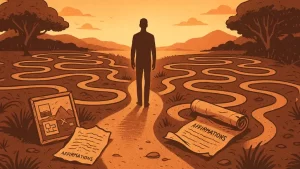
Radio presenter Patrick Kicken stood at the top of his field, but became trapped in an insatiable drive to perform. Burnouts followed, one after another. There always seemed to be something more to do, always something more to prove.
Only when he came into contact with non-dualism did something begin to shift. Not suddenly. But gradually, the realization emerged that nothing needed to be added to be ‘complete.’ The peace he sought turned out never to lie in achievement — but in letting go of the striving itself.
The 5 Key Takeaways
- Patrick’s successful radio career actually led to two severe burnouts due to his obsession with perfection.
- Non-dualism taught him that his feeling of ‘not being good enough’ was merely thoughts.
- The constant competitive drive even turned a supermarket visit into a stressful competition.
- Spirituality first brought more chaos before it delivered true liberation.
- The practical tip anyone can apply lies surprisingly simple within reach.
Non-Dualism Saved My Life – Patrick Kicken
Radio presenter Patrick Kicken stood at the top of his field, but became trapped in an insatiable drive to perform. Burnouts followed, one after another. There always seemed to be something more to do, always something more to prove.
Only when he came into contact with non-dualism did something begin to shift. Not suddenly. But gradually, the realization emerged that nothing needed to be added to be ‘complete.’ The peace he sought turned out never to lie in achievement — but in letting go of the striving itself.
From Radio Success to Spiritual Crisis
On paper, Patrick had it all figured out. A popular morning show at Veronica, a generous salary, even his own TV commercials. But while the outside world applauded, he felt increasingly empty inside. Success was something that had to be maintained — and that’s exactly what wore him down.
The Fall of Perfection
That drive to perform ran deep. Already in elementary school, he noticed that love was rewarded — with grades, compliments, attention. That seed grew into a life philosophy: everything must be optimal, everything must be right. Even when grocery shopping, he had to ‘do it right.’
The world of commercial radio only reinforced that. There, every decimal in listener ratings counts. Every second had to produce results. The fear of failure became not an exception, but a daily companion.
The Discovery of Eckhart Tolle
Through various motivational speakers, Patrick came across Eckhart Tolle and his book ‘The Power of Now.’ It wasn’t an aha-moment, but a shock. What if the entire foundation you built yourself on was never stable to begin with?
Life is not a problem to be solved, but a mystery to be lived. ~ Sadhguru
Benefits of Non-Dualism
- Reduces competitive drive and stress
- Helps release perfectionism
- Brings inner peace and acceptance
- Makes you aware of automatic thought patterns
Drawbacks of Non-Dualism
- Can initially lead to more chaos
- Requires time and patience to understand
- May be difficult to integrate into daily life
- Can lead to initial burnout from shaken self-image
When Your Self-Image Collapses
Tolle’s insights shattered Patrick’s inner foundation. The thought that his self-worth was based on conditioning — on an idea that love had to be earned — cut him deeply. Suddenly it became clear that the ‘self’ he was working on might not be real at all.
The feeling of not being enough, the perfectionist striving — it was all built on assumptions. And when those wavered, his self-image collapsed like a house of cards.
The First Burnout as a Breakthrough
What followed was not enlightenment, but exhaustion. His first real burnout felt like a collapse of everything he knew. And yet — it turned out afterward to be exactly what was needed. When the old no longer works, space opens up for something new.
In that raw emptiness, he looked for the first time with different eyes at his childhood, and how conditional love had become his compass. It had to hurt to feel something deeper.
Glossary
- Non-Dualism: Philosophy stating that everything is one and duality is an illusion
- Performance Drive: Compulsive need to be the best at everything
- Conditional Love: Love given only when performance is good
- Burnout: Emotional exhaustion from prolonged stress
From Competition to Acceptance
It ran deep: the tendency to turn everything into a competition. Even the supermarket became a battlefield. Who is faster, who picks the best products, who knows the shortest route? But in that constant comparing, something essential disappeared — the pleasure of simply existing, without purpose.
Non-dualism offered a different perspective. Not the split between winning and losing, right or wrong, but the idea that everything is part of one whole. As if black and white need each other to be visible. In that light, even the struggle itself becomes part of something that no longer needs to be won.
Practical Application in Daily Life
Patrick’s most important insight turns out to be surprisingly down-to-earth: take yourself a little less seriously. Not as a trick, but as a life attitude. We are all human, all searching, all lost sometimes. Possessions, achievements, status — they are fleeting phenomena.
Instead of striving to be exceptional, he learned to appreciate the ordinary. A good sandwich. A warm cup of soup. A conversation without an agenda. Non-dualism became not an abstract philosophy, but a way to be present without constantly judging whether it’s ‘good enough.’
Conclusion
Patrick Kicken’s story shows that success doesn’t always align with inner peace. His encounter with non-dualism didn’t bring him ready-made answers, but a different way of seeing. A way that softened the pressure of having to and left room for simply being.
What remained was simplicity. Not as loss, but as liberation. Performance drive gave way to presence. And perhaps his most important message? We don’t need to know it all. We only need to dare to stop pretending we already are.
Related Articles


Frequently Asked Questions
What exactly is non-dualism?
Non-dualism is a philosophy stating that everything is one and that the experience of separation between ‘self’ and ‘the world’ is an illusion.
How did non-dualism help Patrick Kicken?
It helped him release his performance drive and stress by providing insight into the illusory nature of his self-image and beliefs.
What is the connection between performance pressure and conditional love?
Patrick discovered that his drive to perform stemmed from a childhood where love was primarily experienced as a reward for success.
Is non-dualism practically applicable?
Yes, it teaches you to live more mindfully in the moment and to identify less with thoughts and judgments about yourself and others.
Can non-dualism also be confronting?
Absolutely. Letting go of old beliefs can be confusing and even lead to a temporary identity crisis or burnout.