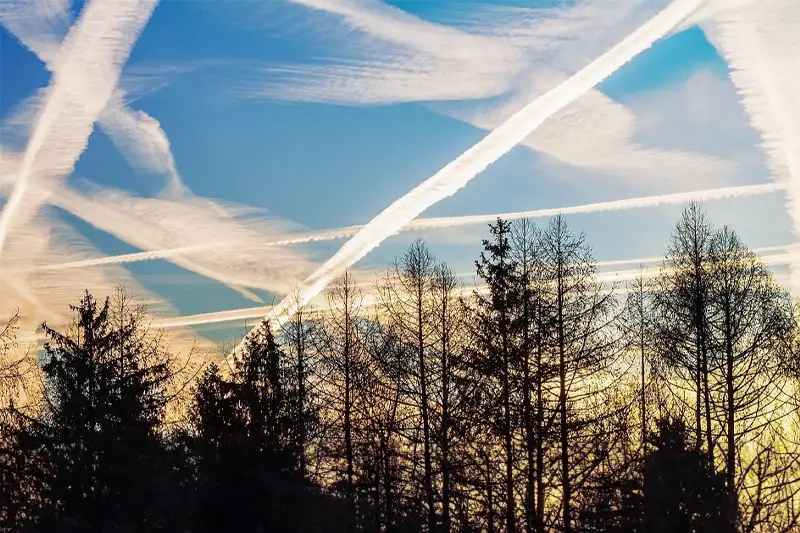
This report analyzes the hypothesis of a long-term, covert global geoengineering program on the basis of verifiable documentation, including patents, military plans, and independent atmospheric chemical studies. The analysis focuses on the objective evaluation of established capacity, strategic intent, and the mechanisms of secrecy, drawing a clear distinction between documented intent and proven operational activity.
Part I: Conceptual framework, terminology, and historical foundations
1.1 Terminological precision: geoengineering versus ‘chemtrails’
An accurate definition of the terms used is essential. Geoengineering refers to large-scale, intentional technological intervention in the Earth’s climate system with the goal of countering global warming. The two main areas are Solar Radiation Management (SRM) and Carbon Dioxide Removal (CDR). Stratospheric Aerosol Injection (SAI) is a prominent form of SRM in which reflective aerosols, often sulfates, are launched into the stratosphere to reflect a small portion of incoming solar radiation back into space.
The ‘chemtrail’ hypothesis is the popular but scientifically rejected belief that persistent condensation trails (“contrails”) left behind by high-flying aircraft are in fact chemical or biological agents being covertly dispersed. Proponents of this theory claim that these trails, unlike normal contrails that disappear quickly, point to a secret, long-term program serving SRM, weather modification, or sinister biological/chemical purposes.
1.2 The historical context of weather modification (pre-21st century)
Government involvement in atmospheric intervention is historically well documented. As early as the 1950s and 1960s, methods were developed to produce rain or snow from natural clouds through the use of seeding agents such as urea, potassium nitrate, and ammonium nitrate. An important precedent for large-scale atmospheric intervention by US government agencies is Project STORMFURY, conducted by the Navy and ESSA (later NOAA), which aimed at hurricane modification by deploying aircraft for research and operational experiments.
At the policy level, the National Weather Modification Policy Act (P.L. 94-490) was enacted in 1976, requiring the Secretary of Commerce to conduct an in-depth study into the status of the science and technology of weather modification. This study also had to assess the economic and legal implications, as well as the international context, including the feasibility of an international agreement on the peaceful use of weather modification. The documentation confirms that the government not only conducted research, but also recognized at the highest level the need to regulate the use of these technologies. The explicit focus on peaceful use in this civil policy stands in clear tension with the military doctrine that emerged in the 1990s (see Part III).
Table I. Historical government participation in weather modification
| Year | Document/Program | Focus |
|---|---|---|
| 1969/1972 | Project STORMFURY (Op. Plan) | Hurricane weakening via aircraft |
| 1976 | National Weather Modification Policy Act (P.L. 94-490) | Study of status, economic and legal implications |
| 1996 | USAF “Owning the Weather in 2025″ | Military dominance, force multiplier |
Part II: Technological capacity and documentation (patents)
The analysis of patents provides verifiable evidence of the technical capacity and intent to implement the mechanisms required for a long-term geoengineering program, whereby the patented solutions correspond remarkably with the claimed operational methods of the chemtrail hypothesis.
2.1 The fundamental mechanism: Stratospheric Aerosol Injection (SAI)
The most cited document establishing the technical basis for SAI with exotic materials is US Patent 5003186A, filed in 1990 and assigned to Hughes Aircraft Company. This patent explicitly describes a method for reducing global warming caused by the greenhouse effect.
The method involves ‘seeding’ the stratosphere (between 7 and 13 kilometers altitude) with Welsbach-like materials. The materials described are characterized by wavelength-dependent emissivity; they must have high emissivity (and thus low reflectivity) in the visible and far-infrared (8–12 micron) spectrum, and low emissivity in the near-infrared spectrum. This ensures that the particles convert heat energy into far-infrared radiation that is emitted into space. The materials specified in the patent are Welsbach materials and the oxides of metals.
Regarding the dispersal mechanism, the patent states that the small particles can be dispersed by seeding aircraft. The document also mentions the suggestion, based on earlier work, that the particles can be injected via jet fuel. The technical specification of metal oxides and the suggestion of dispersal via regular aircraft constitute a strong correlation with the claims of the ‘chemtrail’ hypothesis, which claims the presence of aluminum and barium (metal oxides) and the use of commercial tanker jets.
2.2 Advanced delivery and aerosol systems
The development of SAI-related technologies has continued. US Patent 20100071771A1 describes a method for ejecting material into the atmosphere at high altitude via a conduit or a ‘payload delivery system’ to increase the reflectivity of solar energy. Another patent, US20100127224A1, describes the injection of fine particles, primarily silica, into the stratosphere for mitigation of global warming.
Beyond aerosol injection, other advanced modification concepts have also been patented. A Satellite Weather Modification System (SWMS) (US5984239A, 1999), for example, describes a network of satellites and ground stations that use solar energy to modify the atmosphere, with the capacity to alter precipitation and reclaim desert land. This demonstrates the breadth of the claimed technological capability for controlled global modification.
Table II. Overview of relevant geoengineering patents
| Patent number | Date | Assigned to | Described mechanism | Relevance |
|---|---|---|---|---|
| US5003186A | 1991 | Hughes Aircraft Co. | Stratospheric Welsbach Seeding (metal oxides/SAI) | Technical blueprint of controversial materials. |
| US20100071771A1 | 2010 | Individual | High-altitude conduit/payload delivery system | Advanced dispersal techniques. |
| US20100127224A1 | 2010 | Individual | Injection of reflective silica aerosol | Alternative SAI materials. |
Part III: Military intent and strategic planning
The hypothesis of a covert geoengineering program finds strong support in the strategic intent expressed in military documents. These documents rationalize the development of weather modification as a crucial instrument of war, creating a compelling reason for classification and secrecy.
3.1 The doctrine of atmospheric dominance
The 1996 US Air Force report titled “Weather as a Force Multiplier: Owning the Weather in 2025″ is the fundamental evidence of military intent in this field. This report was commissioned by the Air Force Chief of Staff to examine the concepts and technologies needed to keep the US the dominant aerospace power of the future.
The official rationale states that owning the weather will give the warfighter the ability to shape the battlespace in ways never before possible. Weather modification is described as a “high risk, high reward” undertaking, with a strategic dilemma comparable to the splitting of the atom. The capabilities range from small-scale adjustment of natural weather patterns to full dominance over global communications and counterspace control.
3.2 Technological roadmap and intervention mechanisms
The development of an integrated weather modification capability requires technological advances in five areas, including advanced nonlinear modeling, computational capacity, a global sensor network, and, essentially, “weather intervention techniques.”
The report’s internal roadmap reveals a strategic shift: while traditional applications such as fog and cloud modification are losing importance, the value of storm modification and, ultimately, ‘Artificial Weather’ (AW) is increasing. By 2025, AW is seen as the “premium capability.” A specific intervention mechanism mentioned in the context of denying surveillance is the creation of “clouds made of smart particles.” The direct linking of military dominance to the dispersal of nanoparticles (smart particles, nano-chaff) confirms that the type of technology claimed by the geoengineering hypothesis has long been the focus of US military strategy.
The High-frequency Active Auroral Research Program (HAARP) in Alaska, a powerful HF transmitter for the study of the ionosphere, is often seen by critics as the experimental infrastructure that emerged from the ambitions described in the USAF report.
3.3 Legal tension and the necessity of secrecy
The most compelling explanation for the secrecy hypothesis lies in the legal and ethical implications of the military doctrine itself. The authors of the USAF report noted that the application of larger weather control mechanisms, such as large-scale climate modification or storm control, would be “controversial and potentially harmful” and “inconsistent with standing UN” treaties, including the Environmental Modification Convention (ENMOD).
The decision to exclude these advanced applications solely on the basis of their unlikely technical feasibility before 2025 — and not on the basis of legal or ethical constraints — implies a strategic desire to circumvent ENMOD once the technologies become available. The military ambition to achieve full dominance of the atmosphere, including ‘Artificial Weather,’ thereby exceeds the international legal and political tolerance for such weapons. This gap between the civil policy goal (peaceful use, P.L. 94-490) and the military strategic goal (dominance and warfare) creates an immediate, verifiable rationale for the development and implementation of these systems under strict classification.
Part IV: Analysis of chemical anomalies and verification of testimonies
The core of the operational hypothesis rests on the verification of chemical residues in the atmosphere. Although claims exist about the presence of toxic elements, the independent scientific studies that attempt to prove the origin of these elements have been scientifically disqualified.
4.1 Claims about toxic elements in the atmosphere
According to the hypothesis, aircraft are dispersing toxic substances, primarily heavy metals such as aluminum, barium, and strontium. Measured rainwater samples show very high concentrations, with values for aluminum reaching up to 620 micrograms per liter and for barium up to 95 micrograms per liter. This is considered highly concerning, as the continuous inhalation and deposition of these metals can negatively affect public health and the environment (soil, water, food chain) — a concern that has even been raised in the European Parliament.
4.2 The coal fly ash (CFA) hypothesis
Independent researchers have postulated that toxic coal fly ash (CFA), an industrial waste product, is the most likely atomized particle being used for geoengineering.
The evidence for this claim was provided through two comparative methods with a high statistical confidence (99% confidence interval):
- Rainwater versus leachate: The elemental composition of eight elements in rainwater, leached from atmospheric particles, matched the composition of elements leached from CFA in water in the laboratory.
- HEPA dust versus untreated CFA: A 14-element ‘fingerprint’ of outdoor dust (collected on HEPA filters) proved to be essentially identical to the chemical element ratios of unleached CFA.
CFA is potentially harmful to public health. It contains ultrafine particles, chemically mobile, neurotoxic aluminum that is released in the body after inhalation, and carcinogenic and radioactive elements (arsenic, uranium, thorium) that pose a risk of lung cancer and other respiratory diseases.
4.3 Scientific refutation and retraction
The broader scientific community rejects the ‘chemtrail’ hypothesis, emphasizing that persistent trails are explained by normal atmospheric processes — particularly sufficient humidity and temperature at altitude — and not by the presence of chemical additives.
Crucially, however, the peer-reviewed studies that supported the CFA hypothesis have been formally retracted by the publishers. The reasons for the retraction included methodological errors and the judgment that the language in the article was “often not sufficiently scientifically objective.” The author of the retracted papers, J. Marvin Herndon, has in turn disputed the retraction, claiming it was a “well-organized attempt (CIA?)” to deceive and conceal the truth about mass poisoning.
4.4 Alternative explanations for atmospheric metals
While the hypothesis attributes the cause to geoengineering, independent scientific research offers alternative explanations for the presence of heavy metals in the upper atmosphere. NOAA scientists have discovered that up to 10% of sulfuric acid particles in the stratosphere contain aluminum and exotic metals (such as niobium and hafnium). These particles have been traced to the vaporization of satellites and burned-out rocket boosters re-entering the atmosphere. The ratio of rare elements in these particles corresponds to the special alloys used in spacecraft.
Table III. Comparison of elemental fingerprints and sources
| Element | Maximum claimed concentration (μg/liter) | Role in CFA hypothesis | Scientifically recognized alternative source |
|---|---|---|---|
| Aluminum (Al) | 620 | Neurotoxin, normalization element | Space debris, vaporizing rocket boosters |
| Barium (Ba) | 95 | Part of 3-element ‘fingerprint’ | Space debris, vaporizing rocket boosters |
| Strontium (Sr) | (Not specified) | Highly abundant leaching element | Space debris |
Part V: Secrecy mechanisms, transparency, and synthesis
The analysis of secrecy mechanisms and the synthesis of all findings are crucial for understanding the credibility and persistent nature of the hypothesis.
5.1 Documentation of limited transparency (‘gag orders’)
An important element supporting the secrecy hypothesis is the documented restrictions on transparency within relevant government agencies. Complaints have been filed by the National Weather Service Employees Organization (NWSEO) and Public Employees for Environmental Responsibility (PEER) against the imposition of ‘gag orders‘ by the National Weather Service (NWS), NOAA, and the Department of Commerce.
These complaints allege that the orders muzzle the disclosure of information about organizational planning and the rationale behind actions. Moreover, specific directives in some cases restricted communication with foreign contacts on urgent international matters, such as fisheries and climate. The NWSEO argued that these orders violated the Whistleblower Protection Enhancement Act of 2012.
Although the official rationale for these orders often relates to political, administrative, or fisheries-related matters, they demonstrate a documented pattern of limited transparency within the government agencies responsible for weather- and climate-related data and policy. Historically, there is a precedent for imposing strict instructions on scientists to avoid press inquiries during sensitive technological comparisons (for example, after the Chernobyl disaster). This pattern fuels public distrust that more information is being withheld than is officially acknowledged.
5.2 Synthesis of the hypothesis
The exhaustive analysis of the available verifiable documentation reveals a clear separation between two analytical levels:
Capacity and strategic intent (strong evidence)
The technical and strategic foundations for a covert SAI program are solid. Public documents from the US government and related entities confirm:
- The technical blueprint (patents): Patented technology exists for dispersing metal oxides (Welsbach materials) in the stratosphere to modify the climate, including dispersal via jet fuel.
- The strategic intent (military doctrine): The USAF military framework considers atmospheric control a “premium” warfare capability (Artificial Weather with ‘smart particles’) that conflicts with international environmental treaties (ENMOD). The ambition to possess an illegal capability is the logical driving force behind the necessity for secrecy.
- Operational verification (weak and nuanced evidence)
The operational evidence is problematic.
- Chemical correlation: Measured anomalies exist in the composition of rainwater (Al, Ba, Sr) that correlate with the chemical fingerprint of coal fly ash. This is the most direct evidence for the operational claim.
- Scientific status: The crucial evidence has been scientifically disqualified by the retraction of the key CFA studies due to methodological and objectivity errors. As a result, irrefutable, peer-reviewed evidence for the operational execution of the claimed program is lacking.
- Secrecy mechanisms: A pattern of limited transparency exists at atmospheric and climate-related agencies (NOAA/NWS) through ‘gag orders.’ Although these orders reinforce the secrecy hypothesis, the documented reasons do not explicitly link the orders to SAI activities.
Conclusions
The analysis leads to the conclusion that the hypothesis of a covert, long-term geoengineering program is not directly proven by the cited, scientifically sound literature, but that the verifiable documentation of capacity and intent is remarkably strong and provides sufficient grounds for serious concern and further investigation.
The most urgent aspect of this research is the verifiable tension between the American legislative desire for peaceful weather modification (1976) and the military strategic intent for dominant weather warfare (1996). This gap provides a legitimate, documented explanation for why such technologies would be developed covertly.
The critical gap in the evidence remains the independent and irrefutable reconfirmation of the chemical anomalies. New, methodologically rigorous research is needed into the origin of elevated atmospheric concentrations of aluminum, barium, and strontium, whereby the exclusion of alternative sources such as space debris (as established by NOAA scientists) must be critically verified in order to definitively establish or disprove the operationality of a geoengineering program.
Verified Sources
- YouTube video on geoengineering and climate modification – Video material on geoengineering and atmospheric interventions.
- MDPI: Patents and geoengineering – Article on patents relating to climate technologies.
- Penn State University: Atmospheric albedo – Explanation of increasing albedo as a geoengineering technique.
- Wikipedia: Chemtrail conspiracy theory – Information on the chemtrail theory and criticism thereof.
- Lab Manager: Chemtrails vs contrails – Explanation of the difference between condensation trails and alleged chemtrails.
- Google Patents: US3613992A – Weather modification – Original patent for a method of weather modification.
- DTIC: Project STORMFURY – Military documents on hurricane modification.
- Ford Library: National Weather Modification Policy Act (1976) – US government document on weather modification policy.
- NOAA: Weather modification policy – Congressional reports on national weather modification programs.
- Cabinet Magazine: We Will Bury You. In Mud. – Essay on the use of mud in warfare and climate strategy.