
The drive to perform at work can unintentionally trigger a biochemical process that undermines your health. Your body makes no distinction between the pressure of an approaching deadline and the threat of physical danger. The physiological response is identical and can ultimately pave the way for type 2 diabetes.
Every stress trigger activates an ancient survival mechanism. This system is designed to save you, not to withstand modern workplace pressure. When this ‘on’ button gets pressed chronically, your metabolism pays the price.
The 5 Key Takeaways
- Your body responds to work stress with the same hormones as to a life-threatening situation.
- Chronic stress leads to constantly elevated blood sugar levels, even without eating sugar.
- Insulin resistance is the precursor to type 2 diabetes and is directly fueled by stress.
- Fat storage around your belly is often a visible signal of a dysregulated stress and insulin system.
- The process is reversible in many cases by breaking the biological stress response.
Your body sees no difference between a deadline and a tiger
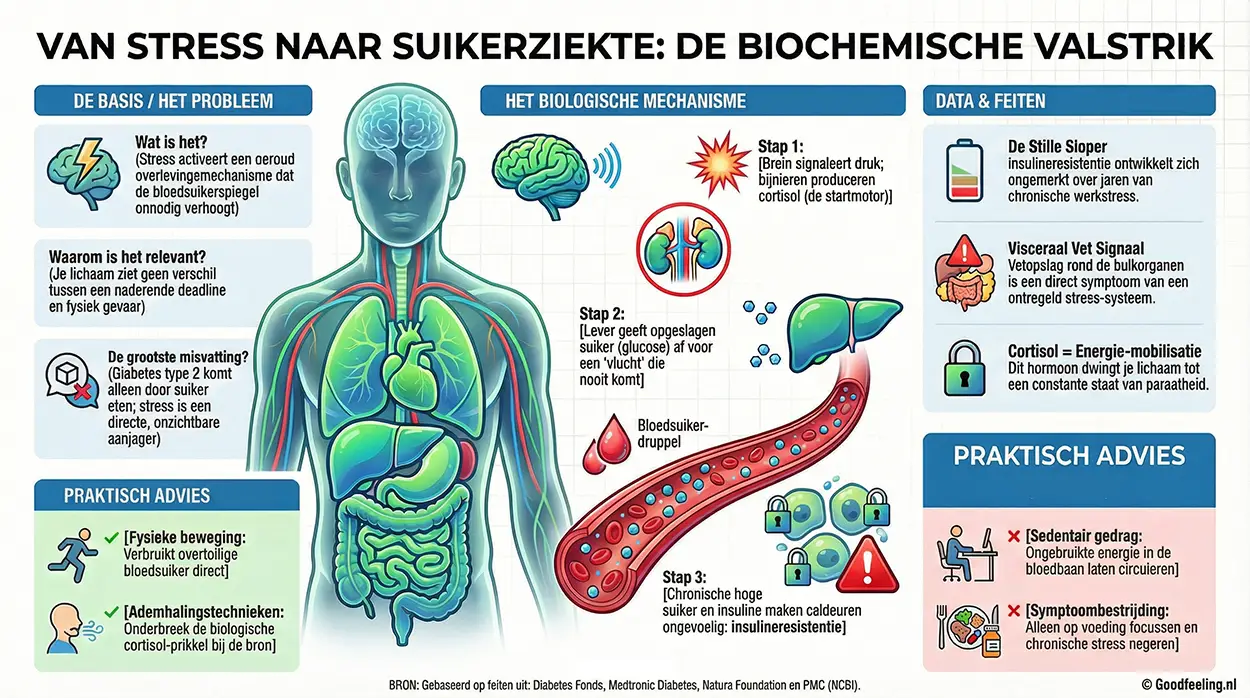
When your brain signals pressure or danger, your adrenal glands produce cortisol. This hormone is the starter motor of the fight-or-flight response. The primary task of cortisol is to mobilize quick energy by stimulating your liver to release stored sugar (glucose) into your bloodstream.
This mechanism is perfect for a short sprint, but an office job rarely requires a literal escape from danger. The consequence is that the released sugar remains unnecessarily circulating in your blood. This forces your body into a constant state of readiness, which is the core reason why lowering cortisol in your body is so crucial for your overall health.
Also read: Lowering your cortisol equals more energy at work AND in your private life – Here’s how to do it!
The biochemical route from stress to diabetes
Persistently high blood sugar is an alarm signal for your pancreas. This organ responds by creating the hormone insulin. Insulin works like a key that opens the doors of your body’s cells, so sugar from the blood can be taken in and used as energy.
With chronic stress, this system works overtime. The constant stream of sugar leads to constant insulin production. Eventually, the ‘locks’ on the cell doors become insensitive to the key. This phenomenon, known as insulin resistance, is the fundamental step toward type 2 diabetes.
InsulinRESISTANCE is the silent killer!
Insulin resistance typically develops unnoticed. Your body tries to solve the problem by producing even more insulin, which further exhausts the system. According to the Diabetes Fund, emotional stress can significantly accelerate this process.
The excess sugar and insulin in the blood have harmful consequences. They promote inflammation and fat storage, particularly visceral fat around your abdominal organs. This is actually the phase where your body is losing the battle, long before a doctor diagnoses diabetes.
Breathing techniques for immediate calm
- What happens when you do the Breathing Exercises of Wim Hof
- Breathing exercises that relieve stress and increase concentration
- Body Scan Meditation for body awareness and stress reduction
- Finally peace in your head: How to actually calm your mind
- If you let your stream of thoughts rest, it will let you rest too
Your stress is gone in 11 minutes with these breathing exercises
Breaking the tipping point is possible
The path to type 2 diabetes is not a one-way street. Insulin resistance is in many cases reversible. The key is breaking the vicious cycle of stress and high blood sugar. You don’t do this with vague advice, but with concrete biological signals.
Exercise is crucial here. By working out, you consume the excess sugar in your blood, so your pancreas needs to produce less insulin. This gives your cells the chance to become ‘sensitive’ again. Targeted nutrition and relaxation techniques help normalize cortisol production, breaking the entire chain at its source.
Explanatory glossary
- Cortisol: A hormone that mobilizes sugar reserves in response to stress.
- Glucose: The simplest form of sugar, the primary fuel for your body’s cells.
- Insulin: The hormone that opens body cells to take up glucose from the blood.
- Insulin resistance: A state where body cells become insensitive to insulin, causing blood sugar levels to remain high.
- Pancreas: The organ that produces insulin in response to the amount of sugar in the blood.
Conclusion
The link between a demanding career and diabetes is no coincidence, but a direct biochemical consequence. Chronic stress activates a survival mechanism that systematically overloads your metabolism. It’s an insidious process that can take years.
The good news is that you’re not helpless. Stress management is not a ‘soft skill,’ but a physiological necessity. By consciously choosing exercise, recovery, and proper nutrition, you can reverse the process and take your health back into your own hands.
Also read: practical ways to reduce stress
- The 5 greatest benefits of Mindfulness Meditation for stress relief
- What happens when you do the Breathing Exercises of Wim Hof
- Body Scan Meditation for body awareness and stress reduction
- From surviving to living: How to apply Mindfulness in your busy life
- Finally peace in your head: How to actually calm your mind with Meditation
- 5 Reasons why everyone should try Yoga Nidra for deep relaxation
- The 10 scientifically proven benefits of Meditation you can’t miss
- How to Meditate: Steps, tips and benefits for beginners
- The truth about mindfulness: less woo-woo and more proven science
- The art of letting go: Find your freedom in the NOW
Verified Sources
- Dietist Mandy Breure: Provides practical tips on managing stress with diabetes.
- Diabetes Fund: Explains the connection between emotional stress and diabetes risk.
- Medtronic Diabetes: Describes how stress can directly affect glucose levels.
- Natura Foundation: Provides in-depth information on the pathological system of insulin resistance.
- PMC (NCBI): Scientific article examining the mechanisms behind insulin resistance.
- Ruud Meulenberg: Directly connects stress to the development of insulin resistance.
Related Articles





Frequently asked questions
Can stress alone cause type 2 diabetes?
Stress is a very strong risk factor, but usually it works together with other elements such as diet, exercise, and genetic predisposition. It does create the perfect biochemical environment in which the disease can develop, even in people who seem to live healthy lives.
How quickly can prolonged stress lead to insulin resistance?
This is a gradual process and differs from person to person. It can take months to years. The insidious thing is that you barely notice it at first, while the damage to your metabolism slowly accumulates.
Are the effects of stress on my blood sugar reversible?
Yes, at the stage of insulin resistance, the process is absolutely reversible. By addressing stress factors and improving your lifestyle with exercise and proper nutrition, your cells can regain their sensitivity to insulin.
I eat healthy, do I still need to worry about stress?
Absolutely. Even with a perfect diet, chronic stress can raise your blood sugar levels because your body taps into its own sugar reserves. Eating healthy is crucial, but it’s not a free pass to ignore the impact of stress.