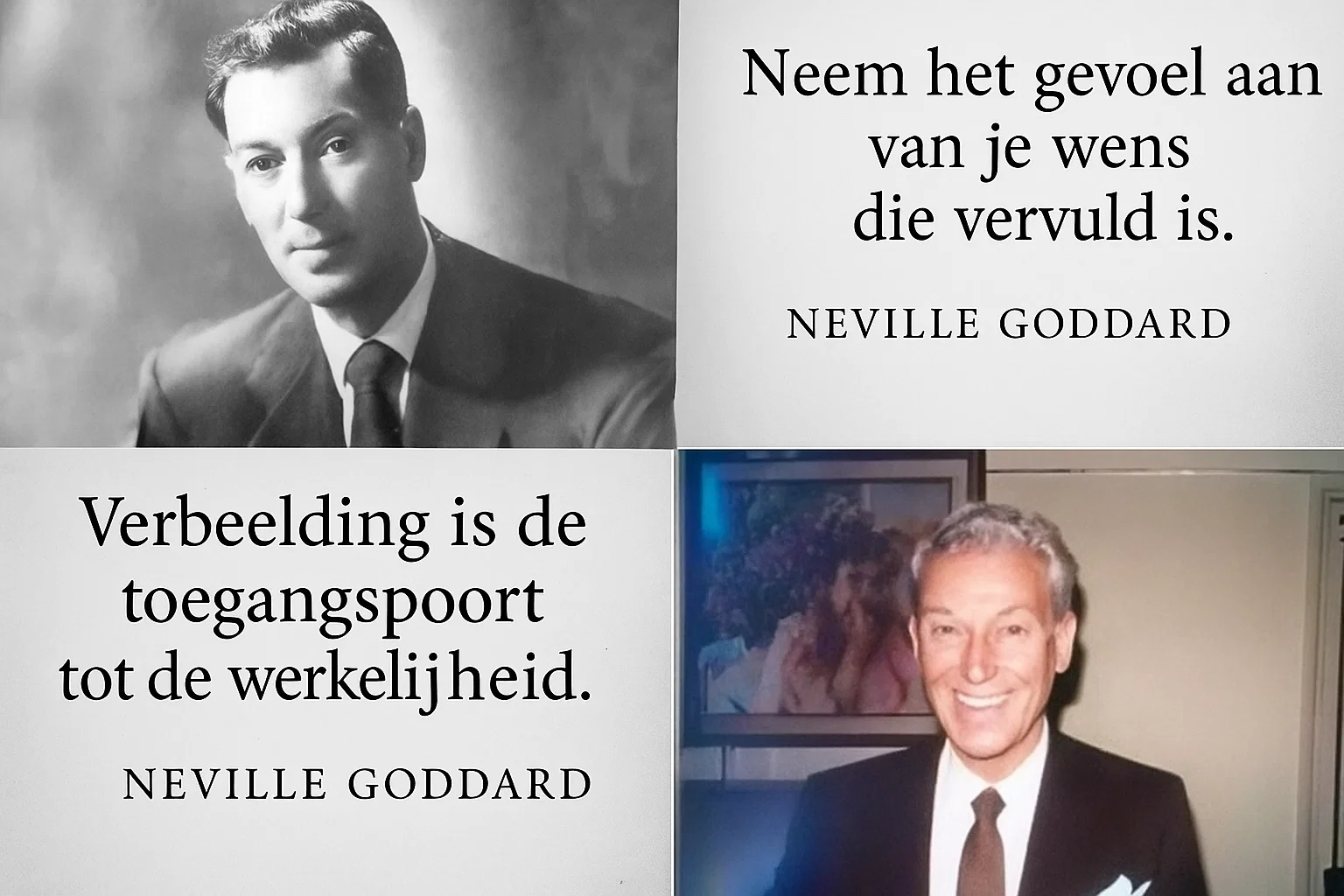
Many people recognize his name, yet few fully grasp the reach of his ideas. In this article, we explore the practical insights and techniques that established him as a key figure in the world of manifestation. From his perspective on imagination to his understanding of consciousness, Neville Goddard developed a method that continues to inspire people to create deliberately.
Who Was Neville Goddard?
Anyone who has ever entertained the idea that thoughts influence reality eventually encounters the name Neville Goddard. His work is often mentioned alongside concepts such as Law of Attraction and conscious manifestation.
Neville Goddard was a spiritual teacher and author who rose to prominence in the mid-twentieth century through his teachings on consciousness and creative power. He lectured to large audiences and published books outlining his techniques — all centered on one fundamental conviction: what you deeply assume within ultimately shapes your external experience.
His premise was straightforward yet profound: directing imagination with intention influences the trajectory of one’s life. It was not presented as a superficial technique, but as a fundamental shift in awareness.

Biographical Overview: The Early Life of Neville Goddard
To understand Goddard’s later teachings, it helps to return to his origins. Neville Lancelot Goddard was born on February 19, 1905, on the island of Barbados, then part of the British West Indies.
He grew up as the fourth of nine children in a lively household shaped by island culture, rhythm, and storytelling. The environment in which he was raised differed greatly from Western metropolitan life, and this formative setting likely influenced his perspective on the world.
From an early age, Neville felt drawn toward something beyond the boundaries of his island home. His curiosity eventually led him to the United States.
From the Dance Floor to Inner Exploration
As a teenager, Neville exchanged island life for the energy of New York City. At seventeen, he moved to the United States to study drama. He began working as a dancer and became part of the vibrant theatrical circuit of the 1920s — from vaudeville to Broadway.
What began as an artistic pursuit later appeared as preparation for a different calling. The stage that would define his legacy was one of inner experience rather than theatrical performance.
A Growing Realization
While pursuing his professional career, something within him gradually shifted. His interest in spiritual and mystical principles deepened. The platform where he ultimately found his voice was centered on imagination and internal awareness.
The Encounter with Abdullah
In 1931, Neville met Abdullah, an Ethiopian Jewish mystic who introduced him to esoteric Christianity and the disciplined use of imagination. This meeting marked a decisive turning point.
Abdullah also taught Joseph Murphy, author of “The Power of Your Subconscious Mind.” The ideas shared within that circle contributed to the foundation of the modern manifestation movement.
Personal Life and Military Service
Neville’s personal life included significant transitions. He married in 1923 and had a son. After divorcing, he later entered a second marriage, from which a daughter was born.
In 1942, he was drafted into military service. Despite his family situation, he reported for duty. After a brief training period, he received an honorable discharge. In a lecture delivered on March 24, 1972, he stated that he had used his imagination to assume his discharge into reality.

The Beginning of His Public Legacy
After the war, he began lecturing widely and publishing a series of books on consciousness, belief, and the power of the subconscious. His work reached a broad audience and even appeared on television, where he discussed themes such as mental creation and inner leadership.
His writings and lectures encouraged individuals to engage consciously with their thoughts. Until his passing on October 1, 1972, Neville remained active in sharing his teachings. His influence continues well beyond his lifetime.
The Books of Neville Goddard
During his lifetime, Neville wrote fifteen books exploring the power of consciousness and intention. His work remains foundational for anyone interested in the practical side of manifestation.
The three most well-known books by Neville Goddard are still widely cited within discussions on manifestation and awareness. Each one highlights a different dimension of his method and philosophy.
| Book Title | Description |
|---|---|
| Feeling Is The Secret | Explains how visualization functions and why experiencing the feeling of the wish fulfilled is central to the manifestation process. |
| Your Faith Is Your Fortune | Describes how inner conviction influences circumstances and outcomes through principles of consciousness. |
| The Power of Awareness | Lays out the foundation of Goddard’s understanding of awareness and how focused inner attention participates in shaping reality. |
The Core of Neville Goddard’s Philosophy
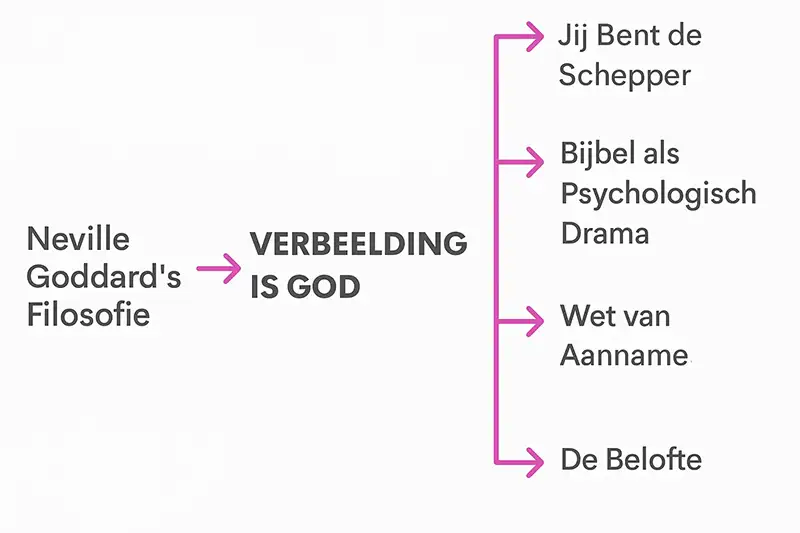
At the center of his teachings stands a striking assertion: imagination is the creative force behind your life.
Where many spiritual traditions refer to an external divine power, Neville suggested that this force resides within the individual. Specifically, within the capacity to feel deliberately, visualize vividly, and direct intention consciously.
The Creative Role of Consciousness
According to Goddard, everything you perceive or experience reflects your inner assumptions and mental imagery. You are both the observer and the participant in the formation of your life. Thoughts accompanied by feeling act as a template that eventually expresses itself outwardly.
The Bible as an Inner Narrative
For Neville, the Bible was not primarily a historical or religious document, but a psychological guide. Its stories and characters symbolize states of consciousness. Moses represents a shift from limiting thought patterns toward internal liberation rather than a literal historical figure.
The Law of Assumption
Rather than waiting for confirmation from external circumstances, Neville taught that you assume your desire is already fulfilled. Sustaining that assumption allows it to solidify in experience. The subconscious registers this inner state and aligns expression accordingly.
This approach differs conceptually from the Law of Attraction, even though the language sometimes overlaps.
Everyone Is You Pushed Out
Another defining concept in his work is the idea that everyone you encounter reflects your own assumptions. Relationships and interactions mirror deeply held beliefs. This perspective emphasizes self-examination, as internal change influences external dynamics.
The Promise
Much of Neville Goddard’s teaching focused on wish fulfillment through what he called The Law. He also described something he referred to as The Promise. In his view, this represents a spiritual awakening in which one recognizes their original divine nature. It is not presented as a technique, but as an inner realization that unfolds in its own time.
What Made Neville Goddard Effective in Manifestation?
Many people understand his principles yet wonder how he applied them so consistently. What allowed his method to feel direct and tangible?
The answer lies in the integration of lived experience, sustained focus, and deliberate practice.
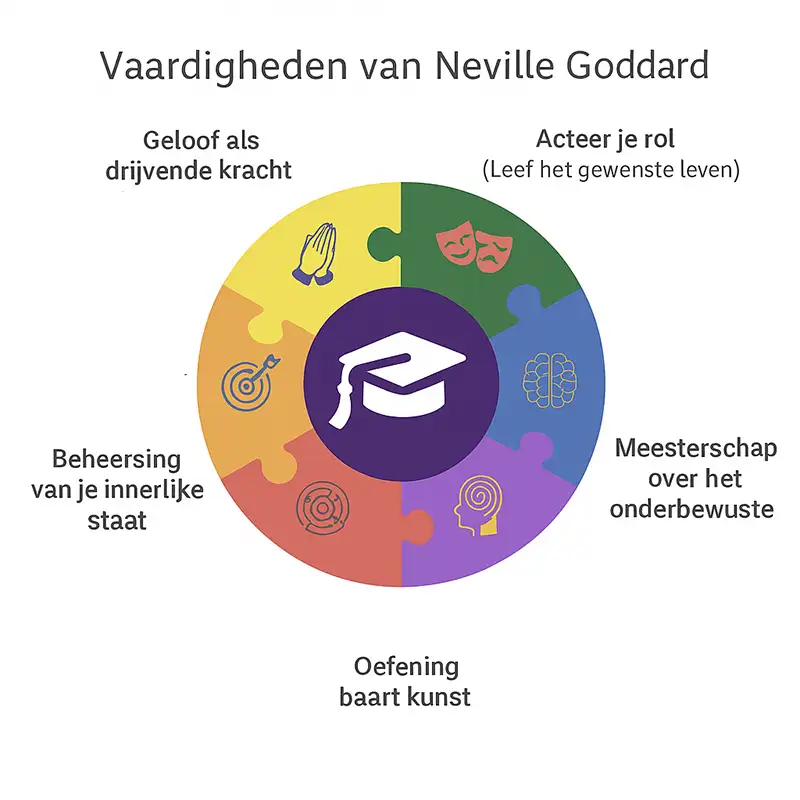
1. The Influence of the Stage: Embodying a Role
Goddard’s background as a performer shaped his approach. Instead of merely thinking about desires, he learned to embody them. Like an actor entering a role fully, he stepped into the lived experience of the future he envisioned.
When imagining an ideal outcome, he did so from within the scene — identifying as the person already living it.
2. Direct Access to the Subconscious
Neville demonstrated a clear understanding of how the subconscious operates. He maintained that the subconscious does not distinguish between physical reality and vividly felt imagination. This insight allowed him to treat imagination as a direct pathway to internal influence.
Through what he called the “State Akin to Sleep,” he entered a relaxed, drowsy condition in which analytical resistance softened and suggestion became more receptive.

3. Directed Awareness
Neville lived with deliberate attention. His approach to manifestation required focused inner observation. He practiced recognizing assumptions, adjusting mental patterns, and sustaining an internal image even when outer circumstances appeared unchanged.
Through sustained awareness, he influenced his own thought patterns and noticed signals aligned with his intention.
For many people, such signals pass unnoticed in a world saturated with distraction.
4. Conscious Use of States of Awareness
One of Neville’s strongest skills was shifting deliberately between different states of consciousness. He actively worked with what he called the “state akin to sleep” and the practice of “living from the end.”
He entered the condition in which suggestion becomes most receptive and remained mentally present within it.
The state he described as State Akin to Sleep offered direct access to the subconscious. In that drowsy interval — when analytical thought softens — he introduced intention.
He also practiced what he termed living from the end: behaving internally as though the desire had already materialized. This inner alignment, in his view, directed influence toward the subconscious.
By working consistently with both states, he positioned himself within what he considered the appropriate mental atmosphere for manifestation.
5. Practice as Daily Discipline
Neville applied his methods continuously. He treated manifestation as an orientation toward life rather than a separate technique. Thoughts, inner imagery, and emotional tone were approached deliberately.
From small everyday matters to major life events, he regarded each situation as material for practice.
Repetition reinforced familiarity with the process. Over time, the discipline itself became second nature.
6. Conviction as Reinforcement
An important foundation of his method was steady conviction. Neville approached his practice with certainty rather than hesitation.
Consistent practice strengthened confidence, and visible results reinforced commitment.
Those exploring his work need not master everything immediately. Each intentional act of imagination contributes to gradual change.
Four States of Consciousness According to Neville Goddard
Neville frequently described four distinct states of awareness, each serving a specific function within the manifestation process. Learning to transition between these states enhances influence over perception and response.
-
Waking Consciousness
This is ordinary daily functioning — thinking, acting, deciding. It operates within familiar patterns and visible conditions.
-
State Akin to Sleep
A relaxed interval between waking and sleep in which analytical resistance subsides and the subconscious becomes more receptive to suggestion and imagery.
-
State of I AM
A direct sense of being. Neville associated this with recognition of oneself as creative awareness — prior to narrative or identity.
-
State of the Wish Fulfilled
The internal experience that the desire has already come to pass, including the emotional and sensory qualities consistent with fulfillment.
These four states function together as a coordinated system. Each has its role, and deliberate movement between them shapes the interplay of thought, feeling, and expression.
| State | Description |
|---|---|
| Waking Consciousness | The everyday operational state in which decisions are made and surroundings are perceived. |
| State Akin to Sleep | A relaxed awareness where rational analysis softens and suggestion penetrates more deeply. |
| State of I AM | A condition of simple presence, without narrative overlay, associated with fundamental awareness. |
| State of the Wish Fulfilled | The felt experience that the desire is already realized, including emotional and sensory coherence. |
Neville Goddard and Mystical Experience
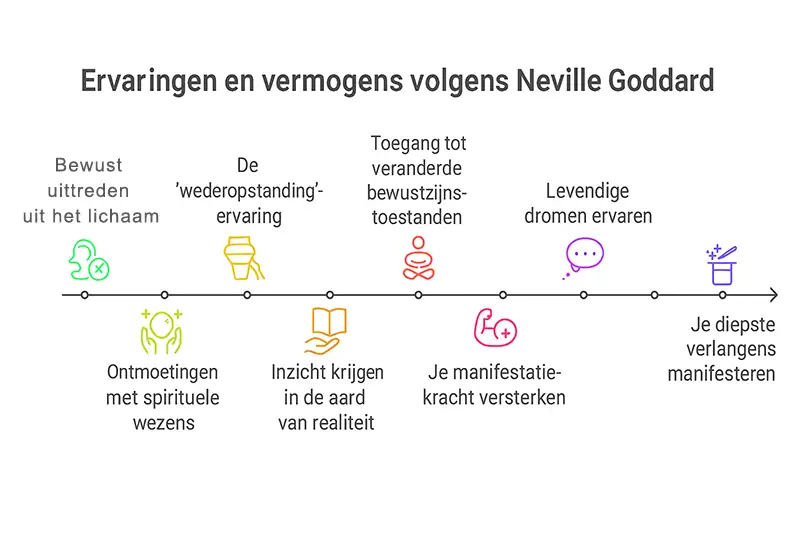
A lesser-discussed aspect of Neville Goddard’s work involves his capacity to explore lucid dreaming and altered states deliberately. Interpretations of his lectures suggest that he regarded such states as extensions of his broader method.
Was Neville Goddard a Lucid Dreamer?
Although Neville did not label himself explicitly as a lucid dreamer, his books and lectures contain references to vivid, consciously directed inner scenes in which he exercised intentional participation.
In “The Law and the Promise,” he recounts experiences in which dream-like states were entered deliberately to initiate desired outcomes.
In the lecture “Step Into the Picture: Who God Really Is,” he describes entering an immersive inner experience with full awareness and acting within it deliberately.
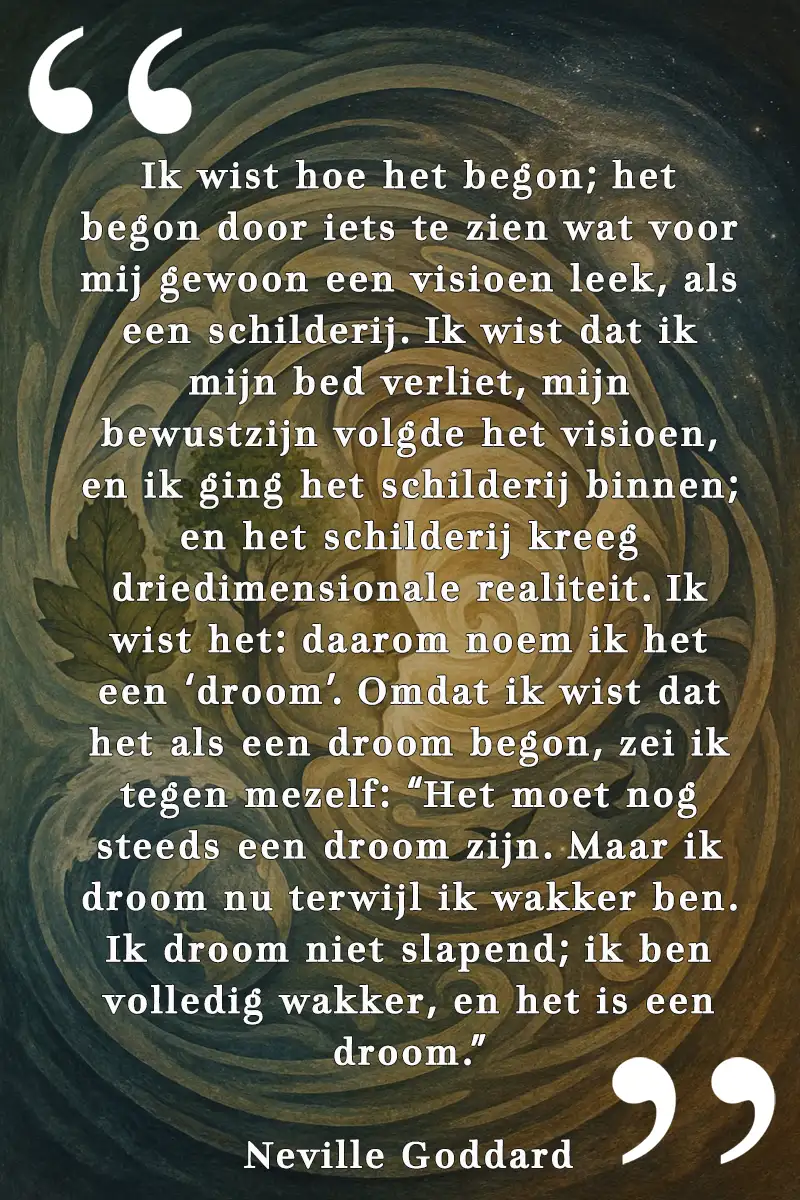
Based on his descriptions, it appears likely that he accessed conscious dream states naturally, using them to refine and rehearse his techniques in detail.
Mystical Experiences and Out-of-Body Accounts
In his lectures, Neville also spoke about spiritual experiences that extended beyond dream work. He described moments in which he experienced leaving his body consciously, moving through different layers of awareness and encountering presences he interpreted symbolically or energetically.
One of his most frequently discussed experiences occurred in 1959. He referred to it as his “rebirth from above” — an event he described as more vivid and convincing than ordinary physical reality.
“An activity taking place within man while he sleeps — or seems to sleep.”
For Neville, this confirmed that physical reality represents a reflection of a broader, malleable dimension of experience. That dimension, in his view, could be accessed and influenced through imagination and the subconscious.
What Can Be Drawn from This?
For those exploring his path, the practical takeaway is this: access to deeper states of awareness — through meditation, trance, or lucid dreaming — may enhance influence over lived experience.
The Power of Assumption: Neville Goddard’s Core Principle
One of the central techniques in Neville Goddard’s work is the inner assumption that a desire is already fulfilled. He framed this as more than visualization — it involves complete internal identification with the end result.
State of the Wish Fulfilled: Beyond Daydreaming
Rather than merely formulating a wish, Neville encouraged individuals to experience themselves as the person for whom the desire is already realized. This was presented as an internal shift rather than a mental exercise.
“You must assume the feeling of the wish fulfilled until that assumption takes on the sensory tones of reality.”
This meant not only imagining a scenario, but also sensing its emotional and physical implications. Picture the new job — feel the chair, hear colleagues’ voices, notice the scent of coffee in the office.
When the internal scene becomes sufficiently vivid, the subconscious responds as though it were actual experience.
The natural question then follows: how does one enter this state? That is where his method becomes practical.

The Neville Goddard Method: Step by Step
The method itself is structurally simple, though it requires consistency and attention. It centers on working deliberately with relaxation, imagery, and feeling rather than elaborate ritual.
Step 1: Relaxation and the Shift into Drowsy Clarity
In his lectures and writings, Neville stressed the importance of a relaxed, almost sleepy condition. He referred to this as the state akin to sleep — the transitional moment before sleep when conscious analysis softens and imagination becomes more fluid.
How to Enter This State:
- Choose a quiet space where interruption is unlikely.
- Close your eyes and breathe slowly for several cycles.
- Release physical tension from head to toe.
- Allow the mind to drift lightly while retaining gentle control over imagery.
This transitional condition increases receptivity to internal suggestion. It serves as the starting point for the method.
Step 2: Vivid Sensory Visualization
Once relaxed, begin a clear, sensory-rich visualization. The aim is to construct a concise scene that implies fulfillment rather than focusing on the process of getting there.
Key Elements:
- Create a scene that implies completion (for example, shaking hands with a new supervisor).
- Engage all senses: sight, sound, touch, scent, even taste if relevant.
- Remain in first-person perspective, experiencing rather than observing.
- Include specificity: textures, lighting, spatial details.
When the scene is detailed and immersive, the subconscious processes it similarly to lived experience. Neville maintained that vividly imagined events and physical events are interpreted through comparable internal mechanisms.
Emotional Intensity: Feeling It Real
Visualization alone, in his view, remains incomplete without emotional engagement. He described this as “feeling it real” — cultivating the emotion naturally associated with fulfillment.
This may involve gratitude, relief, confidence, or joy. The emotional tone energizes the internal scene.
If imagining a new opportunity, experience the bodily sense of acceptance and acknowledgment. Let the emotional response arise authentically rather than artificially.
Persistence: Consistency Without Strain
An additional component of Goddard’s approach involves remaining aligned with the assumption, even if outer circumstances appear unchanged.
This means returning to the internal scene regularly and revisiting the felt sense of fulfillment. The emphasis rests on calm repetition rather than urgency.
The process resembles planting a seed. The work unfolds beneath the surface before visible change appears.
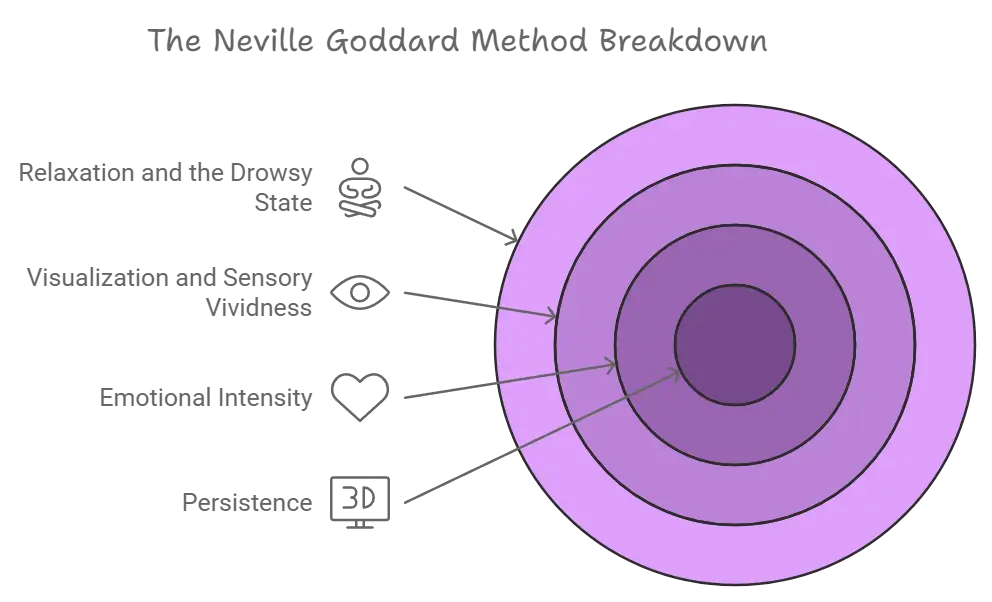
The Method in Four Core Steps:
- Relaxation (state akin to sleep)
- Vivid visualization
- Emotional involvement
- Steady persistence without force
Across his writings, these elements recur consistently. As with any skill, development emerges through repetition and refinement.
Personal Application of the Method
The effectiveness of the method becomes clearer through direct application. In a meditative state — just before sleep or after focused breathing — the internal image often gains clarity.
Practitioners frequently report that revisiting the inner scene in a receptive state deepens emotional resonance.
A Noted Observation:
Some individuals find that subsequent dreams incorporate elements of the visualized scenario. This can be interpreted as subconscious integration expressed symbolically.
A practical example:
Before an important exam, I spent several days preparing through visualization. Each evening, I replayed a scene in which I completed the exam successfully. Eventually, I dreamed that I saw the most important question appear clearly before me.
On the day of the exam, that question appeared in almost the same form. The response came to mind with unusual clarity and confidence.
Practical Tools to Begin
Below are four simple exercises that translate Neville Goddard’s principles into direct application. Consider them a toolkit for deliberate manifestation practice.
1. The “As If” Exercise
Select one day to act as though your desire has already been fulfilled. Carry yourself with the composure of someone who has just received a promotion. Respond from the perspective of someone who feels valued and supported. Behavior then becomes an extension of a revised internal state.
2. Gratitude in the Present Tense
Before sleep, write down five statements of gratitude as though the desired outcome has already occurred. This practice reinforces the internal assumption while also promoting mental calm and deeper rest.
3. The “Trailer” Technique
Create a brief 30-second scene in which your desire is already realized. Keep it vivid and sensory-rich. Repeat this mental sequence several times a day. Treat it as a preview of a life already unfolding.
4. Breathwork for Relaxation
Use the 4-7-8 breathing pattern before visualization: inhale for 4 counts, hold for 7, exhale for 8. This rhythm helps regulate the nervous system and prepares the mind for focused imagery.

Overview of Neville Goddard’s Techniques
A deeper study of his work reveals multiple techniques. While they vary in structure, they consistently revolve around relaxation, visualization, feeling, and repetition.
| Technique | Explanation |
|---|---|
| Revision | Revisit a past event and reimagine it in a way aligned with your preferred outcome. This reshapes present perception. |
| Lullaby Method | Repeat a concise affirmation while drifting into sleep, embedding suggestion in the subconscious. |
| “Isn’t it wonderful?” | Use the phrase followed by a positive implication of fulfillment to evoke a sense of completion. |
| Inner Conversations | Consciously guide internal dialogue as though circumstances have already shifted. |
| I Remember When | Refer to your desire as if it occurred in the past, reinforcing its sense of inevitability. |
| Congratulations | Imagine others congratulating you, adding emotional and social realism to the scene. |
| Eavesdropping | Visualize overhearing people discussing your success, introducing indirect validation. |
| Ladder Technique | Repeatedly imagine performing a simple act, such as climbing a ladder, to test imaginative influence. |
| Telephone Technique | Envision receiving a phone call delivering the exact news you wish to hear. |
| “Smell the Money” | Incorporate scent into visualization, using smell to deepen sensory immersion. |
Each technique serves a shared aim: strengthening the felt sense that fulfillment has already occurred. Experimentation helps determine which format resonates most naturally.
Key Insights from His Work:
- Neville developed a practical approach for consciously evoking the feeling of the wish fulfilled.
- His mentor Abdullah encouraged exploration of symbolic and mystical interpretation.
- Practicing deliberate states of being, such as the state akin to sleep and living from the end, reshapes perception.
- Dream imagery can assist in integrating revised assumptions.
- His method centers on relaxation, imagination, emotion, and repetition.
- The concept “Everyone Is You Pushed Out” suggests relationships reflect internal assumptions.
- Techniques from revision to ladder visualization function as tools for subconscious conditioning.
- Consistent application supports gradual integration into daily thinking and feeling patterns.
Putting Knowledge into Practice
Have these insights resonated with you? Then this is the moment to apply them.
Understanding how something works remains incomplete without direct experience. Techniques can be studied and discussed, yet their impact emerges through consistent application.
A brief reminder:
Manifestation centers on cultivating a pattern of thinking and feeling aligned with the life you intend to express.
Practical Challenge for This Week:
Select one technique from this article. Only one. Practice it daily for seven consecutive days. Whether you choose the “As If” approach or the short scene visualization, the focus rests on repetition and observation of its effect.
As Neville expressed:
“An awakened imagination works with a purpose. It creates and preserves the desirable, and transforms or eliminates the undesirable.”
Related Articles



Frequently Asked Questions
What did Neville Goddard believe?
Goddard maintained that imagination forms the core mechanism through which reality is experienced. By consciously selecting inner images and assumptions, individuals influence their external conditions. He regarded imagination as an operative creative force rather than a symbolic metaphor.
Who or what is God according to Neville Goddard?
In his interpretation, God represents one’s own consciousness. Awareness, attention, and imagination comprise what people traditionally refer to as God, existing within each individual.
What did Neville Goddard say about desire?
He viewed desires as signals of creative potential. Rather than suppressing them, he encouraged assuming the feeling of fulfillment and sustaining that internal state.
When did Neville Goddard meet his teacher Abdullah?
Goddard encountered Abdullah in 1931. That meeting significantly shaped his later articulation of the Law of Assumption.
Where and when was Neville Goddard born?
He was born on February 19, 1905, on St. Thomas in the U.S. Virgin Islands.
What is a well-known quote from Neville Goddard?
“An assumption, though false, if persisted in, will harden into fact.” This statement encapsulates his teaching on sustained belief shaping lived experience.
Was Neville Goddard considered enlightened?
He described profound spiritual experiences, including one he referred to as “The Promise.” Interpretations of enlightenment vary, and he framed it as recognition of one’s essential nature.
Did Neville Goddard have a partner?
He married Mildred Mary Hughes in 1923 and later married Catherine Willa Van Schmus in 1942.
Did Neville Goddard have children?
Yes, he had two children: Joseph Neville Goddard and Victoria Goddard.