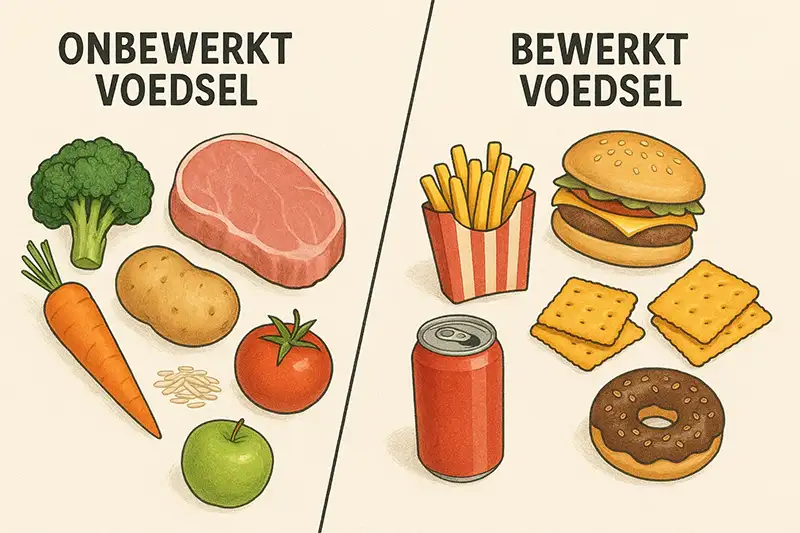
Research led by UCL shows that people who eat primarily unprocessed foods lose almost twice as much weight as those who rely mainly on highly processed products – even when calories and nutrients remain the same. This way of eating also resulted in greater fat loss and a larger reduction in daily calorie intake.
The 5 Key Takeaways
- Why a plate of homemade pasta can do more for your weight than you think
- The degree of food processing turns out to be more important than calorie quantity
- A small change in your eating pattern can quickly show noticeable results
- Unprocessed foods often reduce the urge to snack between meals
- The difference in results grows the longer you stick with this way of eating
Unprocessed Food Doubles Weight Loss
New research from UCL and UCLH shows that people lose significantly more weight when they eat primarily unprocessed foods instead of highly processed products. Both eating patterns had equal nutritional values, but the group receiving unprocessed meals lost almost twice as much weight. This suggests that less processing of food can help maintain a healthy weight in the long term.
Published in Nature Medicine, this is the first study to directly compare ultra-processed and minimally processed foods in everyday conditions. It’s also the longest study to date specifically focusing on a diet heavy in processed products.
Read also: Ultra-Processed Foods Increase Risk of Cognitive Decline and Stroke
Study Design: Two Eating Patterns Compared
A total of 55 adults participated. One group started with eight weeks of unprocessed foods, with meals like refrigerated oatmeal and homemade spaghetti bolognese. This was followed by a four-week break where they ate as usual. They then switched to eight weeks of highly processed foods, such as ready-made lasagna and breakfast bars. The second group followed the same schedule but in reverse order. Of the 55 participants, 50 completed at least one full diet cycle.
Both menus were designed according to the British Eatwell Guidelines, with a good balance of fats, proteins, carbohydrates, fiber, and essential nutrients. Participants were given more food than they needed and could eat according to their normal appetite. There was no limit on quantity.
Glossary
- Unprocessed Food: Food that has changed little since its natural state
- Highly Processed Food: Products that have undergone many industrial steps and additions
- Calorie Deficit: When you consume less energy than you burn
- Eatwell Guide: British dietary guidelines for a balanced diet
Greater Fat Loss and Larger Calorie Difference
After eight weeks on each diet, both groups lost weight, likely because food quality was higher than in their normal eating pattern. However, the effect was greater with unprocessed food: an average of 2.06% weight loss compared to 1.05% with highly processed food2.
This amounted to an estimated deficit of 290 kilocalories per day with unprocessed meals, versus 120 kilocalories per day with the processed variant. For comparison: the Eatwell Guide recommends 2,000 kilocalories per day for women and 2,500 for men.
Better Body Composition
The extra weight loss with unprocessed food came mainly from reduced fat mass and body fluid, without loss of muscle mass. This indicates a more favorable distribution of body weight.
The results show that following existing dietary guidelines with an emphasis on unprocessed products is often more effective for weight loss.
Read also: Weight Loss Starts With Fiber: Why Unprocessed Food Makes the Real Difference
The Effect of Processing on Health
Dr. Samuel Dicken from the UCL Centre for Obesity Research explains: “Previous research links highly processed products to worse health outcomes. Yet they’re not all inherently unhealthy if you look purely at nutritional values. With this study, we wanted to clarify what role the degree of processing plays in effects on weight, blood pressure, body composition, and also how people experience eating, such as hunger and snacking behavior.”
“The main goal of the study was to look at the percentage change in weight. In both eating patterns, we saw clear decreases, but with unprocessed food, the effect was almost twice as large. A 2% decline might seem modest, but this is over just eight weeks without people actively eating less. If we extrapolated this trend over a year, it would amount to approximately 13% weight loss in men and 9% in women on an unprocessed diet, compared to 4% in men and 5% in women on a highly processed diet. Over the long term, that difference grows increasingly larger.”
Unprocessed Food Reduces Food Cravings
Before the eating periods and after four and eight weeks, participants completed questionnaires to measure their appetite and cravings for specific foods3.
The results showed that unprocessed food led to greater reductions in hunger-driven eating occasions and in the ability to resist those cravings, compared to highly processed food. This is surprising, as you would normally expect greater weight loss to trigger stronger cravings.
Better Appetite Control
Compared to highly processed food, participants on unprocessed meals reported that their overall appetite control improved twice as much, their control over savory food cravings improved four times as much, and their ability to resist eating what they craved most improved almost twice as much.
Professor Chris van Tulleken from UCL emphasizes: “Our global food system now causes many lifestyle diseases and obesity, largely due to the availability of cheap, unhealthy food. This study shows it’s not just about fat, salt, and sugar, but also about how heavily processed the food is. Responsibility cannot rest solely with the individual. We need to look at the role of large food companies and how they influence our food environment.”
Policy More Important Than Willpower
“Governments, researchers, and other stakeholders must work together on broader policy measures that improve our food supply. Think of warning labels, restrictions on marketing, tax measures, and subsidies. This makes healthy eating achievable, affordable, and attractive for everyone.”
The study also measured other health values, such as blood pressure, heart rate, liver function, blood sugar, cholesterol, and inflammation markers. No negative effects were found from eating highly processed food; sometimes there were even slight improvements compared to the baseline.
Few Differences in Other Measurements
Overall, there were few differences between the diets for these values. The researchers note that longer studies are needed to fully understand the effect of changes in weight and fat mass on these health aspects.
Professor Rachel Batterham from the UCL Centre for Obesity Research says: “Despite the Eatwell Guidelines being widely recommended, fewer than 1% of the British population follows them completely. Most people don’t even reach half of the recommendations.”
Final Advice: Choose Unprocessed Food and Cook Fresh
“The participants’ normal eating pattern often deviated from national guidelines and contained more than average highly processed products. This may explain why switching to a completely processed diet, but with balanced nutritional values, sometimes produced neutral or even slight improvements in certain health measurements.
“The best thing you can do is stay as close as possible to dietary guidelines. Pay attention to total energy intake, limit salt, sugar, and saturated fat, and prioritize fiber-rich products like vegetables, fruits, legumes, and nuts. Choose less processed options where possible and cook yourself, rather than relying on pre-packaged products or ready-made meals. This usually provides extra benefits for your weight, body composition, and overall health.”
Important Notes
- Unprocessed food has changed little from its natural form, such as vegetables, fruits, whole grains, meat, fish, and dairy products like plain yogurt. Highly processed food is significantly altered through industrial processes and often contains ingredients you wouldn’t use at home, such as artificial flavorings, preservatives, and emulsifiers.
- Not everyone lost weight; in both groups, ten people actually gained weight. This was likely because they adhered less strictly to the diet, especially during the second diet they followed. When looking only at the first round, weight loss was greater: an average of 4.09% with unprocessed food and 2.12% with highly processed food.
- The Control of Eating Questionnaire (CoEQ) measures general appetite control, cravings for sweet or savory foods, positive mood, and the feeling that you can resist temptations. The Power of Food Scale (PFS) measures the motivation to want delicious food when it’s nearby, present but not yet tasted, or already tasted but not yet eaten.
Verified Sources
- “Ultraprocessed or minimally processed diets following healthy dietary guidelines on weight and cardiometabolic health: a randomized, crossover trial” – Samuel J. Dicken, Friedrich C. Jassil, Adrian Brown, Monika Kalis, Chloe Stanley, Chaniqua Ranson, Tapiwa Ruwona, Sulmaaz Qamar, Caroline Buck, Ritwika Mallik, Nausheen Hamid, Jonathan M. Bird, Alanna Brown, Benjamin Norton, Claudia A. M. Gandini Wheeler-Kingshott, Mark Hamer, Chris van Tulleken, Kevin D. Hall, Abigail Fisher, Janine Makaronidis, and Rachel L. Batterham, August 4, 2025, Nature Medicine. DOI: 10.1038/s41591-025-03842-0
- Thanks to SciTechDaily
- University College London – https://www.ucl.ac.uk/
This research was made possible in part by the National Institute for Health and Care Research UCLH Biomedical Research Centre and the Rosetrees Trust.
Related Articles





Frequently Asked Questions
What was the most important difference between unprocessed and highly processed food in this study?
Participants who ate primarily unprocessed products lost almost twice as much weight as those who received highly processed food, despite having equal calories and nutritional values.
How long did the study last and how many people participated?
The study lasted eight weeks per diet, with a four-week break in between. A total of 55 adults participated, with 50 completing the study fully.
What other benefits did eating unprocessed food provide?
In addition to greater weight loss, unprocessed food resulted in a larger daily calorie deficit, more fat loss, and better appetite control and resistance to food cravings.
Does this mean all highly processed food is unhealthy?
No, the researchers emphasize that not all highly processed products are inherently unhealthy. It’s mainly about the overall picture of your diet and the degree of processing. Additionally, it’s important to consider the impact of processed food products on overall health. Some processed products can even contain useful nutrients that contribute to a balanced diet. It’s therefore crucial to make conscious choices and pay attention to ingredients and nutritional value.
What is the researchers’ best dietary advice?
Stay as close as possible to dietary guidelines, limit salt, sugar, and saturated fat, eat plenty of fiber-rich products, and choose fresh, unprocessed food that you prepare yourself whenever possible.