Long before Freud and Jung described the unconscious mind, Indian forest philosophers had already discovered that deep within us lurks an invisible thinker. Their revolutionary insights from the 7th century BCE laid the foundation for what we now know as the Eastern spiritual quest.
These ancient sages, who traded their comfortable lives for existence in the jungle, made groundbreaking discoveries about the human mind. Their findings, recorded in the mysterious Upanishads, reveal how thoughts and feelings seem to emerge from nowhere and disappear again.
The 5 Key Takeaways
- The forest philosophers discovered a mysterious ‘thinker behind the scenes’ who produces our thoughts.
- They identified this invisible force as the ‘atman’ – the true self that is greater than all gods.
- Their method of investigating the mind was so revolutionary that other civilizations never even considered it.
- The Upanishads contain secret teachings that were passed only from teacher to student.
- These ancient discoveries are now confirmed by modern brain research using MRI scans.
The Flight to the Jungle
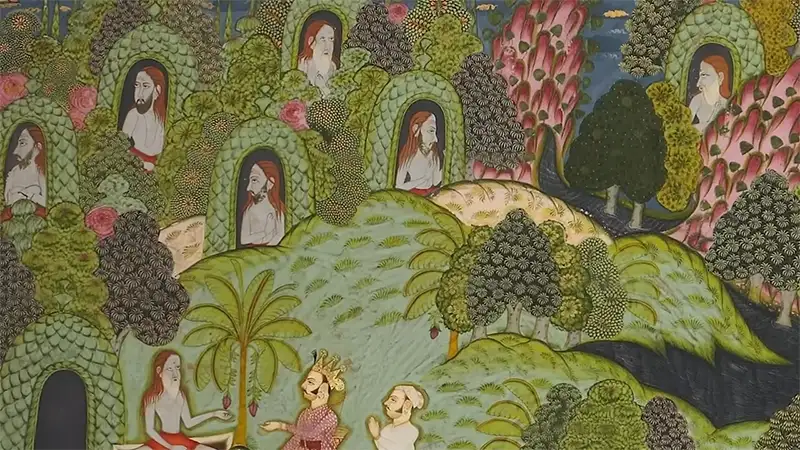
Around 800 BCE, urbanization returned to India, bringing greater prosperity and leisure time. This led a group of philosophers, the so-called renouncers, to abandon their families and possessions to explore the inner world in the jungle.
A Revolution in Thinking
These forest philosophers radically broke with traditional Hindu rituals aimed at collective welfare. Instead, they focused on inner sacrifices to find the true self. Their investigation of the mind was truly groundbreaking—while other civilizations concerned themselves with external matters, they dove deep into the mystery of consciousness.
The texts tell how these sages left their homes, families, and worldly possessions behind. They believed that only by withdrawing from sensory pleasures and everyday family life could they study the mind undisturbed.

Benefits of Upanishadic Wisdom
- Deep insight into how the unconscious mind works
- Practical meditation techniques for inner peace
- Liberation from dependence on external gods
- Discovery of the immortal core within ourselves
Challenges of This Philosophy
- Requires complete dedication and letting go of worldly affairs
- The true self can never be fully described
- Years of study and contemplation are necessary
- Not everyone is suited for a hermitic lifestyle
The Discovery of the Unconscious
The forest philosophers studied five functions of the soul: breathing, speech, sight, hearing, and thinking. With each function, however, they discovered an inner controller that directed these functions. This mysterious force was not itself perceptible, but was the source of all thoughts and feelings.
Their conclusion was astounding: there is indeed a thinker behind the scenes, but we can never directly perceive this thinker. Actually, we can only say what the true self is not—an insight they summarized as ‘neti neti’ (not this, not that).
The Immortal Self
Because the atman cannot be described, the philosophers reasoned that this reality has no properties. And something without properties cannot change—therefore it must be eternal and immortal. This meant that within each of us exists an immortal reality that transcends hunger, thirst, sorrow, and death.
This discovery became so important that it became the primary objective of Eastern philosophy. The quest for this ultimate mystery within ourselves became the highest ideal—even higher than the worship of gods.
Glossary
- Upanishads: Secret teachings, literally ‘sitting near the teacher’
- Atman: The true self, originally ‘life breath’ but later ‘soul’
- Brahman: The essence of the universe, cosmic reality
- Renouncers: Philosophers who gave up their worldly lives for spiritual quest
Greater Than the Gods
The philosophers reached a stunning conclusion: because even the gods have a self, they are subject to the same reality as we mortals. If we have the same sacred atman within us that equals Brahman, why do we need gods at all? This was truly revolutionary thinking for that time.
They taught that when someone understands ‘I am Brahman,’ he becomes the whole world and even the gods cannot stop him. The gods were thereby assigned a subordinate role—a unique Indian thought that formed the basis for all later spiritual developments.
The Cosmic Connection
Perhaps the most groundbreaking insight was that atman (the self) and Brahman (the universe) are actually the same. The texts describe this discovery as the most important conclusion of all the Upanishads. Both are equally unknowable and immortal, so they must be the same mystery.
This philosophy suggests that all beings, gods, worlds, and bodies are connected within us—like spokes to the hub of a wheel. The self is described as the ruler and king of all beings, offering a completely new perspective on humanity’s place in the universe.
Conclusion
The ancient Indian forest philosophers truly did groundbreaking work by being the first to describe the unconscious mind. Their insights into the mysterious thinker behind our thoughts were so profound that they laid the foundation for all Eastern spirituality.
It is remarkable how these discoveries from the 7th century BCE are now confirmed by modern brain research. Their teaching that we all are part of a greater whole—that atman and Brahman are one—continues to inspire to this day. This wisdom shows that the quest for the true self is indeed one of humanity’s deepest longings.
Gerelateerde artikelen



Frequently Asked Questions
What are the Upanishads?
The Upanishads are ancient Indian texts containing philosophical teachings and spiritual insights. They form part of the Vedas and are considered the foundation of Vedanta philosophy. The Upanishads address topics such as the nature of the self (Atman), the relationship between Atman and Brahman, and the path to spiritual liberation.
What do you mean by Upanishads?
The term “Upanishad” literally means “sitting near the teacher” in Sanskrit. It refers to the way the teaching was transmitted—through personal instruction from a teacher to a student. The Upanishads contain secret teachings and spiritual knowledge intended for those who wished to seriously explore the mysteries of existence.
How old are the Upanishads?
The Upanishads originated over a long period, with the oldest Upanishads dating from the 7th or 8th century BCE. The younger Upanishads are from later periods, possibly extending into the early centuries of the Christian era. In total, more than 200 Upanishads are known, of which 13 are considered the most important.
What are the most important Upanishads?
What are the Four Vedas?
The Four Vedas are the oldest sacred texts of Hinduism. They consist of the Rigveda, the Samaveda, the Yajurveda, and the Atharvaveda. The Vedas contain hymns, prayers, rituals, and philosophical reflections that form a foundation for Hindu religion and philosophy.
Are Buddhism and Hinduism the Same?
Although Buddhism and Hinduism both originated in India and share certain similarities, they are not the same. Hinduism is a religion with a broad range of gods, rituals, and philosophical schools, while Buddhism focuses on achieving enlightenment through meditation and following the Eightfold Path.